Semiconductors and Semiconducting Devices — Important Questions
NIOS · Class 12 · Physics
45 important questions from Semiconductors and Semiconducting Devices for NIOS Class 12 Physics, with answers. Written for the board exams 2027.
Interactive on Super Tutor
Studying Semiconductors and Semiconducting Devices? Get the full interactive chapter.
Quizzes, flashcards, AI doubt-solver and a step-by-step study plan — built for important questions and more.
Free trial, no card needed.
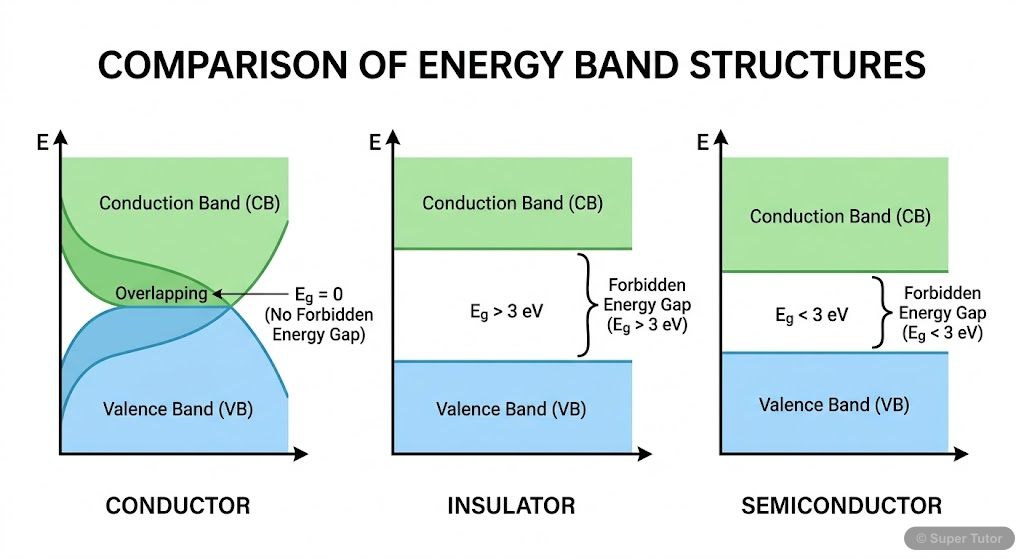
One of 12 illustrations for Semiconductors and Semiconducting Devices in Super Tutor — alongside flashcards, concept maps and practice questions.
Important Questions from Semiconductors and Semiconducting Devices
The emitter current (I_E) in a transistor is 5 mA and the base current (I_B) is 0.1 mA. What is the collector current (I_C)?
Show answer
4.9 mA
Step 1: The fundamental current relationship in a transistor is: I_E = I_C + I_B. Step 2: Rearranging: I_C = I_E - I_B. Step 3: Substituting values: I_C = 5 mA - 0.1 mA. Step 4: I_C = 4.9 mA. Wrong options: 5.1 mA results from adding instead of subtracting. 5.0 mA ignores the base current. 0.5 mA is a random incorrect calculation.
In which region of the energy band diagram do free electrons reside that contribute to electrical conduction in a solid?
Show answer
Conduction band
Step 1: In the energy band model of solids, electrons occupy different energy bands. Step 2: The valence band contains electrons that are tightly bound and involved in covalent bonding. Step 3: When electrons gain sufficient energy (more than the band gap), they jump to the conduction band. Step 4: Electrons in the conduction band are free to move and contribute to electrical conduction. Wrong options: The valence band electrons are bound and do not freely conduct. The forbidden energy gap has no allowed energy states. 'Core band' is not a standard term in this context.
A p-n junction diode is forward biased. Its knee voltage is 0.7 V. Which of the following statements best describes the current behaviour below knee voltage?
Show answer
Current is negligibly small (almost zero)
Step 1: Knee voltage (also called threshold voltage) is the minimum forward bias voltage required to overcome the barrier potential and allow significant current to flow. Step 2: For Silicon, the knee voltage is about 0.7 V. Step 3: Below this voltage, the applied potential is not sufficient to overcome the depletion layer barrier. Step 4: Hence, the current is negligibly small or almost zero below the knee voltage. Wrong options: Large current flows only after the knee voltage is exceeded. Reverse current occurs in reverse bias, not forward bias. Breakdown occurs only in reverse bias at high
In a transistor, which region has the least thickness and lightest doping?
Show answer
Base
Step 1: A transistor has three regions: Emitter, Base, and Collector. Step 2: The emitter is the most heavily doped region as it must inject a large number of charge carriers. Step 3: The collector is the largest region as it must collect most of the charge carriers and dissipate heat. Step 4: The base is the thinnest and most lightly doped region. This is crucial so that most of the charge carriers injected by the emitter pass through the base and reach the collector without recombining. Wrong options: Emitter is most heavily doped. Collector is largest in size. Depletion region is not one of
+41 more questions on Semiconductors and Semiconducting Devices (NIOS Class 12 Physics)
Practise AllFrequently Asked Questions
What are the important topics in Semiconductors and Semiconducting Devices for NIOS Class 12 Physics?
How many important questions are there in Semiconductors and Semiconducting Devices?
Sources & Official References
Content is aligned to the official syllabus. Refer to the board website for the latest curriculum.
More resources for Semiconductors and Semiconducting Devices
Practice Quiz
Test yourself with a quick quiz
Revision Notes
Key points for last-minute revision
Formula Sheet
The chapter's formulas in one place
Chapter Summary
Understand the chapter at a glance
Concept Maps
See how topics connect
Study Plan
Step-by-step plan for this chapter
Flashcards
Quick-fire cards for active recall
Syllabus
What topics to cover
For serious students
Get the full Semiconductors and Semiconducting Devices chapter — start free.
Quizzes, flashcards, an AI doubt solver and a study plan for NIOS Class 12 Physics. Free to start, no card needed.