Kinetic Theory of Gases — Important Questions
NIOS · Class 12 · Physics
44 important questions from Kinetic Theory of Gases for NIOS Class 12 Physics, with answers. Includes multiple choice and multiple correct questions.
Interactive on Super Tutor
Studying Kinetic Theory of Gases? Get the full interactive chapter.
Quizzes, flashcards, AI doubt-solver and a step-by-step study plan — built for important questions and more.
Free trial, no card needed.
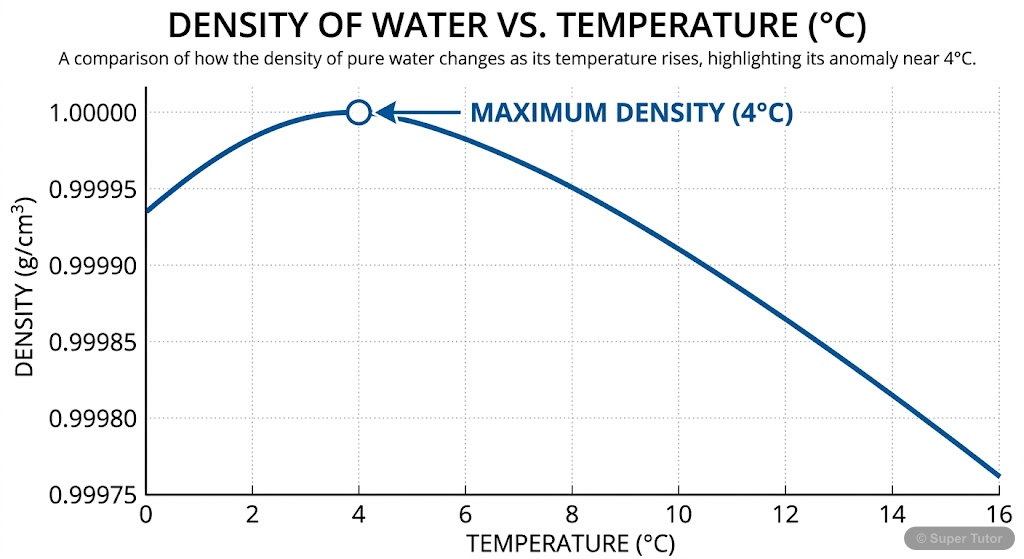
One of 6 illustrations for Kinetic Theory of Gases in Super Tutor — alongside flashcards, concept maps and practice questions.
Important Questions from Kinetic Theory of Gases
10²³ molecules of a gas, each of mass 4×10⁻²⁶ kg, are enclosed in a box of volume 8×10⁻³ m³. If the RMS speed of molecules is 400 m/s, the pressure exerted by the gas is approximately:
Show answer
2.67 × 10⁴ Pa
Step 1: Use P = (1/3)(Nm/V)c̄². Here N = 10²³, m = 4×10⁻²⁶ kg, V = 8×10⁻³ m³, c_rms = 400 m/s, so c̄² = c²_rms = 1.6×10⁵ m²/s². Step 2: Calculate Nm = 10²³ × 4×10⁻²⁶ = 4×10⁻³ kg (total mass of gas). Step 3: Nm/V = 4×10⁻³ / 8×10⁻³ = 0.5 kg/m³ (this is density ρ). Step 4: P = (1/3) × 0.5 × 1.6×10⁵ = (1/3) × 8×10⁴ = 2.67×10⁴ Pa. Step 5: Option A is wrong (forgetting the factor 1/3). Option C is wrong (using 1/2 instead of 1/3).
At what temperature will the RMS speed of nitrogen molecules be equal to the RMS speed of hydrogen molecules at 300 K? (Molar mass of N₂ = 28 g/mol, H₂ = 2 g/mol)
Show answer
4200 K
Step 1: RMS speed = √(3RT/M). For equal RMS speeds: √(3RT_N₂/M_N₂) = √(3R×300/M_H₂). Step 2: Squaring both sides: T_N₂/M_N₂ = 300/M_H₂. Step 3: T_N₂ = 300 × (M_N₂/M_H₂) = 300 × (28/2) = 300 × 14 = 4200 K. Step 4: Physical reasoning: since N₂ is 14 times heavier than H₂, it needs 14 times higher temperature to achieve the same RMS speed. Step 5: Common error: students calculate 300 × 28/2 = 4200 but sometimes make arithmetic errors giving 1200 K (using ratio 4) or 2100 K (halving the answer).
A container has 1 mole of a monoatomic ideal gas. Another container has 1 mole of a diatomic ideal gas. Both are at the same temperature T. The ratio of total internal energy of the monoatomic gas to that of the diatomic gas is:
Show answer
3:5
Step 1: For 1 mole of monoatomic gas: degrees of freedom f = 3. By equipartition, total energy = (3/2)RT. Step 2: For 1 mole of diatomic gas (at moderate T): degrees of freedom f = 5. Total energy = (5/2)RT. Step 3: Ratio = (3/2)RT : (5/2)RT = 3:5. Step 4: The R and T cancel since both gases are at the same temperature and we have equal (1 mole) amounts. Step 5: A common error is choosing 1:1 (thinking that equal temperatures mean equal energies) — this ignores the different degrees of freedom for different types of molecules.
Mean free path of gas molecules is given by σ = 1/(√2 nπd²), where n is number density and d is molecular diameter. If the pressure of the gas is doubled at constant temperature, the mean free path becomes:
Show answer
Halved
Step 1: At constant temperature, from the ideal gas law PV = NkT, we get n = N/V = P/(kT). Step 2: So number density n is directly proportional to pressure P at constant temperature. Step 3: Substituting in the mean free path formula: σ = 1/(√2 nπd²) = kT/(√2 πd²P). Step 4: So σ ∝ 1/P at constant temperature. When pressure doubles (P → 2P), the mean free path halves (σ → σ/2). Step 5: Physical reasoning: higher pressure means more molecules per unit volume (higher n), so molecules collide more frequently, reducing the mean free path.
+40 more questions on Kinetic Theory of Gases (NIOS Class 12 Physics)
Practise AllFrequently Asked Questions
What are the important topics in Kinetic Theory of Gases for NIOS Class 12 Physics?
How many important questions are there in Kinetic Theory of Gases?
Sources & Official References
Content is aligned to the official syllabus. Refer to the board website for the latest curriculum.
More resources for Kinetic Theory of Gases
Practice Quiz
Test yourself with a quick quiz
Revision Notes
Key points for last-minute revision
Formula Sheet
The chapter's formulas in one place
Chapter Summary
Understand the chapter at a glance
Concept Maps
See how topics connect
Study Plan
Step-by-step plan for this chapter
Flashcards
Quick-fire cards for active recall
Syllabus
What topics to cover
For serious students
Get the full Kinetic Theory of Gases chapter — start free.
Quizzes, flashcards, an AI doubt solver and a study plan for NIOS Class 12 Physics. Free to start, no card needed.