Electromagnetic Induction and Alternating Current — Syllabus
NIOS · Class 12 · Physics
What Electromagnetic Induction and Alternating Current covers in NIOS Class 12 Physics: 4 topics, for the 2026-27 session.
Interactive on Super Tutor
Studying Electromagnetic Induction and Alternating Current? Get the full interactive chapter.
Quizzes, flashcards, AI doubt-solver and a step-by-step study plan — built for syllabus and more.
Free trial, no card needed.
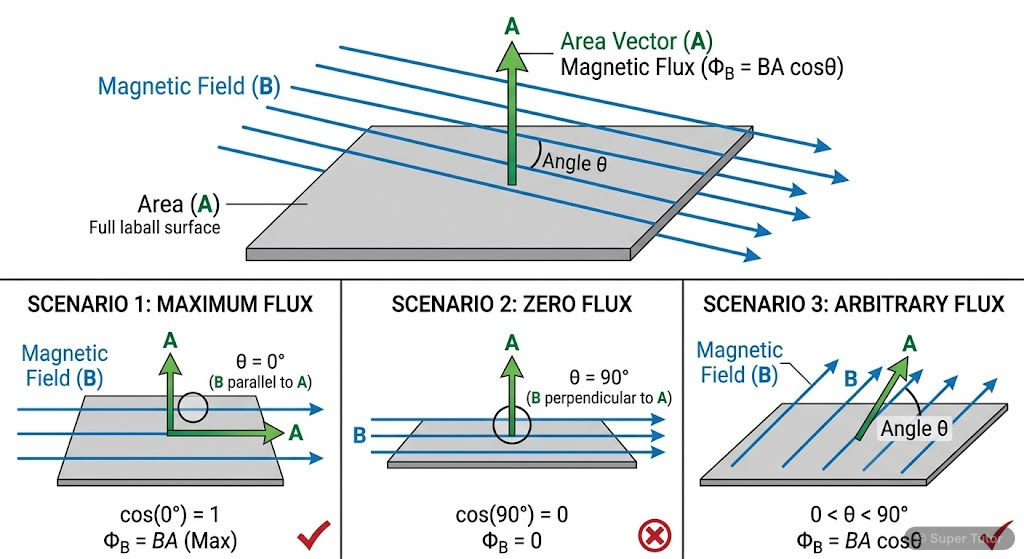
One of 26 illustrations for Electromagnetic Induction and Alternating Current in Super Tutor — alongside flashcards, concept maps and practice questions.
Topics in Electromagnetic Induction and Alternating Current
Electromagnetic Induction — Faraday's Laws
- Electromagnetic induction is the phenomenon of producing an EMF (and hence current) in a coil whenever the magnetic flux linked with the coil changes.
- Key observation: A stationary magnet near a coil produces NO current. Only a CHANGING magnetic flux induces EMF.
- Faraday's First Law: Whenever the magnetic flux linked with a circuit changes, an EMF is induced in it.
Lenz's Law and Eddy Currents
- Lenz's Law states: The direction of the induced current is always such that it OPPOSES the change in magnetic flux that caused it.
- Combined Faraday-Lenz law: ε = −dΦ_B/dt. The negative sign represents Lenz's law (opposition to the cause).
- Lenz's law is a consequence of the Law of Conservation of Energy. The induced current does work against the cause, so external work must be done to maintain the flux change.
Self-Inductance and Mutual Inductance
- Self-inductance (L) is the property of a coil by which it opposes any change in the current flowing through it by inducing a back EMF in itself.
- When current I flows through a coil, the flux linkage is Φ = LI. Hence, L = Φ/I.
- Self-induced back EMF: ε = −L·(dI/dt). The negative sign shows opposition to change (Lenz's law).
Alternating Current — Resistor, Capacitor, and Inductor Circuits
- Alternating current (AC) is a current whose magnitude changes continuously and direction reverses periodically.
- AC voltage: V = V_m·cosωt, AC current: I = I_m·cosωt, where V_m and I_m are peak (maximum) values.
- RMS (Root Mean Square) values: V_rms = V_m/√2 ≈ 0.707·V_m and I_rms = I_m/√2 ≈ 0.707·I_m.
Key Concepts
Central concept: Electromagnetic Induction and Alternating Current
Work through every topic in Electromagnetic Induction and Alternating Current with notes and quizzes
Start This ChapterFrequently Asked Questions
What are the important topics in Electromagnetic Induction and Alternating Current for NIOS Class 12 Physics?
How should I revise Electromagnetic Induction and Alternating Current for the NIOS Class 12 board exam?
Sources & Official References
Content is aligned to the official syllabus. Refer to the board website for the latest curriculum.
More resources for Electromagnetic Induction and Alternating Current
Practice Quiz
Test yourself with a quick quiz
Important Questions
Exam-style questions with answers
Revision Notes
Key points for last-minute revision
Formula Sheet
The chapter's formulas in one place
Chapter Summary
Understand the chapter at a glance
Concept Maps
See how topics connect
Study Plan
Step-by-step plan for this chapter
Flashcards
Quick-fire cards for active recall
For serious students
Get the full Electromagnetic Induction and Alternating Current chapter — start free.
Quizzes, flashcards, an AI doubt solver and a study plan for NIOS Class 12 Physics. Free to start, no card needed.