Wave Phenomena and Light — Important Questions
NIOS · Class 12 · Physics
44 important questions from Wave Phenomena and Light for NIOS Class 12 Physics, with answers. Includes multiple choice and multiple correct questions.
Interactive on Super Tutor
Studying Wave Phenomena and Light? Get the full interactive chapter.
Quizzes, flashcards, AI doubt-solver and a step-by-step study plan — built for important questions and more.
Free trial, no card needed.
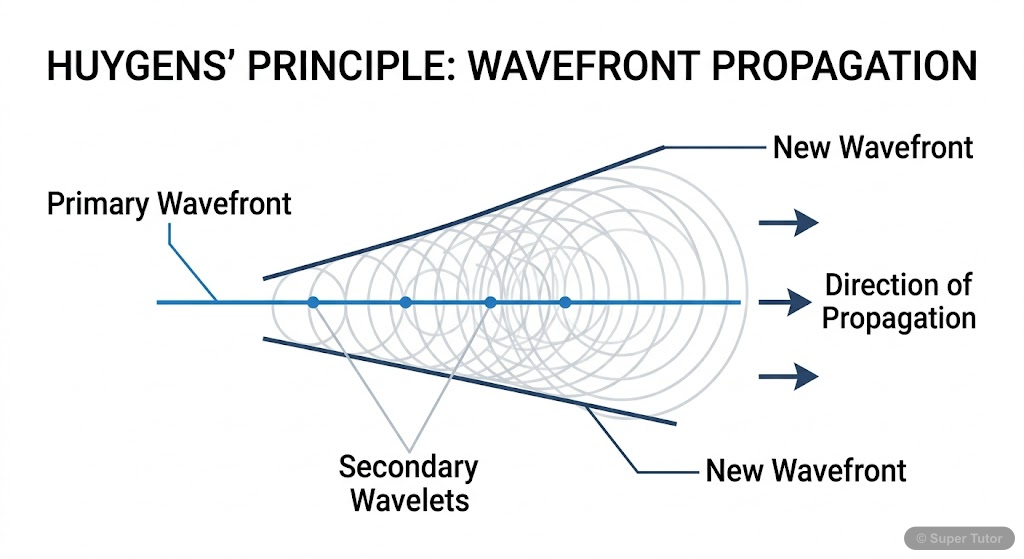
One of 7 illustrations for Wave Phenomena and Light in Super Tutor — alongside flashcards, concept maps and practice questions.
Important Questions from Wave Phenomena and Light
In Young's double slit experiment, yellow light (λ = 600 nm) is replaced by green light (λ = 500 nm) keeping all other parameters the same. What happens to the fringe width?
Show answer
Fringe width decreases by a factor of 5/6
Step 1: Fringe width β = λD/d. Since D and d remain unchanged, β is directly proportional to λ. Step 2: β_yellow = 600D/d and β_green = 500D/d. Step 3: Ratio β_green/β_yellow = 500/600 = 5/6. Step 4: Since 5/6 < 1, the new fringe width is SMALLER than the original. So fringe width decreases by a factor of 5/6. Step 5: Option A is wrong — it incorrectly states an increase. Option C is wrong because fringe width clearly depends on λ. Option D confuses 'decrease' with 'increase'.
In a single slit diffraction experiment, the width of the central maximum is observed to be twice the width of each secondary maximum. If the slit width is 'a' and the wavelength of light is λ, what is the angular position of the FIRST minimum?
Show answer
sin θ = λ/a
Step 1: In single slit diffraction, minima (dark fringes) occur when the path difference between waves from the two extreme edges of the slit is an integer multiple of λ. Step 2: The condition for the nth minimum is: a sin θ = nλ. Step 3: For the FIRST minimum (n = 1): a sin θ = λ → sin θ = λ/a. Step 4: The central maximum extends from −θ to +θ, giving it twice the angular width compared to secondary maxima (which span from one minimum to the next). Step 5: Option A (λ/2a) would be half the correct value. Option C (2λ/a) corresponds to the second minimum, not the first.
Light is incident on a glass surface (refractive index μ = 1.5) at Brewster's angle. What is the approximate value of the polarising angle?
Show answer
56.3°
Step 1: Brewster's Law states: tan(iₚ) = μ, where iₚ is the polarising angle and μ is the refractive index. Step 2: Given μ = 1.5, so tan(iₚ) = 1.5. Step 3: iₚ = tan⁻¹(1.5) ≈ 56.3°. Step 4: At Brewster's angle, the reflected ray is completely plane polarised. Also, the reflected ray and the refracted ray are perpendicular to each other (iₚ + r = 90°). Step 5: Option A (33.7°) is actually the refraction angle r = 90° − 56.3°. Option C (45°) corresponds to μ = 1, which is not glass. Option D (63.4°) corresponds to μ ≈ 2.0.
In Young's double slit experiment, each wave has amplitude 'a'. What is the maximum intensity of the bright fringes in terms of the intensity I₀ due to a single slit?
Show answer
4I₀
Step 1: Intensity of a single wave: I₀ ∝ a². Step 2: For constructive interference (phase difference δ = 2nπ), the resultant amplitude A = 2a. Step 3: Intensity at bright fringe: I_max ∝ A² = (2a)² = 4a². Step 4: Therefore, I_max = 4a² = 4I₀ (since I₀ ∝ a²). Step 5: Note: Energy is conserved — the average intensity over the pattern remains 2I₀ (as dark fringes have zero intensity). Option B (2I₀) would be the average, not the maximum. Option D (√2 I₀) has no physical basis here.
+40 more questions on Wave Phenomena and Light (NIOS Class 12 Physics)
Practise AllFrequently Asked Questions
What are the important topics in Wave Phenomena and Light for NIOS Class 12 Physics?
How many important questions are there in Wave Phenomena and Light?
Sources & Official References
Content is aligned to the official syllabus. Refer to the board website for the latest curriculum.
More resources for Wave Phenomena and Light
Practice Quiz
Test yourself with a quick quiz
Revision Notes
Key points for last-minute revision
Formula Sheet
The chapter's formulas in one place
Chapter Summary
Understand the chapter at a glance
Concept Maps
See how topics connect
Study Plan
Step-by-step plan for this chapter
Flashcards
Quick-fire cards for active recall
Syllabus
What topics to cover
For serious students
Get the full Wave Phenomena and Light chapter — start free.
Quizzes, flashcards, an AI doubt solver and a study plan for NIOS Class 12 Physics. Free to start, no card needed.