Work, Energy and Power — Important Questions
NIOS · Class 12 · Physics
45 important questions from Work, Energy and Power for NIOS Class 12 Physics, with answers. Includes multiple choice and multiple correct questions.
Interactive on Super Tutor
Studying Work, Energy and Power? Get the full interactive chapter.
Quizzes, flashcards, AI doubt-solver and a step-by-step study plan — built for important questions and more.
Free trial, no card needed.
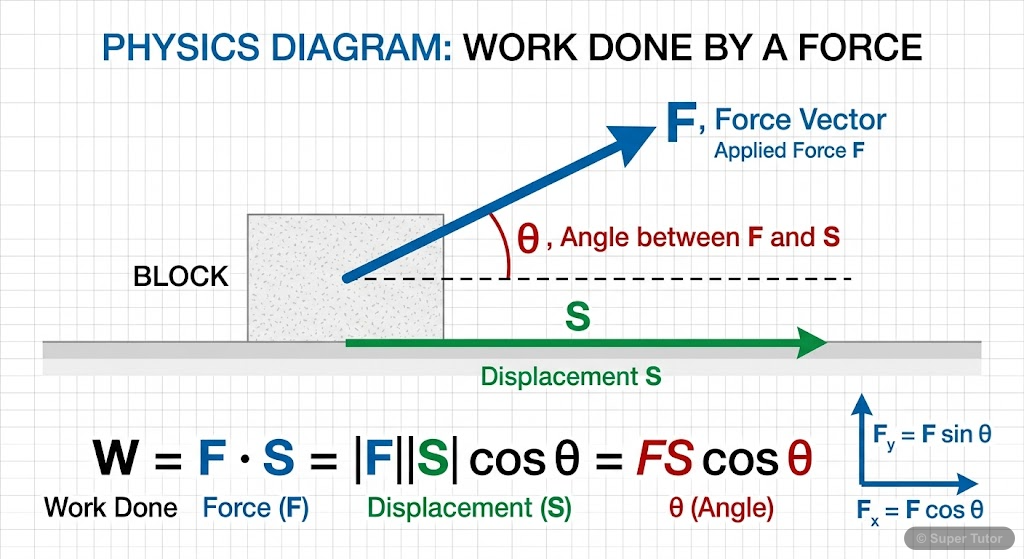
One of 3 illustrations for Work, Energy and Power in Super Tutor — alongside flashcards, concept maps and practice questions.
Important Questions from Work, Energy and Power
A block is moved from point A to point B along two different paths on a rough surface. Which of the following statements is correct?
Show answer
Work done by gravity is the same along both paths.
Step 1: Gravity is a conservative force; its work depends only on the vertical displacement (height difference), not on the path. Step 2: Friction is a non-conservative force; its work depends on the length and nature of the path. Step 3: Since friction does negative work and is path-dependent, total mechanical energy is NOT conserved. Option A is wrong because friction is path-dependent. Option C is wrong because friction dissipates energy. Option D is the definition of a conservative force, which friction is NOT.
Two identical balls A and B have masses m each. A moves with velocity v and B is at rest. They undergo a perfectly elastic head-on collision. What are the velocities of A and B after the collision?
Show answer
A: 0, B: v
Step 1: In an elastic collision between identical masses, velocities are exchanged. Step 2: Using the result for equal masses (mA = mB = m) with vBi = 0: vAf = vBi = 0 and vBf = vAi = v. Step 3: A comes to rest and B moves with A's initial velocity v. This is verified by checking both momentum (mv = mv ✓) and kinetic energy (½mv² = ½mv² ✓) conservation. Option A is the result of an inelastic collision. Option C means no collision happened. Option D violates energy conservation.
A ball of mass 2 kg is dropped from a height of 20 m. What is its kinetic energy just before it hits the ground? (g = 10 m/s²)
Show answer
400 J
Step 1: By conservation of energy, all PE at the top converts to KE at the bottom. Step 2: PE at top = mgh = 2 × 10 × 20 = 400 J. Step 3: KE just before hitting ground = 400 J (since PE = 0 at ground level). Option A (200 J) uses g = 5 or h = 10 incorrectly. Option B (20 J) only uses mh. Option D (800 J) doubles the result.
A person carries a 10 kg bag horizontally at a constant velocity for 5 m on a level floor. How much work is done by the person against gravity?
Show answer
0 J
Step 1: Work done = Fd cosθ, where θ is the angle between force and displacement. Step 2: Gravity acts vertically downward; displacement is horizontal. Step 3: θ = 90°, so cos 90° = 0. Step 4: W = mgh cos 90° = 0 J. The person does no work against gravity because there is no vertical displacement. Options A and B incorrectly assume vertical displacement. Option D is half of mgs which has no physical meaning here.
+41 more questions on Work, Energy and Power (NIOS Class 12 Physics)
Practise AllFrequently Asked Questions
What are the important topics in Work, Energy and Power for NIOS Class 12 Physics?
How many important questions are there in Work, Energy and Power?
Sources & Official References
Content is aligned to the official syllabus. Refer to the board website for the latest curriculum.
More resources for Work, Energy and Power
Practice Quiz
Test yourself with a quick quiz
Revision Notes
Key points for last-minute revision
Formula Sheet
The chapter's formulas in one place
Chapter Summary
Understand the chapter at a glance
Concept Maps
See how topics connect
Study Plan
Step-by-step plan for this chapter
Flashcards
Quick-fire cards for active recall
Syllabus
What topics to cover
For serious students
Get the full Work, Energy and Power chapter — start free.
Quizzes, flashcards, an AI doubt solver and a study plan for NIOS Class 12 Physics. Free to start, no card needed.