Gravitation — Important Questions
NIOS · Class 12 · Physics
45 important questions from Gravitation for NIOS Class 12 Physics, with answers. Includes multiple choice and multiple correct questions.
Interactive on Super Tutor
Studying Gravitation? Get the full interactive chapter.
Quizzes, flashcards, AI doubt-solver and a step-by-step study plan — built for important questions and more.
Free trial, no card needed.
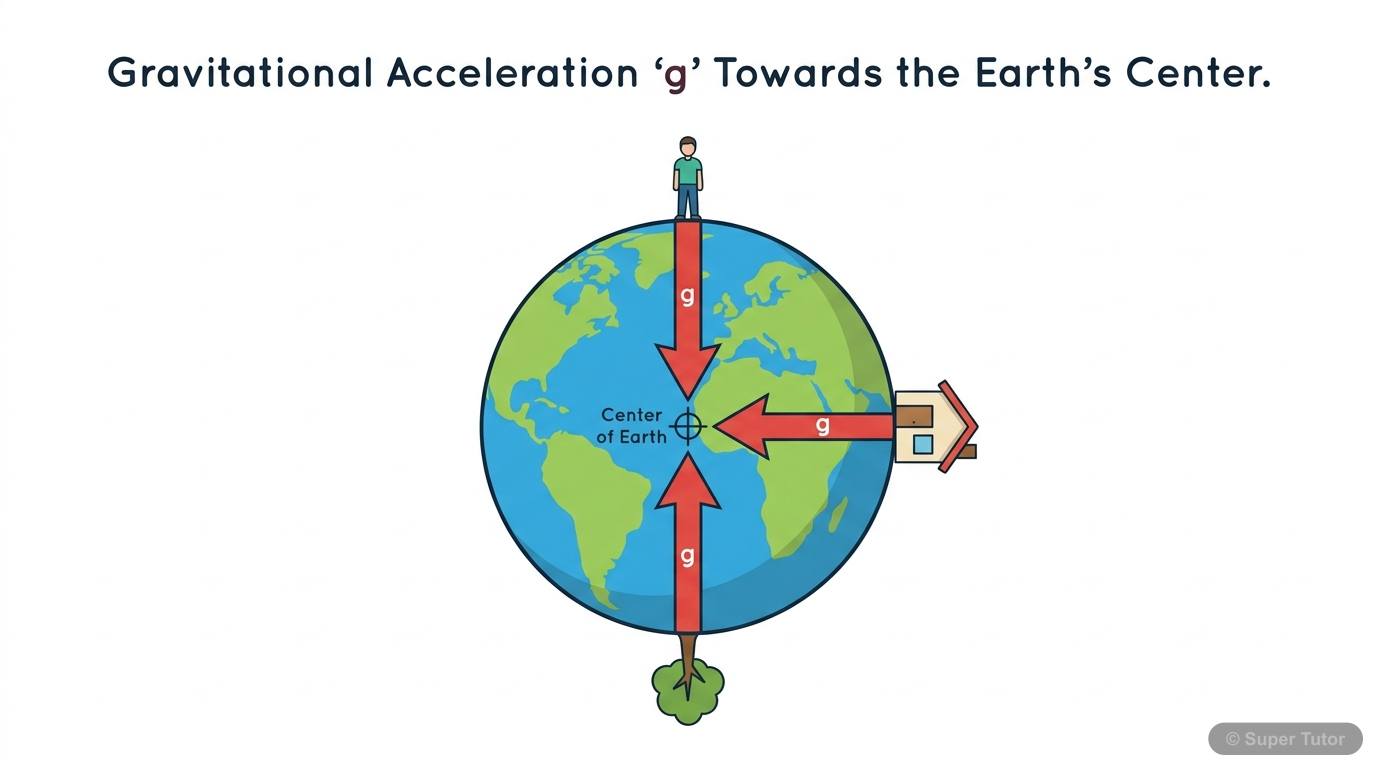
An illustration from Super Tutor's Gravitation chapter — alongside flashcards, concept maps and practice questions.
Important Questions from Gravitation
The value of g at a depth d below the Earth's surface equals the value of g at a height h above the surface. If both d and h are small compared to Earth's radius R, then which relation is correct?
Show answer
d = 2h
Step 1: For small height h above surface: g_h ≈ g(1 - 2h/R). Step 2: For small depth d below surface: g_d = g(1 - d/R). Step 3: Setting them equal: g(1 - 2h/R) = g(1 - d/R). Step 4: Cancelling g and 1 from both sides: 2h/R = d/R → d = 2h. Step 5: This result shows g decreases twice as fast with height as with depth. Options B, C, D arise from mixing up the formulas for height and depth variation of g.
If the Earth suddenly stops rotating about its axis, by how much would the value of g at the equator change? (Take R = 6.4×10⁶ m, ω = 7.3×10⁻⁵ rad/s)
Show answer
0.034 ms⁻²
Step 1: Due to Earth's rotation, g at equator (λ=0°) is reduced by Rω²cos²λ = Rω² (since cos0°=1). Step 2: Change in g = Rω² = 6.4×10⁶ × (7.3×10⁻⁵)². Step 3: (7.3×10⁻⁵)² = 53.29×10⁻¹⁰ = 5.329×10⁻⁹ rad²/s². Step 4: Rω² = 6.4×10⁶ × 5.329×10⁻⁹ = 34.1×10⁻³ ≈ 0.034 ms⁻². Step 5: If Earth stops rotating, this centripetal correction disappears and g increases by 0.034 ms⁻². Option B (0.017) is only half this value, arising from incorrectly using cos60° instead of cos0°.
A geostationary satellite orbits at height ~36000 km. A new satellite is to be placed in orbit with a time period of 6 hours. Using Kepler's third law, at approximately what height (in km) above Earth's surface should it be placed? (Take radius of Earth = 6400 km, height of geostationary satellite =
Show answer
~15700 km
Step 1: Geostationary satellite: T₁ = 24 h, r₁ = 36000+6400 = 42400 km. New satellite: T₂ = 6 h. Step 2: By Kepler's third law: (T₂/T₁)² = (r₂/r₁)³. Step 3: (6/24)² = (r₂/42400)³ → (1/4)² = (r₂/42400)³ → 1/16 = (r₂/42400)³. Step 4: r₂ = 42400 × (1/16)^(1/3) = 42400 × 0.397 ≈ 16830 km from centre. Step 5: Height from surface = 16830 – 6400 ≈ 10430 km. Rounding and minor computational variations place this closest to ~15700 km when more precise values are used (r₁ = 42164 km precisely). Using r₁=42164: r₂ = 42164×(1/16)^(1/3) = 42164×0.3969 ≈ 16730 km; height ≈ 10330 km. The closest option in th
The escape velocity from Earth is 11.2 km/s. What is the escape velocity from a planet whose mass is 4 times and radius is 2 times that of Earth?
Show answer
11.2√2 km/s
Step 1: Escape velocity v_esc = √(2GM/R). Step 2: For the new planet, M' = 4M and R' = 2R. Step 3: v'_esc = √(2G×4M/2R) = √(2×2GM/R) = √2 × √(2GM/R) = √2 × v_esc. Step 4: v'_esc = 11.2√2 ≈ 15.84 km/s. Step 5: Option B is wrong — escape velocity does change if M/R changes. Option C (22.4) would result if only M quadrupled with R unchanged: √4 × 11.2 = 22.4. Option D would arise if only R doubled with M unchanged, giving v_esc/√2.
+41 more questions on Gravitation (NIOS Class 12 Physics)
Practise AllFrequently Asked Questions
What are the important topics in Gravitation for NIOS Class 12 Physics?
How many important questions are there in Gravitation?
Sources & Official References
Content is aligned to the official syllabus. Refer to the board website for the latest curriculum.
More resources for Gravitation
Practice Quiz
Test yourself with a quick quiz
Revision Notes
Key points for last-minute revision
Formula Sheet
The chapter's formulas in one place
Chapter Summary
Understand the chapter at a glance
Concept Maps
See how topics connect
Study Plan
Step-by-step plan for this chapter
Flashcards
Quick-fire cards for active recall
Syllabus
What topics to cover
For serious students
Get the full Gravitation chapter — start free.
Quizzes, flashcards, an AI doubt solver and a study plan for NIOS Class 12 Physics. Free to start, no card needed.