Electromagnetic Induction and Alternating Current — Chapter Summary
NIOS · Class 12 · Physics
Summary of Electromagnetic Induction and Alternating Current for NIOS Class 12 Physics. Part of the NIOS Class 12 Physics syllabus.
Interactive on Super Tutor
Studying Electromagnetic Induction and Alternating Current? Get the full interactive chapter.
Quizzes, flashcards, AI doubt-solver and a step-by-step study plan — built for chapter summary and more.
Free trial, no card needed.
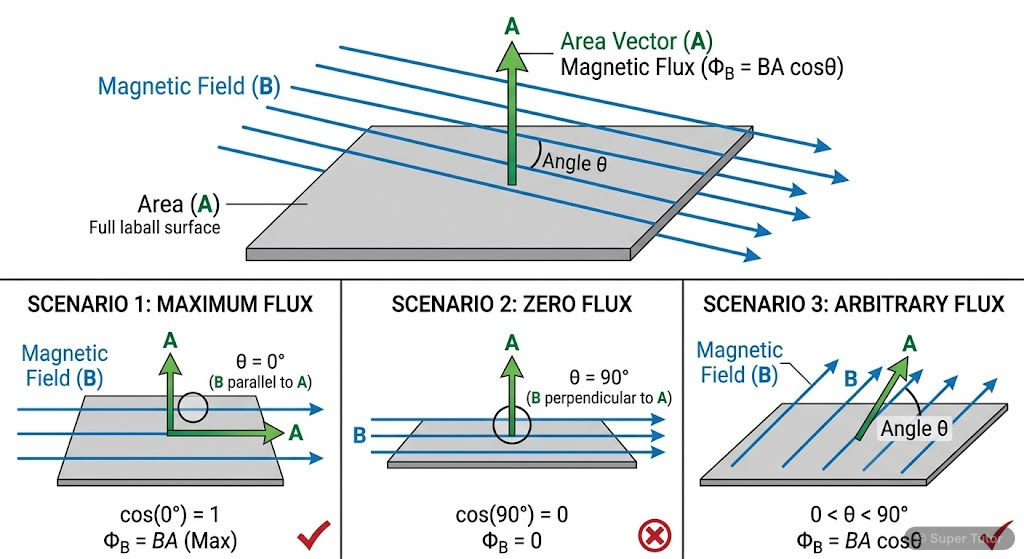
One of 26 illustrations for Electromagnetic Induction and Alternating Current in Super Tutor — alongside flashcards, concept maps and practice questions.
Overview
Electromagnetic Induction and Alternating Current is one of the most important chapters in Class 12 Physics. It explains how electricity is generated — the very foundation of our modern world. From the fan running in your room to the lights in your city, everything depends on the principle of electr
Key Concepts
Electromagnetic induction is the phenomenon
Electromagnetic induction is the phenomenon in which a changing magnetic flux through a closed loop induces an electromotive force (emf) and hence a c
Magnetic flux (φ_B) through a surface
Magnetic flux (φ_B) through a surface is defined as the total number of magnetic field lines passing through that surface. Mathematically, φ_B = B · A
Faraday's Law states that the magnitude
Faraday's Law states that the magnitude of the induced emf in a loop is equal to the rate of change of magnetic flux linked with that loop: |ε| = dφ_B
Lenz's Law states that the direction
Lenz's Law states that the direction of the induced current is always such that it opposes the change in magnetic flux that caused it. In mathematical
When a solid conductor (like
When a solid conductor (like an iron sheet) is placed in a changing magnetic field, induced currents are set up in closed loops within the body of the
Learning Objectives
- Explain the phenomenon of electromagnetic induction with simple experiments involving magnets and coils
- State and apply Faraday's Law and Lenz's Law of electromagnetic induction
- Understand eddy currents, their causes, harmful effects, and useful applications
- Define self-inductance and mutual inductance and derive expressions for them
- Analyse the behaviour of AC circuits containing only a resistor, only a capacitor, or only an inductor
Frequently Asked Questions
What are the important topics in Electromagnetic Induction and Alternating Current for NIOS Class 12 Physics?
How should I revise Electromagnetic Induction and Alternating Current for the NIOS Class 12 board exam?
Sources & Official References
Content is aligned to the official syllabus. Refer to the board website for the latest curriculum.
More resources for Electromagnetic Induction and Alternating Current
Practice Quiz
Test yourself with a quick quiz
Important Questions
Exam-style questions with answers
Revision Notes
Key points for last-minute revision
Formula Sheet
The chapter's formulas in one place
Concept Maps
See how topics connect
Study Plan
Step-by-step plan for this chapter
Flashcards
Quick-fire cards for active recall
Syllabus
What topics to cover
For serious students
Get the full Electromagnetic Induction and Alternating Current chapter — start free.
Quizzes, flashcards, an AI doubt solver and a study plan for NIOS Class 12 Physics. Free to start, no card needed.