Elastic Properties of solids — Important Questions
NIOS · Class 12 · Physics
45 important questions from Elastic Properties of solids for NIOS Class 12 Physics, with answers. Includes multiple choice and multiple correct questions.
Interactive on Super Tutor
Studying Elastic Properties of solids? Get the full interactive chapter.
Quizzes, flashcards, AI doubt-solver and a step-by-step study plan — built for important questions and more.
Free trial, no card needed.
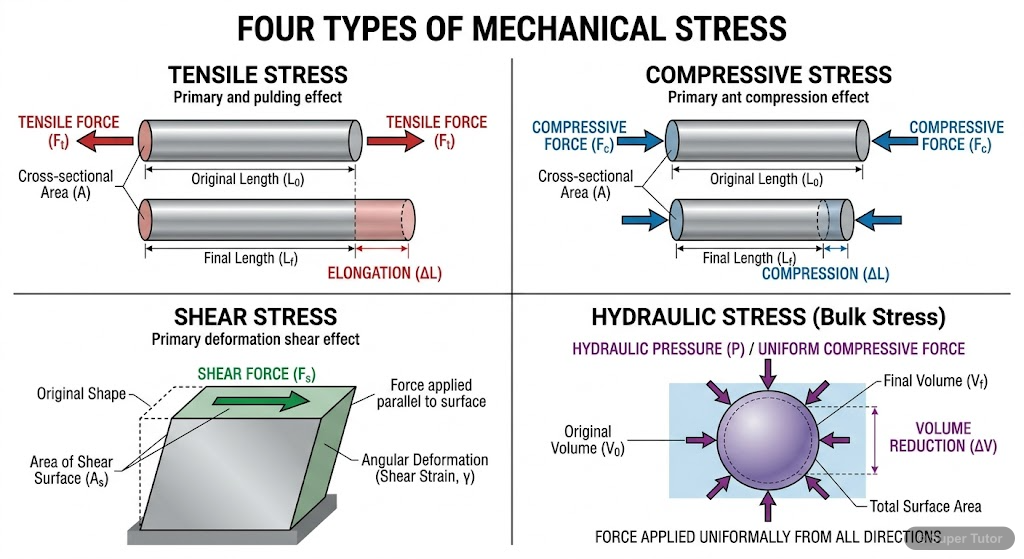
Learn better with visuals Super Tutor pairs illustrations like this with notes and quizzes for Elastic Properties of solids.
Important Questions from Elastic Properties of solids
In the stress-strain curve of a metallic wire, the wire is loaded beyond the elastic limit (point B) but the load is then gradually removed. Which of the following correctly describes what happens?
Show answer
The wire follows a dotted path parallel to OA back to zero stress but retains a permanent set (residual strain).
Step 1: Beyond the elastic limit, the wire behaves plastically — permanent deformation occurs in the crystal structure. Step 2: When load is removed, the wire does recover partially (elastic recovery), following a line parallel to the initial OA region of the curve. Step 3: However, it does NOT return to zero strain; a residual strain called 'permanent set' remains. Step 4: Option A is wrong because complete recovery is only possible within the elastic limit. Option C is wrong because the wire breaks only at the fracture point F, which is well beyond B. Option D incorrectly suggests higher str
What is the maximum length of a steel wire that can be suspended vertically without breaking under its own weight? Given: breaking stress = 4.0 × 10⁸ N m⁻², density of steel = 7.9 × 10³ kg m⁻³, g = 9.8 m s⁻².
Show answer
5.17 km
Step 1: The weight of a wire of cross-sectional area A and length ℓ is W = Aℓρg. Step 2: Stress at the top due to its own weight = W/A = ℓρg. Step 3: At maximum length, this equals breaking stress: ℓ_max = Breaking stress / (ρg). Step 4: ℓ_max = (4.0 × 10⁸) / (7.9 × 10³ × 9.8) = (4.0 × 10⁸) / (7.742 × 10⁴) ≈ 5.17 × 10³ m ≈ 5.17 km. Option B results from dividing by 2ρg (factor of 2 error); option C from using ρ = 3.9 × 10³; option D from using g = 16 m/s². The key insight is that cross-sectional area cancels out, so maximum length is independent of wire thickness.
A spring of spring constant 500 N m⁻¹ is first compressed by 4 cm and then by 8 cm from its natural length. What is the ratio of elastic potential energy stored in the second case to the first case?
Show answer
4 : 1
Step 1: Elastic potential energy U = ½kx², so U ∝ x². Step 2: In case 1: x₁ = 4 cm = 0.04 m; U₁ = ½ × 500 × (0.04)² = ½ × 500 × 0.0016 = 0.4 J. Step 3: In case 2: x₂ = 8 cm = 0.08 m; U₂ = ½ × 500 × (0.08)² = ½ × 500 × 0.0064 = 1.6 J. Step 4: Ratio U₂/U₁ = 1.6/0.4 = 4:1. This can also be seen directly: since x₂ = 2x₁, U₂/U₁ = (2x₁)²/x₁² = 4. Option A (2:1) is wrong — it assumes U ∝ x (linear), not quadratic. Option C (8:1) is wrong — it assumes U ∝ x³.
Two wires, one of steel and one of rubber, have identical dimensions. Equal longitudinal forces are applied to both. Which of the following statements is physically correct and explains why steel is more elastic than rubber?
Show answer
Rubber wire stretches more for the same force; hence more stress is needed in steel for the same strain, so steel is more elastic.
Step 1: Elasticity is defined as the ability to resist deformation — a body requiring more stress to produce the same strain is more elastic. Step 2: When equal forces are applied, rubber stretches far more than steel (lower Young's modulus for rubber). Step 3: To produce the SAME strain in steel as in rubber, a much larger stress is required — this means steel's internal restoring force is much stronger. Step 4: Hence steel is more elastic. Option A is self-contradictory. Option C is factually wrong — steel stretches far less. Option D confuses 'stretchability' (large strain capability) with
+41 more questions on Elastic Properties of solids (NIOS Class 12 Physics)
Practise AllFrequently Asked Questions
What are the important topics in Elastic Properties of solids for NIOS Class 12 Physics?
How many important questions are there in Elastic Properties of solids?
Sources & Official References
Content is aligned to the official syllabus. Refer to the board website for the latest curriculum.
More resources for Elastic Properties of solids
Practice Quiz
Test yourself with a quick quiz
Revision Notes
Key points for last-minute revision
Formula Sheet
The chapter's formulas in one place
Chapter Summary
Understand the chapter at a glance
Concept Maps
See how topics connect
Study Plan
Step-by-step plan for this chapter
Flashcards
Quick-fire cards for active recall
Syllabus
What topics to cover
For serious students
Get the full Elastic Properties of solids chapter — start free.
Quizzes, flashcards, an AI doubt solver and a study plan for NIOS Class 12 Physics. Free to start, no card needed.