Kinetic Theory of Gases — Flashcards
NIOS · Class 12 · Physics
37 flashcards for Kinetic Theory of Gases (NIOS Class 12 Physics) to test yourself on key terms and facts. Part of the NIOS Class 12 Physics syllabus.
Interactive on Super Tutor
Studying Kinetic Theory of Gases? Get the full interactive chapter.
Quizzes, flashcards, AI doubt-solver and a step-by-step study plan — built for flashcards and more.
Free trial, no card needed.
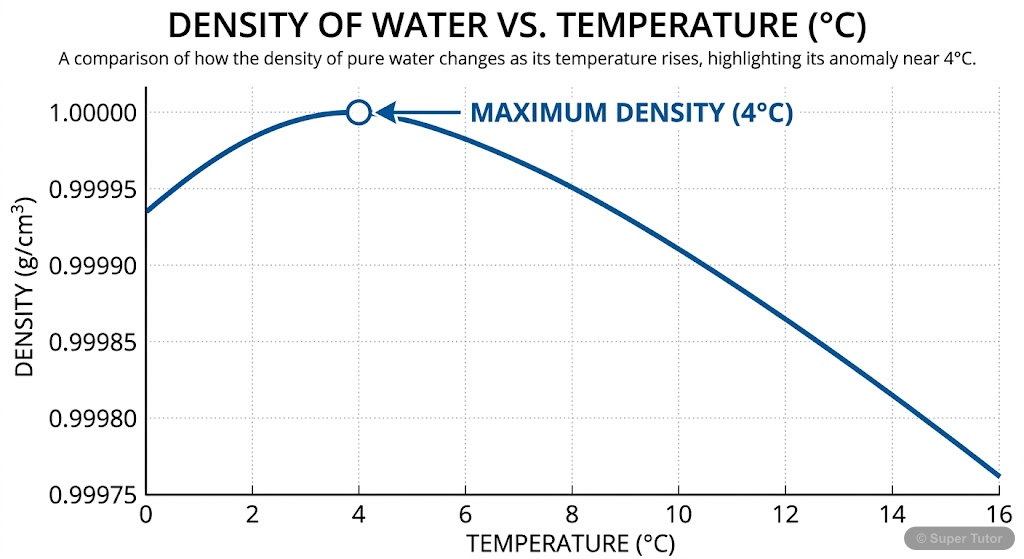
One of 6 illustrations for Kinetic Theory of Gases in Super Tutor — alongside flashcards, concept maps and practice questions.
State the expression for pressure exerted by an ideal gas on the walls of its container. What does each symbol represent?
Answer
Formula: P = (1/3) × ρ × c̄² Where: • P = Pressure exerted by the gas (Pa) • ρ = Density of the gas (kg/m³) • c̄² = Mean square speed of molecules (m²/s²) Alternate form: PV = (1/3) × M × c̄² Where …
Calculate the pressure exerted by 10²² molecules of oxygen, each of mass 5 × 10⁻²⁶ kg, in a hollow cube of side 10 cm, where the average translational speed of a molecule is 500 m/s.
Answer
Given: • N = 10²², m = 5 × 10⁻²⁶ kg, l = 10 cm = 0.10 m, u = 500 m/s Step 1 – Change in momentum per collision: 2mu = 2 × 5×10⁻²⁶ × 500 = 5×10⁻²³ kg·m/s Step 2 – Time between successive impacts: t =…
What are the six main assumptions of the Kinetic Theory of Gases?
Answer
1. A gas has a very large number of identical rigid molecules moving randomly with all possible velocities. Intermolecular forces are negligible. 2. Collisions between molecules and with walls are pe…
Why is the mean square speed (c̄²) NOT the same as the square of the mean speed (c̄)²? Illustrate with an example.
Answer
These are two different mathematical quantities and are NOT equal in general. Example: Five molecules with speeds 1, 2, 3, 4, 5 units. Mean speed: c̄ = (1+2+3+4+5)/5 = 15/5 = 3 units (c̄)² = 9 Mean…
Calculate the RMS speed of hydrogen molecules at 300 K. (Given: m(H₂) = 3.347 × 10⁻²⁷ kg, k = 1.38 × 10⁻²³ J/K)
Answer
Given: • T = 300 K • m = 3.347 × 10⁻²⁷ kg • k = 1.38 × 10⁻²³ J/K Formula: c_rms = √(3kT/m) Step 1 – Numerator: 3kT = 3 × 1.38×10⁻²³ × 300 = 3 × 4.14×10⁻²¹ = 1.242×10⁻²⁰ J Step 2 – Divide by mass: 1…
At what temperature will the RMS speed of hydrogen molecules be double its value at STP (Standard Temperature = 273 K)?
Answer
Given: • Initial temperature T₀ = 273 K • Required: c_rms = 2 × c₀ (double the initial RMS speed) Key relation: c_rms ∝ √T Step 1 – Set up ratio: c/c₀ = √(T/T₀) 2c₀/c₀ = √(T/273) 2 = √(T/273) Step …
State the kinetic interpretation of temperature. What happens to molecular motion at absolute zero?
Answer
Kinetic Interpretation of Temperature: The mean kinetic energy of a gas molecule depends ONLY on the absolute temperature T and is independent of its mass. Formula: (1/2)mc̄² = (3/2)kT Where k = Bol…
Calculate the average kinetic energy of a gas molecule at 300 K. (Given: k = 1.38 × 10⁻²³ J/K)
Answer
Given: • T = 300 K • k = 1.38 × 10⁻²³ J/K Formula: Ē = (3/2)kT Step 1 – Substitute values: Ē = (3/2) × 1.38×10⁻²³ × 300 Step 2 – Calculate: Ē = 1.5 × 4.14×10⁻²¹ Ē = 6.21×10⁻²¹ J Answer: Ē = 6.21 ×…
+29 more flashcards
Practise AllFrequently Asked Questions
What are the important topics in Kinetic Theory of Gases for NIOS Class 12 Physics?
How many flashcards are available for Kinetic Theory of Gases?
How should I revise Kinetic Theory of Gases for the NIOS Class 12 board exam?
Sources & Official References
Content is aligned to the official syllabus. Refer to the board website for the latest curriculum.
More resources for Kinetic Theory of Gases
Practice Quiz
Test yourself with a quick quiz
Important Questions
Exam-style questions with answers
Revision Notes
Key points for last-minute revision
Formula Sheet
The chapter's formulas in one place
Chapter Summary
Understand the chapter at a glance
Concept Maps
See how topics connect
Study Plan
Step-by-step plan for this chapter
Syllabus
What topics to cover
For serious students
Get the full Kinetic Theory of Gases chapter — start free.
Quizzes, flashcards, an AI doubt solver and a study plan for NIOS Class 12 Physics. Free to start, no card needed.