Optical Instruments — Practice Quiz
NIOS · Class 12 · Physics
Try a 4-question quiz on Optical Instruments for NIOS Class 12 Physics: tap an answer to check it and see why. 43 questions in the full chapter test.
Interactive on Super Tutor
Studying Optical Instruments? Get the full interactive chapter.
Quizzes, flashcards, AI doubt-solver and a step-by-step study plan — built for practice quiz and more.
Free trial, no card needed.
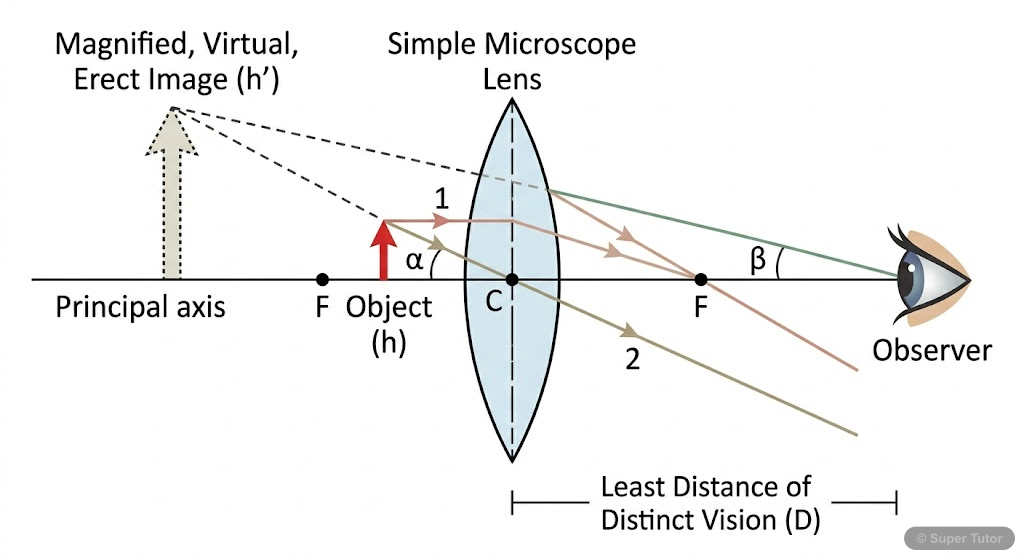
An illustration from Super Tutor's Optical Instruments chapter — alongside flashcards, concept maps and practice questions.
Quick Quiz: Optical Instruments
0/4Tap an answer to check it instantly. No sign-up needed for these 4.
The magnifying power of a simple microscope is given by the formula M = 1 + D/f. If the focal length of the lens is 5 cm and the least distance of distinct vision D = 25 cm, what is the magnifying power?
In normal adjustment of a simple microscope, the image is formed at:
In a compound microscope, the lens that faces the object is called the:
The magnifying power of a compound microscope in normal adjustment is given by M = (v₀/u₀) × (D/fₑ). If v₀ = 15 cm, u₀ = 3 cm, D = 25 cm, and fₑ = 5 cm, what is the magnifying power?
Sample Questions
The magnifying power of an astronomical telescope in normal adjustment, where f₀ = 100 cm and fₑ = 5 cm, is:
Show answer
20
Step 1: Formula for magnifying power of a telescope in normal adjustment: M = f₀/fₑ. Step 2: Substitute f₀ = 100 cm and fₑ = 5 cm. Step 3: M = 100/5 = 20. Option A (5) is fₑ alone. Option C (500) multiplies instead of dividing. Option D (95) subtracts the focal lengths incorrectly.
The length of an astronomical telescope in normal adjustment is:
Show answer
f₀ + fₑ
Step 1: In normal adjustment, the final image is at infinity. Step 2: This means the back focal point of the objective coincides with the front focal point of the eyepiece. Step 3: The distance between the two lenses is therefore f₀ + fₑ. This is the length of the telescope tube. Option A (f₀ − fₑ) is used for Galilean telescope in some contexts. Options B and D are mathematically incorrect interpretations.
Resolving power of a telescope is given by (R.P.)_T = D / (1.22λ). If the diameter of the objective D = 3 cm and wavelength of light λ = 6 × 10⁻⁵ cm, what is the resolving power?
Show answer
4.1 × 10⁴
Step 1: Formula: R.P. = D / (1.22λ). Step 2: D = 3 cm, λ = 6 × 10⁻⁵ cm. Step 3: R.P. = 3 / (1.22 × 6 × 10⁻⁵) = 3 / (7.32 × 10⁻⁵) ≈ 4.1 × 10⁴. Step 4: The other options arise from common errors such as forgetting the factor 1.22 or misplacing the decimal. Larger resolving power means the telescope can distinguish finer details.
Which of the following is an advantage of a reflecting telescope over a refracting telescope?
Show answer
It uses a concave mirror as the objective, making it free from chromatic aberration
Step 1: A reflecting telescope uses a concave (parabolic) mirror as its objective instead of a lens. Step 2: Mirrors reflect all wavelengths at the same angle, so there is no chromatic aberration. Step 3: Lenses in refracting telescopes refract different colours by different amounts, causing chromatic aberration. Step 4: Option A is wrong because reflecting telescopes use mirrors, not lenses. Option C is incorrect as reflecting telescopes can be longer. Option D is incorrect as they still form inverted images.
+39 more questions on Optical Instruments (NIOS Class 12 Physics)
Practise AllFrequently Asked Questions
What are the important topics in Optical Instruments for NIOS Class 12 Physics?
How many practice questions are there for Optical Instruments?
Sources & Official References
Content is aligned to the official syllabus. Refer to the board website for the latest curriculum.
More resources for Optical Instruments
Important Questions
Exam-style questions with answers
Revision Notes
Key points for last-minute revision
Formula Sheet
The chapter's formulas in one place
Chapter Summary
Understand the chapter at a glance
Concept Maps
See how topics connect
Study Plan
Step-by-step plan for this chapter
Flashcards
Quick-fire cards for active recall
Syllabus
What topics to cover
For serious students
Get the full Optical Instruments chapter — start free.
Quizzes, flashcards, an AI doubt solver and a study plan for NIOS Class 12 Physics. Free to start, no card needed.