Nuclei and Radioactivity — Practice Quiz
NIOS · Class 12 · Physics
Try a 4-question quiz on Nuclei and Radioactivity for NIOS Class 12 Physics: tap an answer to check it and see why. 45 questions in the full chapter test.
Interactive on Super Tutor
Studying Nuclei and Radioactivity? Get the full interactive chapter.
Quizzes, flashcards, AI doubt-solver and a step-by-step study plan — built for practice quiz and more.
Free trial, no card needed.
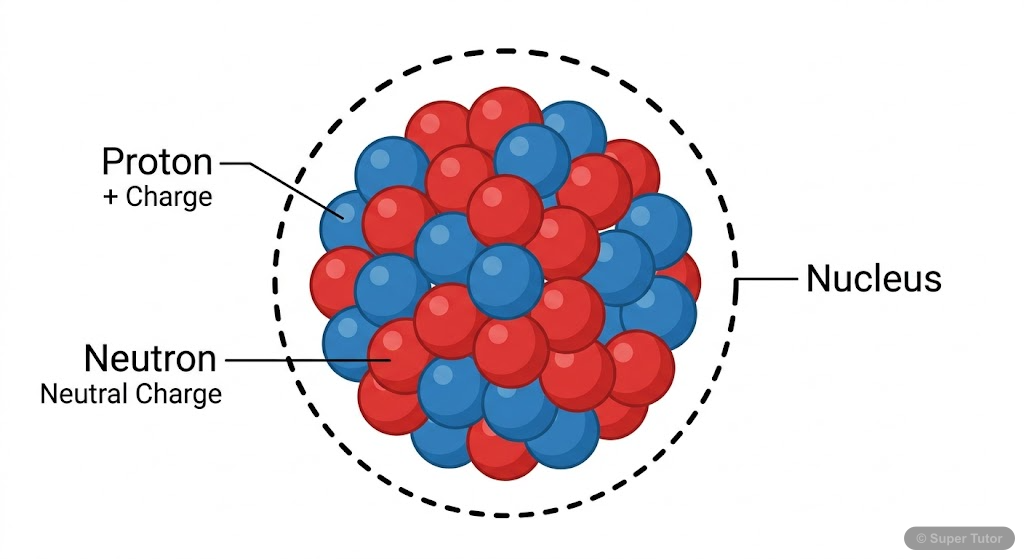
One of 7 illustrations for Nuclei and Radioactivity in Super Tutor — alongside flashcards, concept maps and practice questions.
Quick Quiz: Nuclei and Radioactivity
0/4Tap an answer to check it instantly. No sign-up needed for these 4.
The number of neutrons in the nucleus of ²³⁸₉₂U is:
Which of the following pairs represents isobars?
The radius of a nucleus is given by R = r₀A^(1/3), where r₀ = 1.2 fm. What is the approximate radius of the nucleus of ²⁷₁₃Al?
The mass defect of a nucleus is defined as:
Sample Questions
From the binding energy per nucleon (B/A) versus mass number (A) graph, which element has the highest binding energy per nucleon?
Show answer
Iron (A ≈ 56)
Step 1: The B/A vs A graph shows that binding energy per nucleon increases from lighter nuclei, reaches a maximum, and then gradually decreases for heavier nuclei. Step 2: The maximum B/A value of approximately 8.8 MeV occurs around A = 56, which corresponds to Iron (Fe). Step 3: Helium has B/A ≈ 7.1 MeV; Uranium has B/A ≈ 7.6 MeV; Hydrogen has the lowest B/A. Step 4: Iron is therefore the most stable nucleus — energy must be supplied to break it apart or to fuse it with anything. Key principle: Iron is the most tightly bound nucleus in nature.
When ²³⁸₉₂U undergoes alpha decay, the daughter nucleus formed is:
Show answer
²³⁴₉₀Th
Step 1: In alpha decay, an alpha particle (⁴₂He) is emitted from the parent nucleus. Step 2: Conservation of mass number: 238 − 4 = 234 → daughter has A = 234. Step 3: Conservation of atomic number: 92 − 2 = 90 → daughter has Z = 90, which is Thorium (Th). Step 4: So the daughter nucleus is ²³⁴₉₀Th. Step 5: Option A (Pa, Z=91) would result from beta decay. Option C has wrong A. Option D keeps same Z which is wrong for alpha decay. Key principle: In alpha decay, A decreases by 4 and Z decreases by 2.
The half-life of a radioactive substance is 10 years. Starting with 80 g of the substance, how much will remain after 30 years?
Show answer
10 g
Step 1: Number of half-lives elapsed = Total time / Half-life = 30 / 10 = 3 half-lives. Step 2: After each half-life, the amount becomes half of the previous amount. Step 3: After 1st half-life (10 yr): 80/2 = 40 g. Step 4: After 2nd half-life (20 yr): 40/2 = 20 g. Step 5: After 3rd half-life (30 yr): 20/2 = 10 g. Formula: N = N₀ × (1/2)ⁿ where n = number of half-lives = 80 × (1/2)³ = 80/8 = 10 g.
The relationship between decay constant (λ) and half-life (T₁/₂) of a radioactive substance is:
Show answer
T₁/₂ = 0.693 / λ
Step 1: From the radioactive decay law N(t) = N₀ e^(−λt), at t = T₁/₂, N = N₀/2. Step 2: Substituting: N₀/2 = N₀ e^(−λT₁/₂). Step 3: Dividing both sides by N₀: 1/2 = e^(−λT₁/₂). Step 4: Taking natural log: ln(1/2) = −λT₁/₂ → −0.693 = −λT₁/₂. Step 5: Therefore T₁/₂ = 0.693/λ. Option D (T₁/₂ = 1/λ) is the mean life (τ), not half-life. Mean life τ = 1/λ = 1.44 × T₁/₂.
+41 more questions on Nuclei and Radioactivity (NIOS Class 12 Physics)
Practise AllFrequently Asked Questions
What are the important topics in Nuclei and Radioactivity for NIOS Class 12 Physics?
How many practice questions are there for Nuclei and Radioactivity?
Sources & Official References
Content is aligned to the official syllabus. Refer to the board website for the latest curriculum.
More resources for Nuclei and Radioactivity
Important Questions
Exam-style questions with answers
Revision Notes
Key points for last-minute revision
Formula Sheet
The chapter's formulas in one place
Chapter Summary
Understand the chapter at a glance
Concept Maps
See how topics connect
Study Plan
Step-by-step plan for this chapter
Flashcards
Quick-fire cards for active recall
Syllabus
What topics to cover
For serious students
Get the full Nuclei and Radioactivity chapter — start free.
Quizzes, flashcards, an AI doubt solver and a study plan for NIOS Class 12 Physics. Free to start, no card needed.