Motion of Rigid Body — Practice Quiz
NIOS · Class 12 · Physics
Try a 4-question quiz on Motion of Rigid Body for NIOS Class 12 Physics: tap an answer to check it and see why. 45 questions in the full chapter test.
Interactive on Super Tutor
Studying Motion of Rigid Body? Get the full interactive chapter.
Quizzes, flashcards, AI doubt-solver and a step-by-step study plan — built for practice quiz and more.
Free trial, no card needed.
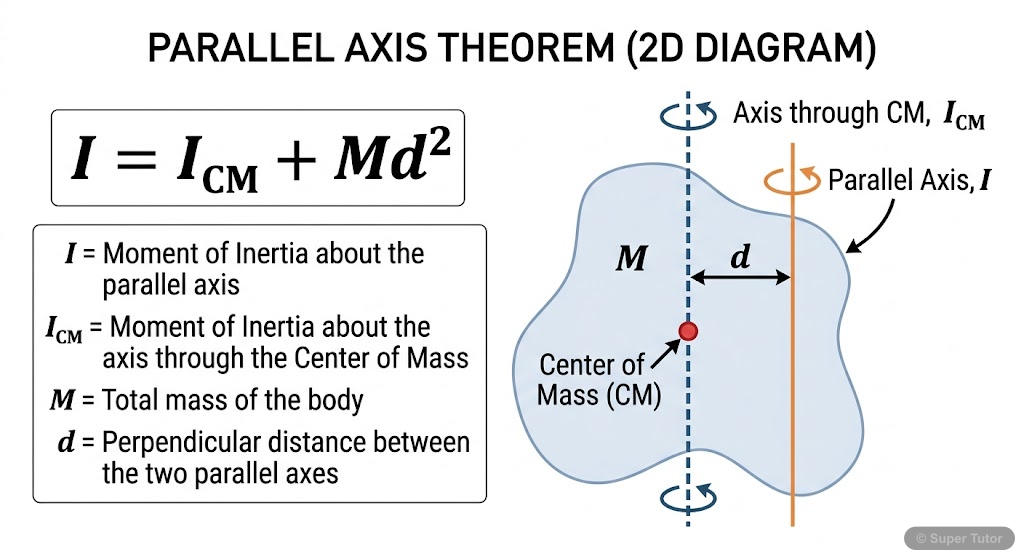
One of 8 illustrations for Motion of Rigid Body in Super Tutor — alongside flashcards, concept maps and practice questions.
Quick Quiz: Motion of Rigid Body
0/4Tap an answer to check it instantly. No sign-up needed for these 4.
Three particles of masses 1 kg, 2 kg, and 3 kg are placed at the vertices of an equilateral triangle of side 1 m. If the 1 kg mass is at the origin (0, 0), the 2 kg mass is at (1, 0) m, and the 3 kg mass is at (0.5, 0.866) m, what is the x-coordinate of the centre of mass of the system?
A uniform solid cylinder of mass M and radius R rotates about its own cylindrical axis. What is its moment of inertia?
The moment of inertia of a thin rod of mass M and length L about an axis through its centre and perpendicular to its length is ML²/12. What is its moment of inertia about a parallel axis through one end?
A force of 10 N is applied at a point 0.5 m from the axis of rotation. The angle between the force and the position vector is 30°. What is the magnitude of the torque produced?
Sample Questions
A wheel starts from rest and attains an angular velocity of 20 rad/s in 4 seconds with uniform angular acceleration. Through what total angle (in radians) does the wheel rotate during this time?
Show answer
40 rad
Step 1: Find angular acceleration: α = (ω_f − ω_i)/t = (20 − 0)/4 = 5 rad/s². Step 2: Use the rotational kinematic equation: θ = ω_i·t + (1/2)αt². Step 3: θ = 0 + (1/2)(5)(4²) = (1/2)(5)(16) = 40 rad. Alternatively, θ = (ω_i + ω_f)/2 × t = (0 + 20)/2 × 4 = 40 rad. Option (a) 80 rad uses ωt = 20×4 ignoring the uniform acceleration (treating it as constant velocity). Option (b) and (d) are arithmetic errors.
A hydrogen molecule consists of two identical atoms each of mass m separated by a distance d. The molecule rotates about an axis halfway between the two atoms. What is the moment of inertia of the molecule about this axis?
Show answer
(1/2)md²
Step 1: Each atom is at distance d/2 from the axis of rotation (since the axis is midway between them). Step 2: Apply I = Σmᵢrᵢ²: each atom contributes m(d/2)² = md²/4. Step 3: Total I = md²/4 + md²/4 = md²/2 = (1/2)md². Option (a) md² incorrectly uses d as the distance instead of d/2. Option (c) 2md² uses 2m×d². Option (d) uses only one atom's contribution.
A spinning dancer pulls her arms inward, reducing her moment of inertia from 4 kg·m² to 1 kg·m². If her initial angular velocity was 2 rad/s, what is her final angular velocity?
Show answer
8 rad/s
Step 1: No external torque acts on the dancer, so angular momentum is conserved: L_i = L_f. Step 2: I_i × ω_i = I_f × ω_f → 4 × 2 = 1 × ω_f. Step 3: ω_f = 8/1 = 8 rad/s. When moment of inertia decreases, angular velocity must increase proportionally to conserve L = Iω. Option (b) 4 rad/s forgets to account for the factor-of-4 reduction in I. Option (d) 16 rad/s results from squaring rather than using direct proportion.
A hoop of mass M and radius R rolls down an inclined plane of height h without slipping. What is its speed at the bottom? (Moment of inertia of hoop about its axis = MR²)
Show answer
√(gh)
Step 1: Energy conservation: Mgh = (1/2)Mv² + (1/2)Iω². Step 2: For pure rolling, v = Rω, so ω = v/R. For a hoop, I = MR², so (1/2)Iω² = (1/2)MR²(v/R)² = (1/2)Mv². Step 3: Mgh = (1/2)Mv² + (1/2)Mv² = Mv², so v = √(gh). Option (a) √(2gh) is for a sliding object with no rotation. Options (c) and (d) correspond to a solid cylinder and solid sphere respectively.
+41 more questions on Motion of Rigid Body (NIOS Class 12 Physics)
Practise AllFrequently Asked Questions
What are the important topics in Motion of Rigid Body for NIOS Class 12 Physics?
How many practice questions are there for Motion of Rigid Body?
Sources & Official References
Content is aligned to the official syllabus. Refer to the board website for the latest curriculum.
More resources for Motion of Rigid Body
Important Questions
Exam-style questions with answers
Revision Notes
Key points for last-minute revision
Formula Sheet
The chapter's formulas in one place
Chapter Summary
Understand the chapter at a glance
Concept Maps
See how topics connect
Study Plan
Step-by-step plan for this chapter
Flashcards
Quick-fire cards for active recall
Syllabus
What topics to cover
For serious students
Get the full Motion of Rigid Body chapter — start free.
Quizzes, flashcards, an AI doubt solver and a study plan for NIOS Class 12 Physics. Free to start, no card needed.