Optical Instruments — Chapter Summary
NIOS · Class 12 · Physics
Summary of Optical Instruments for NIOS Class 12 Physics. Part of the NIOS Class 12 Physics syllabus. Our eyes are remarkable organs, but they have.
Interactive on Super Tutor
Studying Optical Instruments? Get the full interactive chapter.
Quizzes, flashcards, AI doubt-solver and a step-by-step study plan — built for chapter summary and more.
Free trial, no card needed.
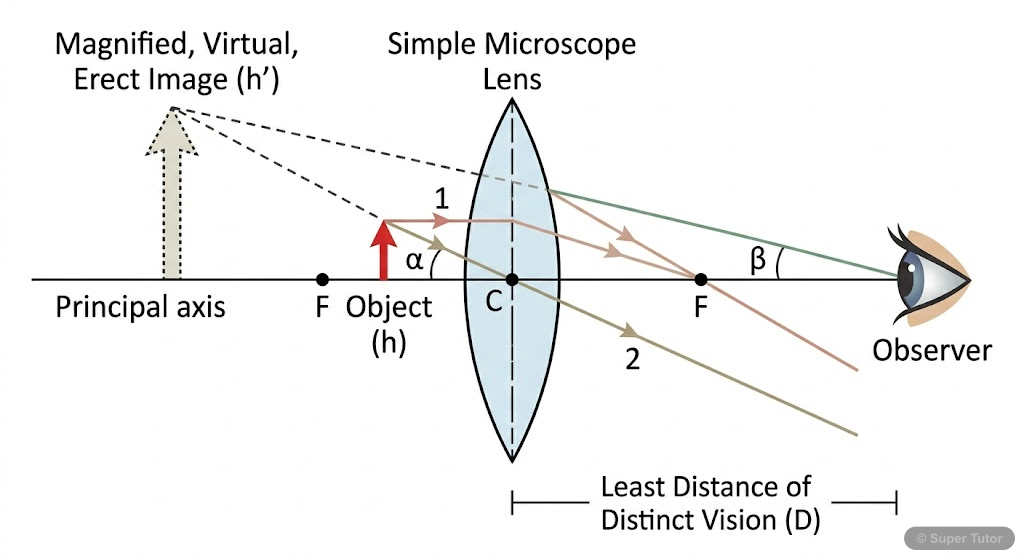
An illustration from Super Tutor's Optical Instruments chapter — alongside flashcards, concept maps and practice questions.
Overview
Our eyes are remarkable organs, but they have limitations — they cannot see objects that are too small (like bacteria) or too distant (like stars and galaxies). Optical instruments are specially designed devices that overcome these limitations by using combinations of lenses and mirrors to form magn
Key Concepts
The Near Point is the closest
The Near Point is the closest distance at which the human eye can see an object clearly. For a normal adult eye, this is taken as D = 25 cm. The Least
A simple microscope is just
A simple microscope is just a single convex lens of short focal length used to see a magnified, virtual, and erect image of a small nearby object. The
A compound microscope uses two convex
A compound microscope uses two convex lenses to achieve very high magnification (much more than a simple microscope). OBJECTIVE LENS: Short focal leng
Total Magnifying Power M = m_o
Total Magnifying Power M = m_o × m_e, where m_o = magnification by objective and m_e = magnification by eyepiece. m_o = v_o / u_o (linear magnificatio
A refracting telescope uses two convex
A refracting telescope uses two convex lenses to view distant objects like stars and planets. OBJECTIVE LENS: Large focal length (f_o), large aperture
Learning Objectives
- Explain the working principle of a simple microscope and derive an expression for its magnifying power
- Explain the working principle of a compound microscope and derive an expression for its magnifying power
- Distinguish between linear magnification and angular magnification (magnifying power)
- Explain the working principle of refracting (astronomical) telescopes and derive the magnifying power formula
- Describe the construction and advantages of a reflecting telescope
Frequently Asked Questions
What are the important topics in Optical Instruments for NIOS Class 12 Physics?
How should I revise Optical Instruments for the NIOS Class 12 board exam?
Sources & Official References
Content is aligned to the official syllabus. Refer to the board website for the latest curriculum.
More resources for Optical Instruments
Practice Quiz
Test yourself with a quick quiz
Important Questions
Exam-style questions with answers
Revision Notes
Key points for last-minute revision
Formula Sheet
The chapter's formulas in one place
Concept Maps
See how topics connect
Study Plan
Step-by-step plan for this chapter
Flashcards
Quick-fire cards for active recall
Syllabus
What topics to cover
For serious students
Get the full Optical Instruments chapter — start free.
Quizzes, flashcards, an AI doubt solver and a study plan for NIOS Class 12 Physics. Free to start, no card needed.