Laws of Motion — Practice Quiz
NIOS · Class 12 · Physics
Try a 4-question quiz on Laws of Motion for NIOS Class 12 Physics: tap an answer to check it and see why. 44 questions in the full chapter test.
Interactive on Super Tutor
Studying Laws of Motion? Get the full interactive chapter.
Quizzes, flashcards, AI doubt-solver and a step-by-step study plan — built for practice quiz and more.
Free trial, no card needed.
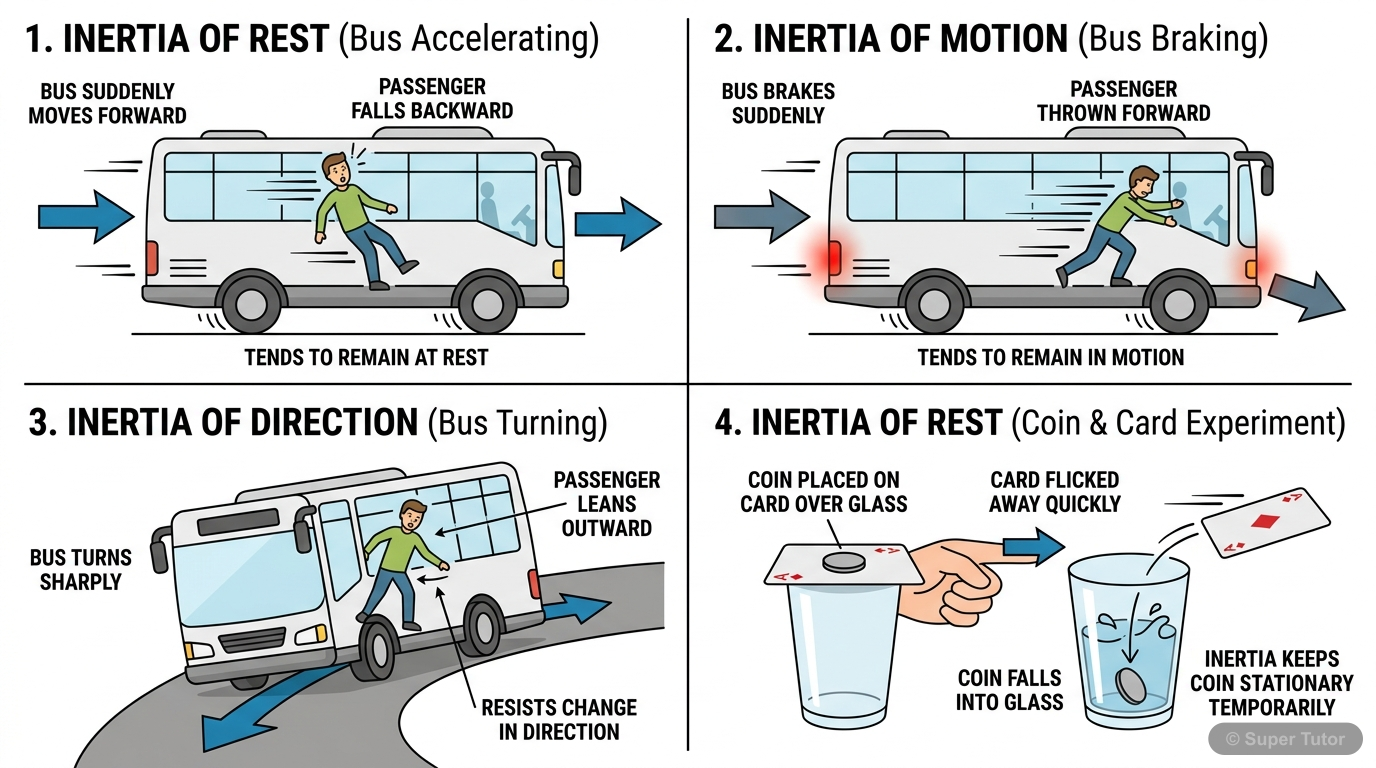
One of 8 illustrations for Laws of Motion in Super Tutor — alongside flashcards, concept maps and practice questions.
Quick Quiz: Laws of Motion
0/4Tap an answer to check it instantly. No sign-up needed for these 4.
A body of mass 5 kg is acted upon by a net force of 20 N. What is the acceleration produced in the body?
A rubber ball of mass 0.2 kg strikes a rigid wall at 10 m/s and rebounds at the same speed. What is the magnitude of change in momentum of the ball?
A gun of mass 4 kg fires a bullet of mass 0.04 kg with a velocity of 300 m/s. What is the recoil velocity of the gun?
A block of mass 5 kg is on a horizontal surface. The coefficient of static friction between the block and surface is 0.3. What is the maximum static friction force on the block? (g = 10 m/s²)
Sample Questions
Two trolleys each of mass m are moving with velocity v and collide with three identical stationary trolleys. After collision, all five trolleys move together. What is the final velocity of the system?
Show answer
2v/5
Using conservation of momentum: Initial momentum = 2m × v = 2mv. Final momentum = 5m × v' (all five trolleys move together). Setting them equal: 2mv = 5mv' → v' = 2v/5. Option A (v/2) suggests only 4 trolleys move together. Option C (2v/3) suggests only 3 total. Option D (v/5) incorrectly halves the numerator.
A 10 kg block is pulled by a horizontal force of 30 N on a surface where the coefficient of kinetic friction μ_k = 0.2. What is the acceleration of the block? (g = 10 m/s²)
Show answer
1 m/s²
Kinetic friction: f_k = μ_k × mg = 0.2 × 10 × 10 = 20 N. Net force = F_applied − f_k = 30 − 20 = 10 N. Acceleration: a = F_net/m = 10/10 = 1 m/s². Option A (3 m/s²) ignores friction entirely. Option C (2 m/s²) uses incorrect friction value. Option D (0.5 m/s²) doubles the mass in the denominator.
An object of mass 2 kg is moving at constant velocity of 5 m/s on a horizontal surface. Which statement correctly describes the situation according to Newton's First Law?
Show answer
No net external force is acting on the object.
Newton's First Law states that a body in uniform motion continues to do so unless a net external force acts on it. Constant velocity means zero acceleration, which by F = ma means net force = 0. Option A is wrong — a forward net force would accelerate the object. Option C is wrong — gravity acts but is balanced by the normal force. Option D is wrong — momentum = mv = 2 × 5 = 10 kg m/s, which is non-zero.
A force of 150 N acts on a 2 kg object initially at rest for 0.2 s. What is the change in momentum of the object?
Show answer
30 kg m/s
Change in momentum = Impulse = F × Δt = 150 N × 0.2 s = 30 kg m/s. This is a direct application of the Impulse-Momentum theorem. Option A (15 kg m/s) uses Δt = 0.1 s instead of 0.2 s. Option C (300 kg m/s) forgets to multiply by time (or uses Δt = 2 s). Option D (3 kg m/s) uses wrong arithmetic.
+40 more questions on Laws of Motion (NIOS Class 12 Physics)
Practise AllFrequently Asked Questions
What are the important topics in Laws of Motion for NIOS Class 12 Physics?
How many practice questions are there for Laws of Motion?
Sources & Official References
Content is aligned to the official syllabus. Refer to the board website for the latest curriculum.
More resources for Laws of Motion
Important Questions
Exam-style questions with answers
Revision Notes
Key points for last-minute revision
Formula Sheet
The chapter's formulas in one place
Chapter Summary
Understand the chapter at a glance
Concept Maps
See how topics connect
Study Plan
Step-by-step plan for this chapter
Flashcards
Quick-fire cards for active recall
Syllabus
What topics to cover
For serious students
Get the full Laws of Motion chapter — start free.
Quizzes, flashcards, an AI doubt solver and a study plan for NIOS Class 12 Physics. Free to start, no card needed.