Structure of Atom — Practice Quiz
NIOS · Class 12 · Physics
Try a 4-question quiz on Structure of Atom for NIOS Class 12 Physics: tap an answer to check it and see why. 43 questions in the full chapter test.
Interactive on Super Tutor
Studying Structure of Atom? Get the full interactive chapter.
Quizzes, flashcards, AI doubt-solver and a step-by-step study plan — built for practice quiz and more.
Free trial, no card needed.
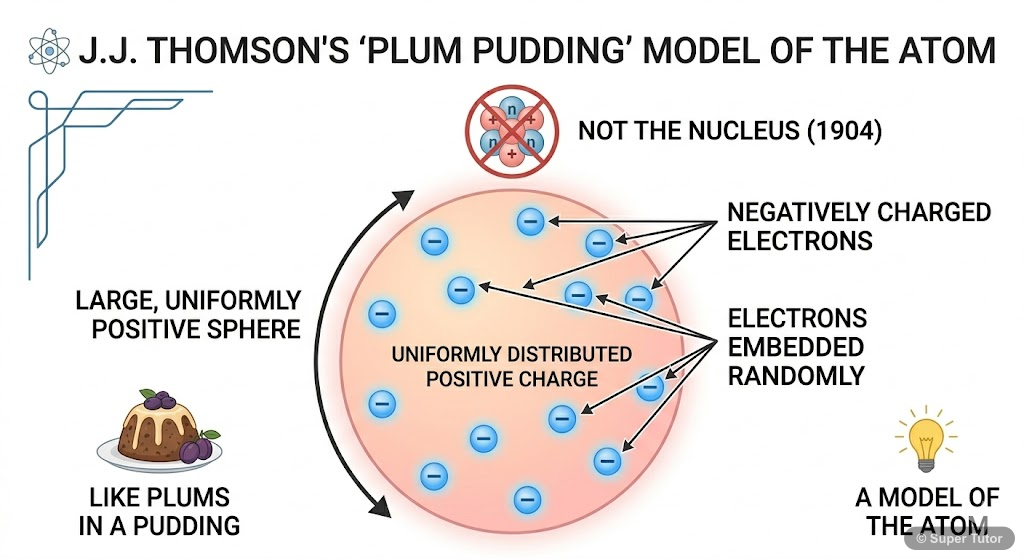
One of 6 illustrations for Structure of Atom in Super Tutor — alongside flashcards, concept maps and practice questions.
Quick Quiz: Structure of Atom
0/4Tap an answer to check it instantly. No sign-up needed for these 4.
In Rutherford's α-particle scattering experiment, approximately 1 in 8000 α-particles was deflected by 180°. What does this observation indicate?
According to Bohr's model, the radius of the nth orbit of a hydrogen atom is given by rₙ = n²a₀, where a₀ = 5.3 × 10⁻¹¹ m is the Bohr radius. What is the radius of the 3rd orbit of hydrogen?
The energy of an electron in the nth orbit of a hydrogen atom is Eₙ = –13.6/n² eV. What is the energy required to remove an electron from the second orbit (ionisation from n = 2)?
Which series of the hydrogen spectrum lies in the visible region of the electromagnetic spectrum?
Sample Questions
An electron in a hydrogen atom jumps from the 4th orbit to the 2nd orbit. Using the formula ν = (R/h)(1/m² – 1/n²), if R = 2.17 × 10⁻¹⁸ J and h = 6.62 × 10⁻³⁴ Js, the energy of the emitted photon is approximately:
Show answer
2.55 eV
Step 1: Energy of emitted photon = E₄ – E₂ (energy of higher orbit minus lower orbit). Step 2: E₄ = –13.6/16 = –0.85 eV; E₂ = –13.6/4 = –3.4 eV. Step 3: ΔE = E₄ – E₂ = –0.85 – (–3.4) = 2.55 eV. Step 4: This transition (n=4 to n=2) belongs to the Balmer series and falls in the visible region. Step 5: Common errors include subtracting in the wrong order (giving negative energy) or using n=4 to n=1 (which gives a Lyman series photon of ~12.75 eV).
Which of the following correctly states a major shortcoming of Rutherford's nuclear model of the atom?
Show answer
It predicted that revolving electrons would lose energy, spiral inward, and the atom would collapse – contradicting atomic stability.
Step 1: In Rutherford's model, electrons revolve around the nucleus in circular orbits. Step 2: A revolving electron is an accelerating charge (centripetal acceleration). Step 3: According to classical electromagnetic theory, any accelerating charge radiates energy continuously. Step 4: As electrons lose energy, their orbit radius decreases and they spiral toward the nucleus – the atom would collapse in ~10⁻⁸ seconds. Step 5: Also, as they spiral in, they would emit radiation of continuously changing frequency (continuous spectrum), contradicting the observed discrete line spectra of atoms.
According to Bohr's second postulate, the angular momentum of an electron in the nth orbit is quantised. What is the angular momentum of an electron in the 3rd orbit of hydrogen? (h = 6.62 × 10⁻³⁴ Js)
Show answer
3.16 × 10⁻³⁴ kg m² s⁻¹
Step 1: Bohr's second postulate states that angular momentum L = mvr = nh/2π. Step 2: For the 3rd orbit, n = 3. Step 3: L₃ = 3h/2π = 3 × 6.62 × 10⁻³⁴ / (2 × 3.14). Step 4: L₃ = 19.86 × 10⁻³⁴ / 6.28 = 3.16 × 10⁻³⁴ kg m² s⁻¹. Step 5: Note that h/2π ≈ 1.055 × 10⁻³⁴ J·s is called ħ (h-bar). The angular momentum is simply nħ. Option (a) equals h/2π (n=1), option (c) is just h (forgetting the 2π), and option (d) = 3h (another common error).
X-rays are produced when fast-moving electrons strike a heavy metal target. The minimum wavelength of X-rays produced (λ_min) when a voltage of 50 kV is applied is given by Duane-Hunt law: λ_min = hc/eV. What is λ_min? (h = 6.62 × 10⁻³⁴ Js, c = 3 × 10⁸ ms⁻¹, e = 1.6 × 10⁻¹⁹ C)
Show answer
2.48 × 10⁻¹¹ m
Step 1: Duane-Hunt law: eV = hc/λ_min, so λ_min = hc/eV. Step 2: V = 50 kV = 50 × 10³ V = 5 × 10⁴ V. Step 3: Numerator: hc = 6.62 × 10⁻³⁴ × 3 × 10⁸ = 19.86 × 10⁻²⁶ J·m. Step 4: Denominator: eV = 1.6 × 10⁻¹⁹ × 5 × 10⁴ = 8 × 10⁻¹⁵ J. Step 5: λ_min = 19.86 × 10⁻²⁶ / 8 × 10⁻¹⁵ = 2.48 × 10⁻¹¹ m. This corresponds to X-rays in the hard X-ray region. Doubling the voltage halves λ_min.
+39 more questions on Structure of Atom (NIOS Class 12 Physics)
Practise AllFrequently Asked Questions
What are the important topics in Structure of Atom for NIOS Class 12 Physics?
How many practice questions are there for Structure of Atom?
Sources & Official References
Content is aligned to the official syllabus. Refer to the board website for the latest curriculum.
More resources for Structure of Atom
Important Questions
Exam-style questions with answers
Revision Notes
Key points for last-minute revision
Formula Sheet
The chapter's formulas in one place
Chapter Summary
Understand the chapter at a glance
Concept Maps
See how topics connect
Study Plan
Step-by-step plan for this chapter
Flashcards
Quick-fire cards for active recall
Syllabus
What topics to cover
For serious students
Get the full Structure of Atom chapter — start free.
Quizzes, flashcards, an AI doubt solver and a study plan for NIOS Class 12 Physics. Free to start, no card needed.