Motion in a Straight Line — Practice Quiz
NIOS · Class 12 · Physics
Try a 4-question quiz on Motion in a Straight Line for NIOS Class 12 Physics: tap an answer to check it and see why. 45 questions in the full chapter test.
Interactive on Super Tutor
Studying Motion in a Straight Line? Get the full interactive chapter.
Quizzes, flashcards, AI doubt-solver and a step-by-step study plan — built for practice quiz and more.
Free trial, no card needed.
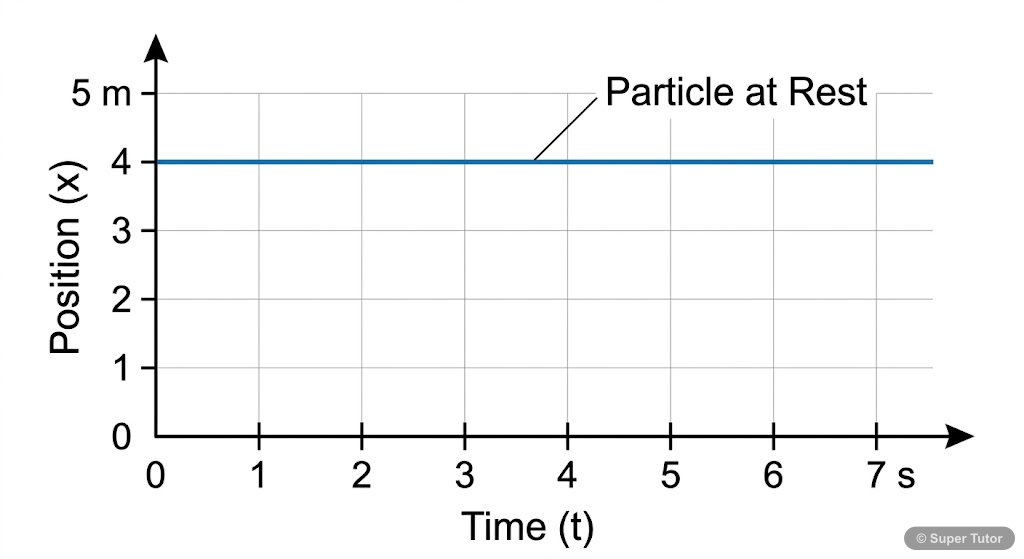
Learn better with visuals Super Tutor pairs illustrations like this with notes and quizzes for Motion in a Straight Line.
Quick Quiz: Motion in a Straight Line
0/4Tap an answer to check it instantly. No sign-up needed for these 4.
A person travels 60 m due East and then 80 m due North in a total time of 20 s. What is the magnitude of the average velocity of the person?
A car starts from rest and accelerates uniformly at 4 m s⁻². What is the velocity of the car after it has travelled a distance of 50 m?
Train A moves due North at 60 km h⁻¹ and Train B moves due South at 80 km h⁻¹. What is the magnitude of the velocity of Train B relative to Train A?
In a position-time (x-t) graph for a moving object, the slope of the graph at any point represents which physical quantity?
Sample Questions
A stone is thrown vertically upward with a velocity of 19.6 m s⁻¹. How long does it take to reach the maximum height? (g = 9.8 m s⁻²)
Show answer
2 s
Step 1: At maximum height, the final velocity v = 0 m s⁻¹. Step 2: Given: u = +19.6 m s⁻¹ (upward), a = −g = −9.8 m s⁻² (deceleration due to gravity acting downward). Step 3: Use the first equation of motion: v = u + at → 0 = 19.6 + (−9.8) × t. Step 4: 9.8t = 19.6 → t = 19.6/9.8 = 2 s. The stone decelerates at 9.8 m s⁻² and reaches zero velocity after 2 seconds. Option 4 s is incorrect as that would be the total time for the round trip (going up and coming back down).
In a velocity-time (v-t) graph, the area enclosed between the curve and the time axis represents which physical quantity?
Show answer
Displacement of the object
Step 1: In a v-t graph, the y-axis is velocity (m s⁻¹) and the x-axis is time (s). Step 2: The area of a rectangle under a horizontal portion of the graph = velocity × time = v × t = displacement (using s = vt for uniform motion). Step 3: Even for non-uniform motion, integrating v with respect to t (which is the area under the curve) gives the displacement: s = ∫v dt. Step 4: Therefore, the area under the v-t graph always gives displacement, not distance (unless the motion is always in one direction). Acceleration is given by the slope of the v-t graph, not the area.
A motorcyclist decelerates uniformly from 72 km h⁻¹ to rest in 10 s. What is the distance covered during this time?
Show answer
100 m
Step 1: Convert initial velocity: u = 72 km h⁻¹ = 72 × (1000/3600) = 20 m s⁻¹. Step 2: Final velocity v = 0 m s⁻¹, time t = 10 s. Step 3: Use s = ((u + v)/2) × t = ((20 + 0)/2) × 10 = 10 × 10 = 100 m. Alternatively, find deceleration: a = (v − u)/t = (0 − 20)/10 = −2 m s⁻², then s = ut + ½at² = 20×10 + ½×(−2)×100 = 200 − 100 = 100 m. The option 720 m is wrong as it uses 72 km h⁻¹ directly without unit conversion. The option 200 m forgets to apply deceleration.
A car moving eastward with a velocity of 15 m s⁻¹ decelerates at 3 m s⁻². After how many seconds will the car come to rest?
Show answer
5 s
Step 1: Given: u = 15 m s⁻¹ (eastward), a = −3 m s⁻² (deceleration means negative acceleration), v = 0 m s⁻¹. Step 2: Use the first equation of motion: v = u + at. Step 3: 0 = 15 + (−3) × t → 3t = 15 → t = 5 s. Step 4: The car will stop after 5 seconds. The option 3 s is wrong (it comes from incorrectly computing 15/5 = 3). The option 45 s is incorrect as it multiplies 15 × 3 instead of dividing. Always check: after 5 s, velocity = 15 − 3×5 = 0 ✓
+41 more questions on Motion in a Straight Line (NIOS Class 12 Physics)
Practise AllFrequently Asked Questions
What are the important topics in Motion in a Straight Line for NIOS Class 12 Physics?
How many practice questions are there for Motion in a Straight Line?
Sources & Official References
Content is aligned to the official syllabus. Refer to the board website for the latest curriculum.
More resources for Motion in a Straight Line
Important Questions
Exam-style questions with answers
Revision Notes
Key points for last-minute revision
Formula Sheet
The chapter's formulas in one place
Chapter Summary
Understand the chapter at a glance
Concept Maps
See how topics connect
Study Plan
Step-by-step plan for this chapter
Flashcards
Quick-fire cards for active recall
Syllabus
What topics to cover
For serious students
Get the full Motion in a Straight Line chapter — start free.
Quizzes, flashcards, an AI doubt solver and a study plan for NIOS Class 12 Physics. Free to start, no card needed.