Optical Instruments — Revision Notes
NIOS · Class 12 · Physics
Optical Instruments revision notes for NIOS Class 12 Physics: 4 topics in quick points. Part of the NIOS Class 12 Physics syllabus.
Interactive on Super Tutor
Studying Optical Instruments? Get the full interactive chapter.
Quizzes, flashcards, AI doubt-solver and a step-by-step study plan — built for revision notes and more.
Free trial, no card needed.
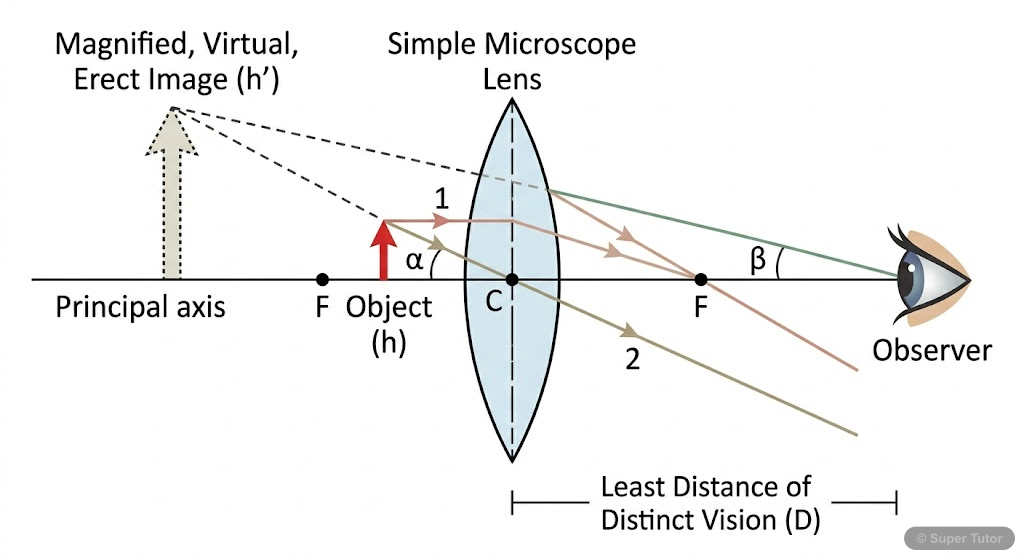
An illustration from Super Tutor's Optical Instruments chapter — alongside flashcards, concept maps and practice questions.
Key Topics to Revise
Key Definitions and Basic Concepts
- Near Point: The closest distance at which the eye can see an object clearly. For a normal human eye, it is approximately 25 cm. This distance varies with age — children can have a near point as close
- Least Distance of Distinct Vision (D): The minimum distance (25 cm for a normal eye) at which the eye sees an object clearly without any strain. Represented by D = 25 cm.
- Far Point: The farthest point up to which the eye can see clearly without strain. For a normal eye, this is at infinity.
Simple Microscope (Magnifying Glass)
- A simple microscope is a single convex lens of short focal length used to see magnified images of small nearby objects.
- The object is placed between F (focus) and O (optical centre) of the convex lens. The image formed is virtual, erect, and magnified on the same side as the object.
- The eye is placed close to the lens and the object distance is adjusted until the image appears at the least distance of distinct vision (D = 25 cm).
Compound Microscope
- A compound microscope uses two convex lenses — the Objective (faces the object, short focal length, small aperture) and the Eyepiece (faces the eye, short focal length, larger aperture).
- The objective has a SHORTER focal length than the eyepiece. Both lenses have short focal lengths.
- Working: Object AB is placed just beyond 2F of the objective. The objective forms a real, inverted, magnified intermediate image A'B' beyond 2F on the other side.
Refracting Telescope (Astronomical Telescope)
- A refracting telescope uses two convex lenses — the Objective (large focal length, large aperture) and the Eyepiece (short focal length, small aperture).
- Unlike microscope, the telescope objective has a LARGE focal length. This is the key difference.
- Working: Parallel rays from a distant object fall on the objective and form a real, inverted, diminished image at its focal plane (since object is at infinity).
Get complete notes with diagrams and examples
Full NotesKey Concepts
Frequently Asked Questions
What are the important topics in Optical Instruments for NIOS Class 12 Physics?
How should I revise Optical Instruments for the NIOS Class 12 board exam?
Sources & Official References
Content is aligned to the official syllabus. Refer to the board website for the latest curriculum.
More resources for Optical Instruments
Practice Quiz
Test yourself with a quick quiz
Important Questions
Exam-style questions with answers
Formula Sheet
The chapter's formulas in one place
Chapter Summary
Understand the chapter at a glance
Concept Maps
See how topics connect
Study Plan
Step-by-step plan for this chapter
Flashcards
Quick-fire cards for active recall
Syllabus
What topics to cover
For serious students
Get the full Optical Instruments chapter — start free.
Quizzes, flashcards, an AI doubt solver and a study plan for NIOS Class 12 Physics. Free to start, no card needed.