Units, Dimensions and Vectors — Practice Quiz
NIOS · Class 12 · Physics
Try a 4-question quiz on Units, Dimensions and Vectors for NIOS Class 12 Physics: tap an answer to check it and see why.
Interactive on Super Tutor
Studying Units, Dimensions and Vectors? Get the full interactive chapter.
Quizzes, flashcards, AI doubt-solver and a step-by-step study plan — built for practice quiz and more.
Free trial, no card needed.
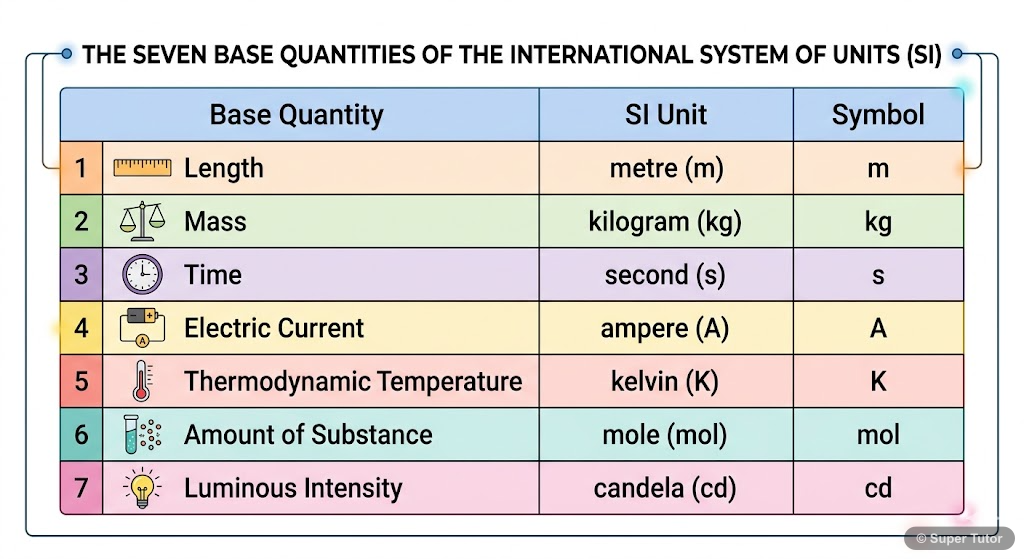
Learn better with visuals Super Tutor pairs illustrations like this with notes and quizzes for Units, Dimensions and Vectors.
Quick Quiz: Units, Dimensions and Vectors
0/4Tap an answer to check it instantly. No sign-up needed for these 4.
The time period T of a simple pendulum is assumed to depend on its length l, mass m of the bob, and acceleration due to gravity g. Using dimensional analysis, which of the following correctly represents the dependence of T?
Newton's law of gravitation gives F = G·m₁·m₂/r². What are the dimensions of the universal gravitational constant G?
A rectangle has length = 3.003 m and width = 2.26 m. What is its area reported to the correct number of significant figures?
Two forces of magnitudes 70 N and 50 N act at an angle of 135° to each other. What is the magnitude of their resultant (to the nearest 0.1 N)?
Sample Questions
A vector A = 4î + 5ĵ and vector D = 6î − 4ĵ. What is the value of A·D (dot product)?
Show answer
4
Step 1: Use the formula A·D = Ax·Dx + Ay·Dy. Step 2: Ax = 4, Ay = 5; Dx = 6, Dy = −4. Step 3: A·D = (4)(6) + (5)(−4) = 24 + (−20). Step 4: A·D = 24 − 20 = 4. Why others are wrong: 44 results from adding instead of algebraically combining (24 + 20 = 44 ignoring the negative sign); 24 considers only the î components; −20 considers only the ĵ components.
Vectors C = 4î + 5ĵ and D = 6î − 4ĵ. What is the magnitude and direction of C × D?
Show answer
46 units in the −z direction (−46k̂)
Step 1: Expand C × D = (4î + 5ĵ) × (6î − 4ĵ). Step 2: = 4(6)(î×î) + 4(−4)(î×ĵ) + 5(6)(ĵ×î) + 5(−4)(ĵ×ĵ). Step 3: Use: î×î = 0, î×ĵ = k̂, ĵ×î = −k̂, ĵ×ĵ = 0. Result = 0 + (−16)k̂ + (30)(−k̂) + 0 = −16k̂ − 30k̂ = −46k̂. Step 4: Magnitude = 46 units, direction = −z direction. Why others are wrong: +46k̂ reverses the sign (confusing ĵ×î with î×ĵ); −4k̂ is the dot product result mistakenly used; −56k̂ results from arithmetic errors.
An equation claims: Energy E = (1/2)mv² + mgh. Check which of the following statements is CORRECT regarding dimensional consistency of both terms.
Show answer
Both terms have dimensions ML²T⁻², so the equation is dimensionally consistent
Step 1: Find dimensions of (1/2)mv²: [m] = M, [v²] = (LT⁻¹)² = L²T⁻². So [mv²] = ML²T⁻². Step 2: Find dimensions of mgh: [m] = M, [g] = LT⁻², [h] = L. So [mgh] = M·LT⁻²·L = ML²T⁻². Step 3: Both terms have the same dimensions ML²T⁻² — this is also the dimension of energy (Work = Force × distance = MLT⁻² × L = ML²T⁻²). Step 4: The equation is dimensionally consistent. Why others are wrong: Options B and C contain arithmetic errors in working out dimensions of mgh; Option D incorrectly states dimensions as MLT⁻² (which is force, not energy).
A vector of magnitude 50 units makes an angle of 60° with the x-axis. What are its x and y components respectively?
Show answer
25 units and 43.3 units
Step 1: For a vector of magnitude A making angle θ with x-axis: Ax = A·cosθ, Ay = A·sinθ. Step 2: Ax = 50 × cos60° = 50 × 0.5 = 25 units. Step 3: Ay = 50 × sin60° = 50 × (√3/2) = 50 × 0.866 = 43.3 units. Step 4: x-component = 25 units, y-component = 43.3 units. Why others are wrong: 43.3 and 25 reverses the roles of sin and cos (angle measured from x-axis uses cos for x); 35.4 and 35.4 corresponds to 45° not 60°; 50 and 50 ignores trigonometry entirely.
+40 more questions on Units, Dimensions and Vectors (NIOS Class 12 Physics)
Practise AllFrequently Asked Questions
What are the important topics in Units, Dimensions and Vectors for NIOS Class 12 Physics?
How many practice questions are there for Units, Dimensions and Vectors?
Sources & Official References
Content is aligned to the official syllabus. Refer to the board website for the latest curriculum.
More resources for Units, Dimensions and Vectors
Important Questions
Exam-style questions with answers
Revision Notes
Key points for last-minute revision
Formula Sheet
The chapter's formulas in one place
Chapter Summary
Understand the chapter at a glance
Concept Maps
See how topics connect
Study Plan
Step-by-step plan for this chapter
Flashcards
Quick-fire cards for active recall
Syllabus
What topics to cover
For serious students
Get the full Units, Dimensions and Vectors chapter — start free.
Quizzes, flashcards, an AI doubt solver and a study plan for NIOS Class 12 Physics. Free to start, no card needed.