Reflection and Refraction of Light — Syllabus
NIOS · Class 12 · Physics
What Reflection and Refraction of Light covers in NIOS Class 12 Physics: 4 topics, for the 2026-27 session. Part of the NIOS Class 12 Physics syllabus.
Interactive on Super Tutor
Studying Reflection and Refraction of Light? Get the full interactive chapter.
Quizzes, flashcards, AI doubt-solver and a step-by-step study plan — built for syllabus and more.
Free trial, no card needed.
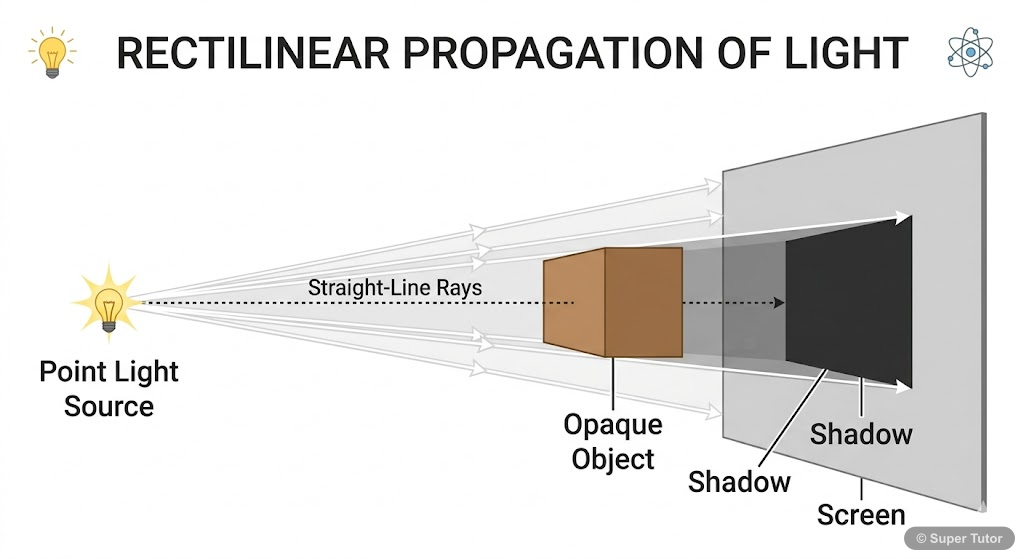
Learn better with visuals Super Tutor pairs illustrations like this with notes and quizzes for Reflection and Refraction of Light.
Topics in Reflection and Refraction of Light
Reflection of Light – Laws and Spherical Mirrors
- Law 1: The incident ray, reflected ray, and the normal at the point of incidence are all in the same plane.
- Law 2: Angle of incidence (∠i) = Angle of reflection (∠r). This holds for both plane and spherical mirrors.
- A spherical mirror is a part of a hollow sphere. If the inner (concave) surface is polished, it is a concave mirror. If the outer (convex) surface is polished, it is a convex mirror.
Refraction of Light – Snell's Law and Refractive Index
- Refraction is the bending of light when it travels from one medium to another due to a change in its speed.
- When light travels from a rarer medium (like air) to a denser medium (like glass), it bends TOWARDS the normal. When it travels from denser to rarer, it bends AWAY from the normal.
- Snell's Law (Law of Refraction): sin i / sin r = μ₁₂, a constant for a given pair of media and a given colour of light.
Total Internal Reflection (TIR) and Its Applications
- Total Internal Reflection (TIR) occurs when light travelling from a denser medium to a rarer medium is incident at an angle GREATER than the critical angle.
- Two essential conditions for TIR: (1) Light must travel from an optically denser medium to a rarer medium. (2) The angle of incidence must be greater than the critical angle (iₐ).
- Critical angle (iₐ): The angle of incidence in the denser medium for which the angle of refraction in the rarer medium is exactly 90°.
Refraction at a Spherical Surface
- When light passes from one medium (refractive index μ₁) to another (refractive index μ₂) through a curved (spherical) interface, the image position can be found using a derived formula.
- Sign convention is the same as for mirrors: distances measured from the pole P in the direction of incident light are positive; opposite direction is negative.
- The derivation uses the fact that for small apertures (paraxial approximation), sin i ≈ i and sin r ≈ r.
Key Concepts
Central concept: Reflection and Refraction of Light
Work through every topic in Reflection and Refraction of Light with notes and quizzes
Start This ChapterFrequently Asked Questions
What are the important topics in Reflection and Refraction of Light for NIOS Class 12 Physics?
How should I revise Reflection and Refraction of Light for the NIOS Class 12 board exam?
Sources & Official References
Content is aligned to the official syllabus. Refer to the board website for the latest curriculum.
More resources for Reflection and Refraction of Light
Practice Quiz
Test yourself with a quick quiz
Important Questions
Exam-style questions with answers
Revision Notes
Key points for last-minute revision
Formula Sheet
The chapter's formulas in one place
Chapter Summary
Understand the chapter at a glance
Concept Maps
See how topics connect
Study Plan
Step-by-step plan for this chapter
Flashcards
Quick-fire cards for active recall
For serious students
Get the full Reflection and Refraction of Light chapter — start free.
Quizzes, flashcards, an AI doubt solver and a study plan for NIOS Class 12 Physics. Free to start, no card needed.