Structure of Atom — Syllabus
NIOS · Class 12 · Physics
What Structure of Atom covers in NIOS Class 12 Physics: 4 topics, for the 2026-27 session. Part of the NIOS Class 12 Physics syllabus.
Interactive on Super Tutor
Studying Structure of Atom? Get the full interactive chapter.
Quizzes, flashcards, AI doubt-solver and a step-by-step study plan — built for syllabus and more.
Free trial, no card needed.
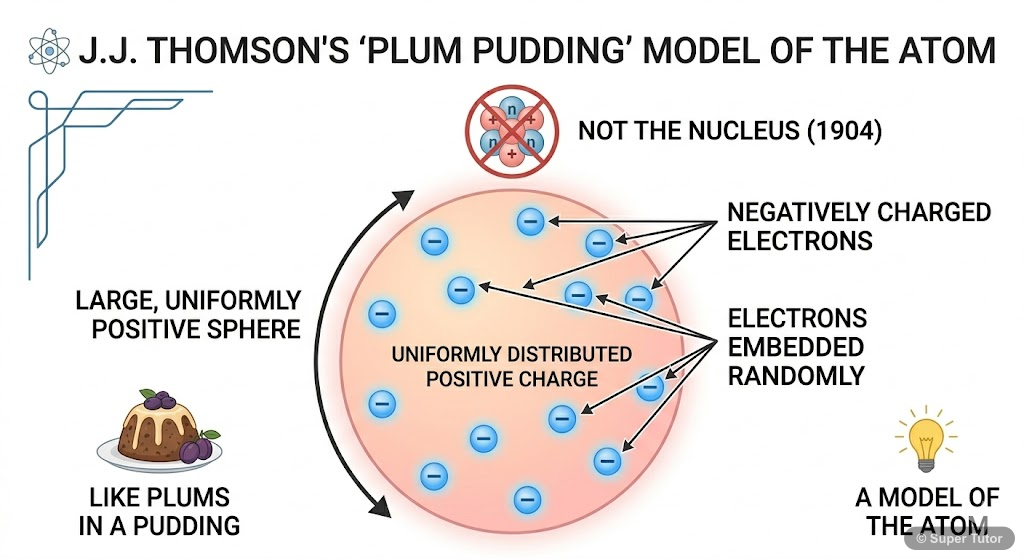
One of 6 illustrations for Structure of Atom in Super Tutor — alongside flashcards, concept maps and practice questions.
Topics in Structure of Atom
Historical Development of Atomic Models
- John Dalton (1808) proposed atoms as the smallest, indivisible particles — the building blocks of matter.
- J.J. Thomson (1897) discovered the electron while studying cathode rays. Since atoms are neutral, he proposed the 'Plum Pudding Model': a positively charged sphere with electrons embedded in it like r
- Thomson's model could NOT explain large-angle scattering of alpha particles.
Rutherford's Alpha Particle Scattering Experiment
- Geiger and Marsden (on Rutherford's advice) bombarded a thin gold foil (~100 nm thick) with alpha particles from a radioactive source.
- Alpha particles (α-particles) are doubly ionised helium atoms (He²⁺), positively charged, with mass about 4 amu.
- The detector was a ZnS (zinc sulphide) fluorescent screen that produced a flash of light when struck by an alpha particle.
Rutherford's Nuclear Model and Its Limitations
- Rutherford proposed the Nuclear Model of Atom based on the scattering experiment results.
- POSTULATES of Rutherford's model: (1) The entire positive charge and almost all the mass of the atom is concentrated in a tiny central region called the nucleus. (2) Electrons revolve around the nucle
- LIMITATION 1 — Instability of Atom: A revolving electron is an accelerating charge (centripetal acceleration). According to classical electromagnetic theory, an accelerating charge continuously emits
Bohr's Model of Hydrogen Atom
- In 1913, Niels Bohr proposed a modified model by combining classical physics with quantum ideas (from Planck's quantum theory).
- Bohr's model successfully explained the stability of the atom AND the line spectrum of hydrogen.
- BOHR'S FOUR POSTULATES:
Key Concepts
Central concept: Structure of Atom
Work through every topic in Structure of Atom with notes and quizzes
Start This ChapterFrequently Asked Questions
What are the important topics in Structure of Atom for NIOS Class 12 Physics?
How should I revise Structure of Atom for the NIOS Class 12 board exam?
Sources & Official References
Content is aligned to the official syllabus. Refer to the board website for the latest curriculum.
More resources for Structure of Atom
Practice Quiz
Test yourself with a quick quiz
Important Questions
Exam-style questions with answers
Revision Notes
Key points for last-minute revision
Formula Sheet
The chapter's formulas in one place
Chapter Summary
Understand the chapter at a glance
Concept Maps
See how topics connect
Study Plan
Step-by-step plan for this chapter
Flashcards
Quick-fire cards for active recall
For serious students
Get the full Structure of Atom chapter — start free.
Quizzes, flashcards, an AI doubt solver and a study plan for NIOS Class 12 Physics. Free to start, no card needed.