Units, Dimensions and Vectors — Syllabus
NIOS · Class 12 · Physics
What Units, Dimensions and Vectors covers in NIOS Class 12 Physics: 4 topics, for the 2026-27 session. Part of the NIOS Class 12 Physics syllabus.
Interactive on Super Tutor
Studying Units, Dimensions and Vectors? Get the full interactive chapter.
Quizzes, flashcards, AI doubt-solver and a step-by-step study plan — built for syllabus and more.
Free trial, no card needed.
Learn better with visuals Super Tutor pairs illustrations like this with notes and quizzes for Units, Dimensions and Vectors.
Topics in Units, Dimensions and Vectors
Physical World and Measurements
- Physics is the most fundamental science — it covers mechanics, heat, optics, electricity, magnetism, nuclear physics, and electronics.
- Physics ranges from the study of sub-atomic particles (size ~10⁻¹⁵ m) to the entire universe (size ~10²⁶ m).
- Every natural phenomenon requires measurement of physical quantities for complete study.
SI Units and Standards of Measurement
- The SI system (Système International d'Unités) was adopted at the 14th General Conference on Weights and Measures in 1971.
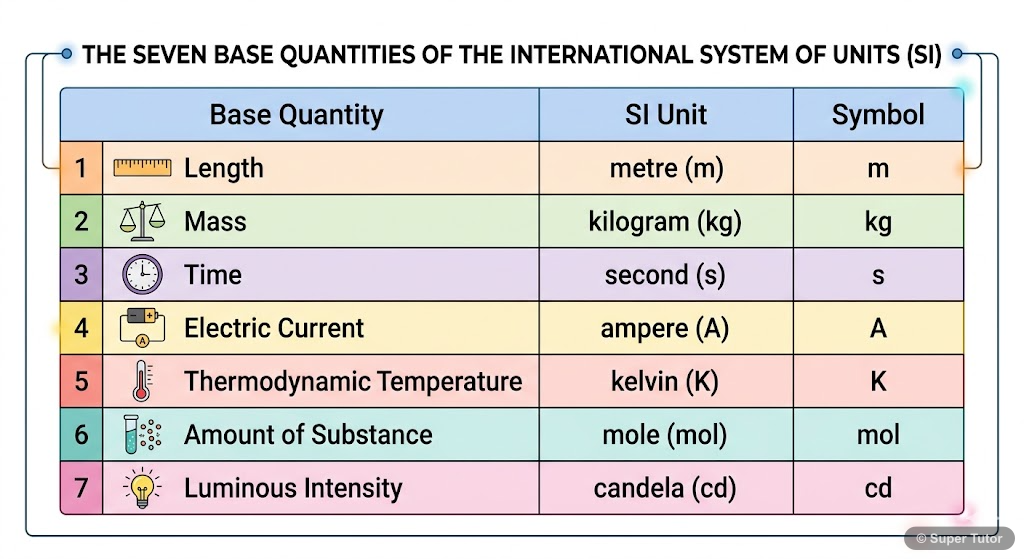
- There are 7 base SI units: metre (m), kilogram (kg), second (s), ampere (A), kelvin (K), candela (cd), mole (mol).
- The SI system is a metric (decimal) system — larger and smaller units are multiples or submultiples of 10.
Significant Figures
- Significant figures are the digits in a measurement that are known with certainty plus the first uncertain digit.
- More significant figures = more accurate measurement = less percentage error.
- Rule 1: All non-zero digits are significant. (Example: 315.58 → 5 sig figs)
Dimensions of Physical Quantities
- Dimensions express a physical quantity in terms of fundamental quantities: Mass (M), Length (L), Time (T), Electric Current (I), Temperature (θ).
- In mechanics, all quantities can be expressed using just M, L, T.
- Volume: [L³], Density: [ML⁻³], Speed/Velocity: [LT⁻¹], Acceleration: [LT⁻²], Force: [MLT⁻²]
Key Concepts
Central concept: Units, Dimensions and Vectors
Work through every topic in Units, Dimensions and Vectors with notes and quizzes
Start This ChapterFrequently Asked Questions
What are the important topics in Units, Dimensions and Vectors for NIOS Class 12 Physics?
How should I revise Units, Dimensions and Vectors for the NIOS Class 12 board exam?
Sources & Official References
Content is aligned to the official syllabus. Refer to the board website for the latest curriculum.
More resources for Units, Dimensions and Vectors
Practice Quiz
Test yourself with a quick quiz
Important Questions
Exam-style questions with answers
Revision Notes
Key points for last-minute revision
Formula Sheet
The chapter's formulas in one place
Chapter Summary
Understand the chapter at a glance
Concept Maps
See how topics connect
Study Plan
Step-by-step plan for this chapter
Flashcards
Quick-fire cards for active recall
For serious students
Get the full Units, Dimensions and Vectors chapter — start free.
Quizzes, flashcards, an AI doubt solver and a study plan for NIOS Class 12 Physics. Free to start, no card needed.