Laws of Motion — Syllabus
NIOS · Class 12 · Physics
What Laws of Motion covers in NIOS Class 12 Physics: 4 topics, for the 2026-27 session. Part of the NIOS Class 12 Physics syllabus.
Interactive on Super Tutor
Studying Laws of Motion? Get the full interactive chapter.
Quizzes, flashcards, AI doubt-solver and a step-by-step study plan — built for syllabus and more.
Free trial, no card needed.
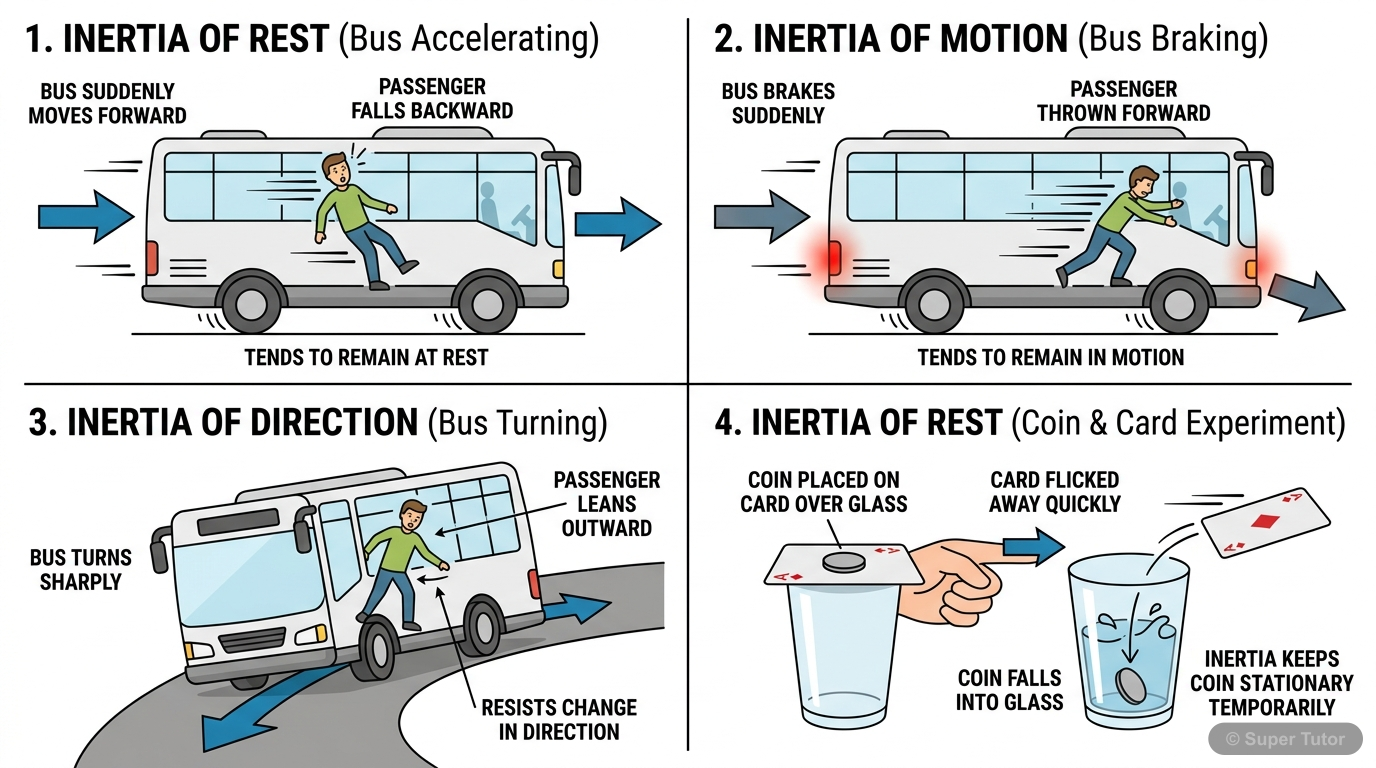
One of 8 illustrations for Laws of Motion in Super Tutor — alongside flashcards, concept maps and practice questions.
Topics in Laws of Motion
1. Concept of Inertia and Force
- Inertia is the natural tendency of a body to resist any change in its state of rest or uniform motion in a straight line.
- Mass is the measure of inertia – a heavier body has more inertia and is harder to accelerate or decelerate.
- Force is a vector quantity that can change the shape, size, speed, or direction of motion of a body.
2. Newton's First Law of Motion
- Statement: A body continues to remain in its state of rest or of uniform motion in a straight line unless acted upon by a net external (unbalanced) force.
- This law is also called the Law of Inertia.
- It defines force qualitatively – force is that which changes the state of motion.
3. Linear Momentum and Newton's Second Law
- Linear Momentum (p) = mass × velocity. It is a vector quantity with direction same as velocity.
- SI unit of momentum: kg m/s or N·s
- Newton's Second Law: The rate of change of momentum of a body is directly proportional to the net external force acting on it, and the change occurs in the direction of the force.
4. Newton's Third Law and Conservation of Momentum
- Newton's Third Law: When two bodies interact, force exerted by body A on body B is equal in magnitude and opposite in direction to force exerted by B on A. F₁₂ = -F₂₁
- Action and reaction forces are ALWAYS equal in magnitude, opposite in direction, and act on DIFFERENT bodies – they never cancel each other.
- Common examples: (a) Rocket propulsion – gases pushed back, rocket moves forward. (b) Swimming – hand pushes water back, body moves forward. (c) Recoil of gun – bullet moves forward, gun kicks back. (
Key Concepts
Central concept: Laws of Motion
Work through every topic in Laws of Motion with notes and quizzes
Start This ChapterFrequently Asked Questions
What are the important topics in Laws of Motion for NIOS Class 12 Physics?
How should I revise Laws of Motion for the NIOS Class 12 board exam?
Sources & Official References
Content is aligned to the official syllabus. Refer to the board website for the latest curriculum.
More resources for Laws of Motion
Practice Quiz
Test yourself with a quick quiz
Important Questions
Exam-style questions with answers
Revision Notes
Key points for last-minute revision
Formula Sheet
The chapter's formulas in one place
Chapter Summary
Understand the chapter at a glance
Concept Maps
See how topics connect
Study Plan
Step-by-step plan for this chapter
Flashcards
Quick-fire cards for active recall
For serious students
Get the full Laws of Motion chapter — start free.
Quizzes, flashcards, an AI doubt solver and a study plan for NIOS Class 12 Physics. Free to start, no card needed.