Motion of Rigid Body — Syllabus
NIOS · Class 12 · Physics
What Motion of Rigid Body covers in NIOS Class 12 Physics: 4 topics, for the 2026-27 session. Part of the NIOS Class 12 Physics syllabus.
Interactive on Super Tutor
Studying Motion of Rigid Body? Get the full interactive chapter.
Quizzes, flashcards, AI doubt-solver and a step-by-step study plan — built for syllabus and more.
Free trial, no card needed.
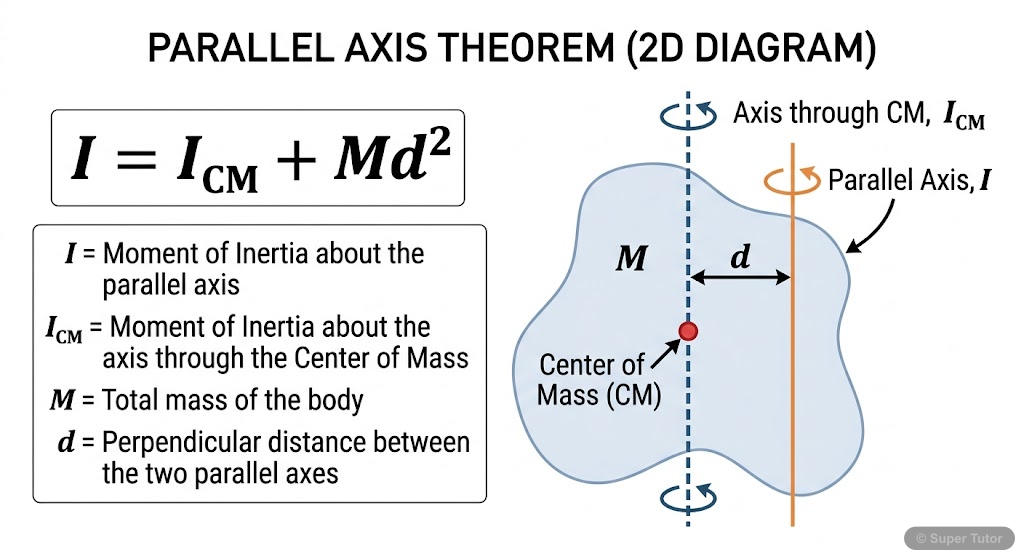
One of 8 illustrations for Motion of Rigid Body in Super Tutor — alongside flashcards, concept maps and practice questions.
Topics in Motion of Rigid Body
1. Rigid Body – Definition and Concept
- A rigid body is a system of particles where the separation between any two particles does NOT change during motion.
- Shape and size of a rigid body remain preserved during its motion.
- In reality, no perfectly rigid body exists — it is an idealisation. Solid objects like cricket balls, steel discs, and wooden blocks are good approximations.
2. Centre of Mass (CM)
- Centre of Mass (CM) is a mathematical point where the entire mass of the body can be assumed to be concentrated for the purpose of studying translational motion.
- The CM may lie outside the physical body — for example, the CM of a ring lies at its geometric centre, which is empty space.
- For a two-particle system with masses m₁ and m₂ at positions z₁ and z₂: z_cm = (m₁z₁ + m₂z₂)/(m₁ + m₂)
3. Translational vs Rotational Motion
- TRANSLATIONAL MOTION: All particles of the body move along parallel paths with equal displacements. The motion of a wooden block pushed across a floor is purely translational.
- ROTATIONAL MOTION: All particles describe concentric circular paths about a fixed axis. Example: a grinding stone rotating about its central axis.
- ROLLING MOTION: Combination of both translational and rotational motions. Example: a cylinder rolling on the floor.
4. Moment of Inertia
- Moment of Inertia (I) is the rotational analogue of mass. It measures the resistance of a body to changes in its rotational motion.
- Definition: I = Σmᵢrᵢ², where rᵢ is the perpendicular distance of the iᵗʰ particle from the axis of rotation.
- SI Unit of Moment of Inertia: kg·m²
Key Concepts
Central concept: Motion of Rigid Body
Work through every topic in Motion of Rigid Body with notes and quizzes
Start This ChapterFrequently Asked Questions
What are the important topics in Motion of Rigid Body for NIOS Class 12 Physics?
How should I revise Motion of Rigid Body for the NIOS Class 12 board exam?
Sources & Official References
Content is aligned to the official syllabus. Refer to the board website for the latest curriculum.
More resources for Motion of Rigid Body
Practice Quiz
Test yourself with a quick quiz
Important Questions
Exam-style questions with answers
Revision Notes
Key points for last-minute revision
Formula Sheet
The chapter's formulas in one place
Chapter Summary
Understand the chapter at a glance
Concept Maps
See how topics connect
Study Plan
Step-by-step plan for this chapter
Flashcards
Quick-fire cards for active recall
For serious students
Get the full Motion of Rigid Body chapter — start free.
Quizzes, flashcards, an AI doubt solver and a study plan for NIOS Class 12 Physics. Free to start, no card needed.