Thermodynamics — Syllabus
NIOS · Class 12 · Physics
What Thermodynamics covers in NIOS Class 12 Physics: 4 topics, for the 2026-27 session. Part of the NIOS Class 12 Physics syllabus.
Interactive on Super Tutor
Studying Thermodynamics? Get the full interactive chapter.
Quizzes, flashcards, AI doubt-solver and a step-by-step study plan — built for syllabus and more.
Free trial, no card needed.
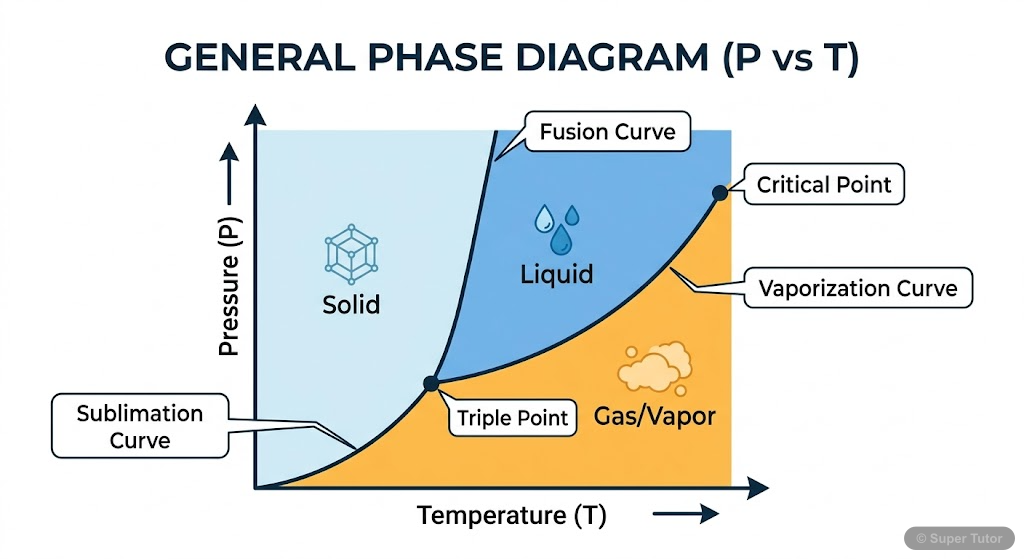
One of 7 illustrations for Thermodynamics in Super Tutor — alongside flashcards, concept maps and practice questions.
Topics in Thermodynamics
Basic Concepts: Heat, Temperature, and Thermodynamic Systems
- Heat is a form of energy that flows from a body at higher temperature to a body at lower temperature due to a temperature difference. It is NOT the same as internal energy.
- Temperature is the property that determines whether two bodies are in thermal equilibrium. Two bodies in thermal equilibrium have the same temperature.
- Unit of heat: 1 calorie = 4.18 Joules; 1 kcal = 1000 cal = 4180 J.
Thermodynamic Processes
- Isothermal Process: Temperature is constant (ΔT = 0). Occurs in perfectly conducting cylinders. ΔQ, ΔU, and ΔW are all finite. For an ideal gas, ΔU = 0, so ΔQ = ΔW.
- Adiabatic Process: No heat exchange (ΔQ = 0). Occurs in perfectly insulating cylinders. From First Law: ΔU = −ΔW. If gas is compressed, work is done ON the gas, ΔU increases (gas heats up). If gas exp
- Isobaric Process: Pressure is constant (ΔP = 0). Example: Heating water under atmospheric pressure. Work done W = PΔV is non-zero.
Zeroth Law of Thermodynamics and Triple Point
- Zeroth Law of Thermodynamics: If two bodies A and B are separately in thermal equilibrium with a third body C, then A and B are also in thermal equilibrium with each other.
- The Zeroth Law introduces the concept of TEMPERATURE as a fundamental property. It is the scientific basis for thermometers.
- Practical significance: A thermometer (body C) reads the same temperature when placed in contact with different bodies (A and B) that are in mutual thermal equilibrium.
Internal Energy and First Law of Thermodynamics
- Internal Energy (U) is the sum of kinetic energy (random molecular motion) and potential energy (intermolecular forces) of all molecules in the system.
- Internal energy is a STATE function — it depends only on the state (P, V, T) of the system, NOT on the path by which the state was reached.
- Internal energy can be increased by: (1) Adding heat to the system, or (2) Doing work ON the system.
Key Concepts
Central concept: Thermodynamics
Work through every topic in Thermodynamics with notes and quizzes
Start This ChapterFrequently Asked Questions
What are the important topics in Thermodynamics for NIOS Class 12 Physics?
How should I revise Thermodynamics for the NIOS Class 12 board exam?
Sources & Official References
Content is aligned to the official syllabus. Refer to the board website for the latest curriculum.
More resources for Thermodynamics
Practice Quiz
Test yourself with a quick quiz
Important Questions
Exam-style questions with answers
Revision Notes
Key points for last-minute revision
Formula Sheet
The chapter's formulas in one place
Chapter Summary
Understand the chapter at a glance
Concept Maps
See how topics connect
Study Plan
Step-by-step plan for this chapter
Flashcards
Quick-fire cards for active recall
For serious students
Get the full Thermodynamics chapter — start free.
Quizzes, flashcards, an AI doubt solver and a study plan for NIOS Class 12 Physics. Free to start, no card needed.