Gravitation — Syllabus
NIOS · Class 12 · Physics
What Gravitation covers in NIOS Class 12 Physics: 4 topics, for the 2026-27 session. Part of the NIOS Class 12 Physics syllabus.
Interactive on Super Tutor
Studying Gravitation? Get the full interactive chapter.
Quizzes, flashcards, AI doubt-solver and a step-by-step study plan — built for syllabus and more.
Free trial, no card needed.
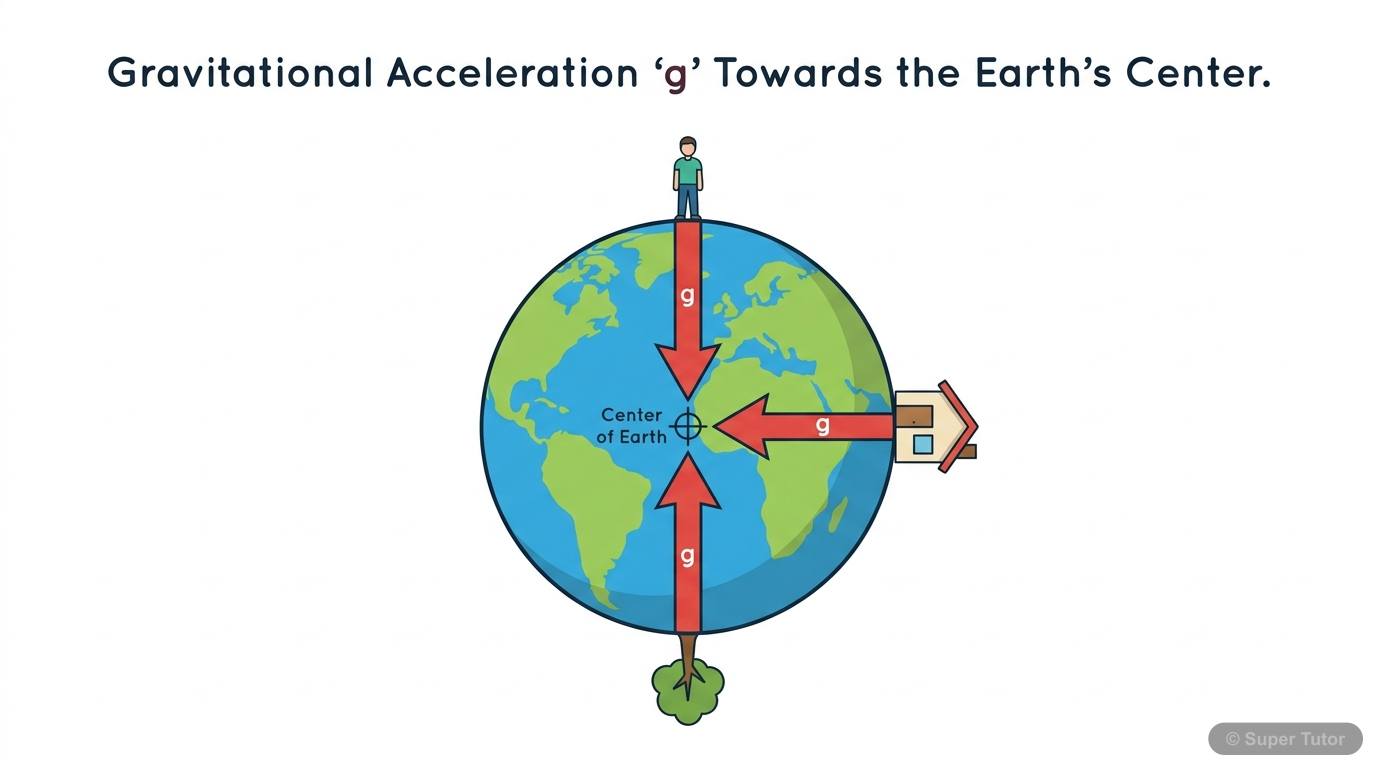
An illustration from Super Tutor's Gravitation chapter — alongside flashcards, concept maps and practice questions.
Topics in Gravitation
Newton's Universal Law of Gravitation
- Every particle in the universe attracts every other particle with a force that is directly proportional to the product of their masses and inversely proportional to the square of the distance between
- The gravitational force is always ATTRACTIVE – it never repels.
- It is a central force – it acts along the line joining the two particles.
Acceleration Due to Gravity (g)
- The acceleration produced in a body due to the gravitational pull of the Earth is called acceleration due to gravity (g).
- g is directed vertically downwards towards the centre of the Earth.
- g is INDEPENDENT of the mass of the falling body – a heavy stone and a light stone fall with the same acceleration.
Variation of g with Height, Depth, and Latitude
- g decreases as we go ABOVE the Earth's surface (height increases).
- g also decreases as we go BELOW the Earth's surface (depth increases).
- g is MAXIMUM at the poles and MINIMUM at the equator.
Weight, Mass, Gravitational Potential and Potential Energy
- MASS is an intrinsic property of a body. It remains CONSTANT everywhere – on Earth, Moon, Mars, or in space.
- WEIGHT is the gravitational force acting on a body. W = mg. It VARIES from place to place as g varies.
- Weight is maximum at poles, minimum at equator. Weight decreases at higher altitudes and inside Earth.
Key Concepts
Central concept: Gravitation
Work through every topic in Gravitation with notes and quizzes
Start This ChapterFrequently Asked Questions
What are the important topics in Gravitation for NIOS Class 12 Physics?
How should I revise Gravitation for the NIOS Class 12 board exam?
Sources & Official References
Content is aligned to the official syllabus. Refer to the board website for the latest curriculum.
More resources for Gravitation
Practice Quiz
Test yourself with a quick quiz
Important Questions
Exam-style questions with answers
Revision Notes
Key points for last-minute revision
Formula Sheet
The chapter's formulas in one place
Chapter Summary
Understand the chapter at a glance
Concept Maps
See how topics connect
Study Plan
Step-by-step plan for this chapter
Flashcards
Quick-fire cards for active recall
For serious students
Get the full Gravitation chapter — start free.
Quizzes, flashcards, an AI doubt solver and a study plan for NIOS Class 12 Physics. Free to start, no card needed.