Agriculture in India - I: Introduction — Flashcards
ICSE · Class 10 · Geography
36 flashcards for Agriculture in India - I: Introduction (ICSE Class 10 Geography) to test yourself on key terms and facts.
Interactive on Super Tutor
Studying Agriculture in India - I: Introduction? Get the full interactive chapter.
Quizzes, flashcards, AI doubt-solver and a step-by-step study plan — built for flashcards and more.
Free trial, no card needed.
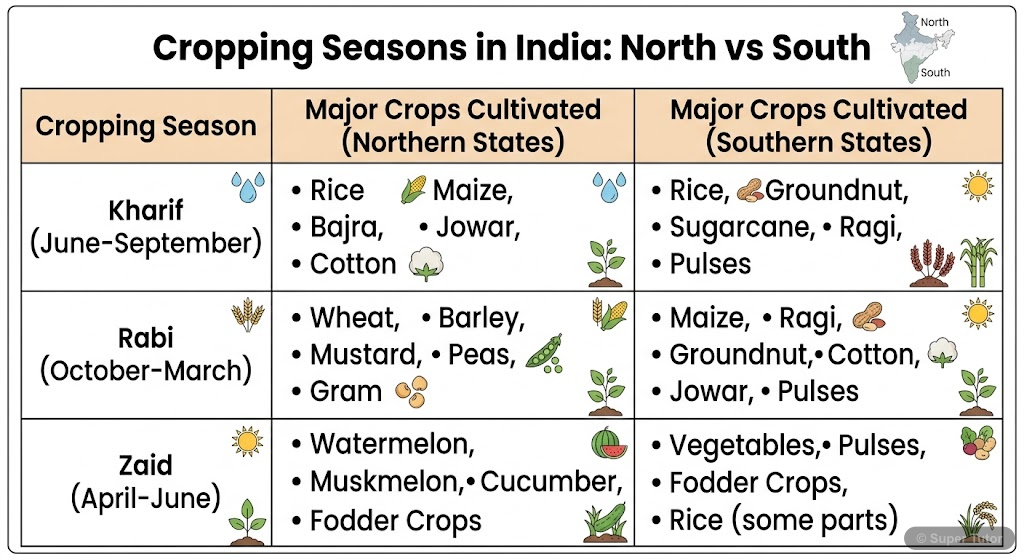
One of 7 illustrations for Agriculture in India - I: Introduction in Super Tutor — alongside flashcards, concept maps and practice questions.
See them allWhy is agriculture considered the backbone of the Indian economy?
Answer
Agriculture is considered the backbone of the Indian economy because it supports food supply, employment, raw materials for industries, and export earnings. It contributes around 17-18% to GDP and pro…
What does net sown area mean, and why is it important in India?
Answer
Net sown area means the area on which crops are grown at least once in a year. In India, it accounts for about 46.6% of the total cultivable area. It shows how important farming is in land use and how…
What is agriculture?
Answer
Agriculture means the management of the environment to produce food. It includes growing crops and, in some cases, rearing livestock. In India, it has been practised since ancient times and remains a …
What are the main crop seasons in India?
Answer
India has three main crop seasons: Kharif, Rabi, and Zayad or Zaid. Kharif crops are grown with the monsoon, Rabi crops are grown in the winter season, and Zaid crops are grown in summer as extra crop…
How does the Kharif season differ from the Rabi season?
Answer
Kharif crops are sown in June after the arrival of rain, with ground preparation in April-May and harvesting in the beginning of November. Rabi crops are sown after the end of October or beginning of …
Which crops are commonly grown in the Kharif season?
Answer
Major Kharif crops include rice, maize, jowar, bajra, cotton, sesame, groundnut, pulses, and jute. These crops are generally grown during the rainy season.
Which crops are commonly grown in the Rabi season?
Answer
Major Rabi crops include wheat, barley, jowar, gram, oilseeds, and tobacco. These crops are generally grown in the winter season and harvested in March.
What are Zaid crops? Give examples.
Answer
Zaid crops are summer crops grown between the Rabi and Kharif seasons. Examples include rice, maize, groundnut, vegetables, fruits, and pulses. They are grown as extra crops in the summer season.
+28 more flashcards
Practise AllFrequently Asked Questions
What are the important topics in Agriculture in India - I: Introduction for ICSE Class 10 Geography?
How many flashcards are available for Agriculture in India - I: Introduction?
How should I revise Agriculture in India - I: Introduction for the ICSE Class 10 board exam?
Sources & Official References
Content is aligned to the official syllabus. Refer to the board website for the latest curriculum.
More resources for Agriculture in India - I: Introduction
Practice Quiz
Test yourself with a quick quiz
Important Questions
Exam-style questions with answers
Revision Notes
Key points for last-minute revision
Chapter Summary
Understand the chapter at a glance
Concept Maps
See how topics connect
Study Plan
Step-by-step plan for this chapter
Syllabus
What topics to cover
For serious students
Get the full Agriculture in India - I: Introduction chapter — start free.
Quizzes, flashcards, an AI doubt solver and a study plan for ICSE Class 10 Geography. Free to start, no card needed.