The Non-Aligned Movement
ICSE · Class 10 · History & Civics
Complete topic list for The Non-Aligned Movement in ICSE Class 10 History & Civics. Key concepts, sub-topics, and what to focus on for board exams.
Interactive on Super Tutor
Studying The Non-Aligned Movement? Get the full interactive chapter.
Quizzes, flashcards, AI doubt-solver and a step-by-step study plan — built for syllabus and more.
1,000+ Class 10 students started this chapter today
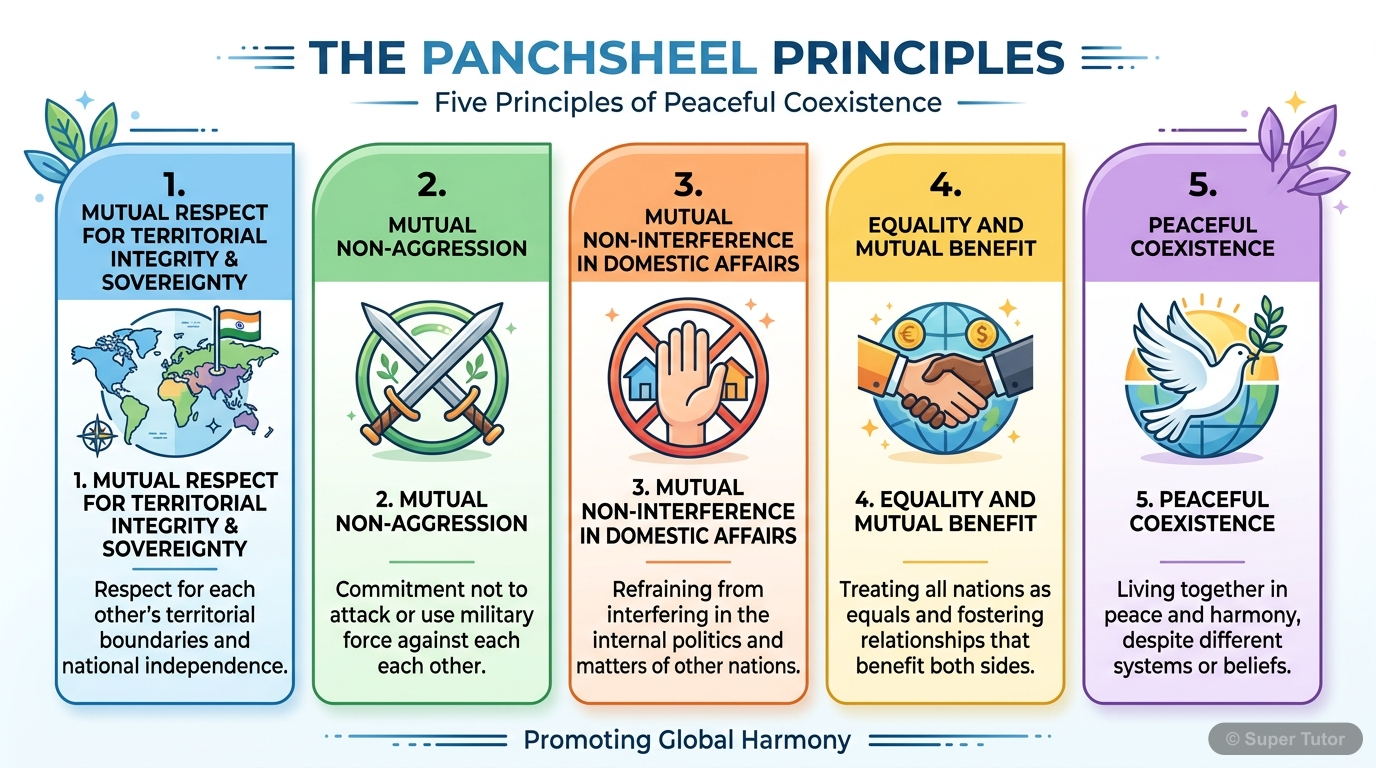
Super Tutor has 5+ illustrations like this for The Non-Aligned Movement alone — flashcards, concept maps, and step-by-step visuals.
See them allTopics in The Non-Aligned Movement
Meaning of Non-Alignment and NAM
- Non-Alignment means keeping away from power blocs to protect independence.
- NAM is a movement of newly independent countries, also called Third World countries.
- Its main aim is to maintain an independent status in international issues.
Factors Responsible for the Foundation of NAM
- The Asian Relations Conference in Delhi in March 1947 was an important early step.
- Nehru said Asian countries should not become pawns in the hands of imperialist powers.
- The division of the world into two rival blocs increased the need for a separate path.
Panchsheel and the Bandung Conference
- Panchsheel means the Five Principles of Peaceful Coexistence.
- The word Panchsheel comes from Sanskrit words panch and sheel.
- These principles were mentioned in the preamble of the Sino-Indian Agreement, 1954.
Chief Architects and Formation of NAM
- The chief architects of NAM were Nehru, Sukarno, Nasser, and Tito.
- Nehru, Nasser, and Tito met informally at Belgrade in July 1956.
- This meeting gave practical shape to the ideas expressed at Bandung.
Key Concepts
Central concept: Non-Aligned Movement
Frequently Asked Questions
What are the important topics in The Non-Aligned Movement for ICSE Class 10 History & Civics?
How to score full marks in The Non-Aligned Movement — ICSE Class 10 History & Civics?
Sources & Official References
Content is aligned to the official syllabus. Refer to the board website for the latest curriculum.
More resources for The Non-Aligned Movement
Practice Quiz
Test yourself with a quick quiz
Important Questions
Practice with board exam-style questions
Revision Notes
Key points for last-minute revision
Formula Sheet
All formulas in one place
Chapter Summary
Understand the chapter at a glance
Concept Maps
See how topics connect visually
Study Plan
Step-by-step plan to ace this chapter
Flashcards
Quick-fire cards for active recall
NCERT Solutions
Every textbook question solved step by step
For serious students
Get the full The Non-Aligned Movement chapter — for free.
Quizzes, flashcards, AI doubt-solver and a step-by-step study plan for ICSE Class 10 History & Civics.