Rise of Dictatorship Fascism and Nazism
ICSE · Class 10 · History & Civics
Complete topic list for Rise of Dictatorship Fascism and Nazism in ICSE Class 10 History & Civics. Key concepts, sub-topics, and what to focus on for board exams.
Interactive on Super Tutor
Studying Rise of Dictatorship Fascism and Nazism? Get the full interactive chapter.
Quizzes, flashcards, AI doubt-solver and a step-by-step study plan — built for syllabus and more.
1,000+ Class 10 students started this chapter today
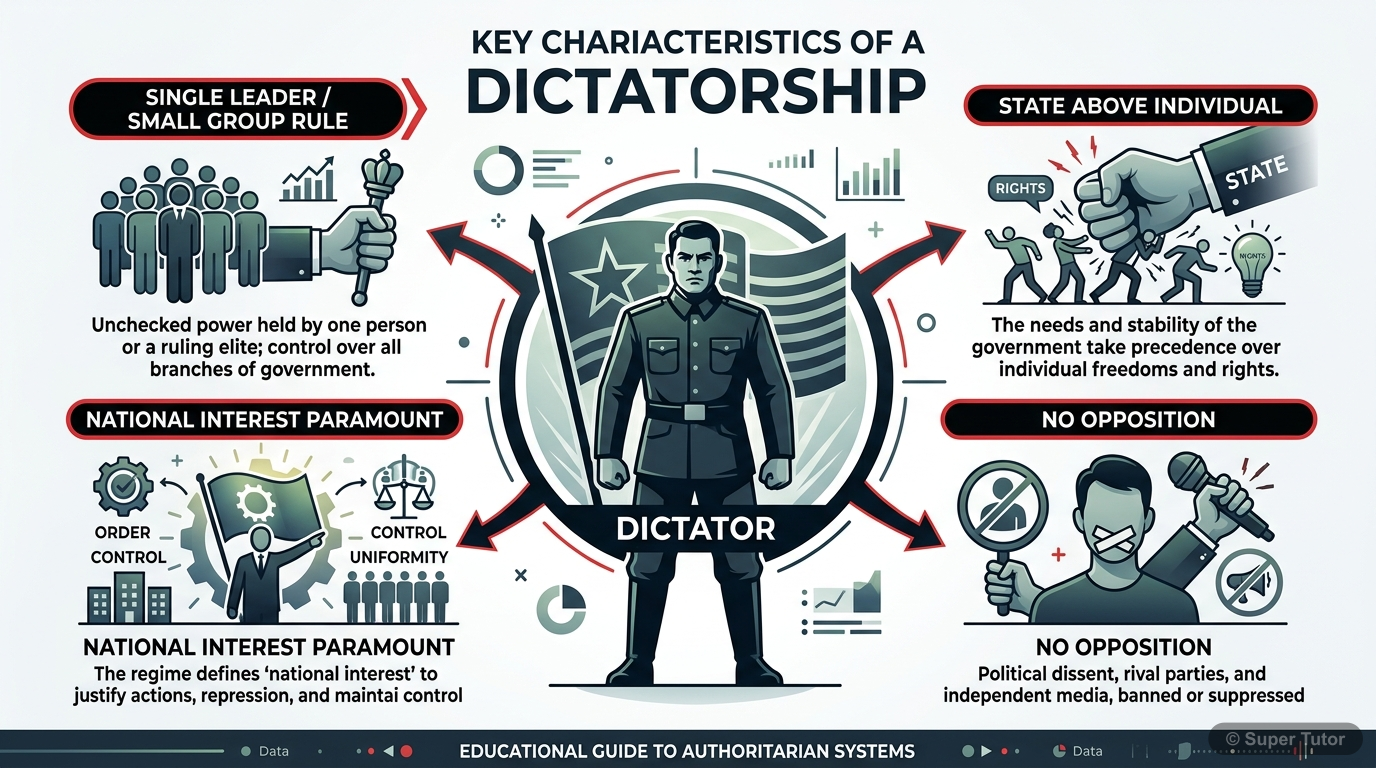
Super Tutor has 6+ illustrations like this for Rise of Dictatorship Fascism and Nazism alone — flashcards, concept maps, and step-by-step visuals.
See them allTopics in Rise of Dictatorship Fascism and Nazism
Meaning and Nature of Dictatorship
- After the First World War, autocratic governments rose in many countries of Europe.
- A dictatorship is a government ruled by one man or a small group of men, with very little say for the masses.
- Dictatorship gives importance to national interests instead of individual interests.
Rise of Fascism in Italy
- Fascism was a dictatorial form of government that rose in Italy under Benito Mussolini.
- The word Fascism comes from fasces, meaning a bundle of rods in Italian.
- The axe symbolised state authority, and the bundle of rods symbolised unity and strength.
Causes of the Rise of Fascism in Italy
- Italy was disappointed after the Treaty of Versailles.
- By the Secret Treaty of London in 1915, Italy hoped to gain Trentino, Trieste, Istria, Fiume, Coastal Regions of Dalmatia, Albania and some parts of Turkey and Germany.
- By the Treaty of Versailles, Italy got only Southern Tyrol and Trentino, and the Coastal Regions of Dalmatia.
Ideology and Principles of Fascism
- Fascism was the antithesis of democracy.
- It supported one party and one leader.
- It believed dictatorship was the best form of government.
Key Concepts
Central concept: Dictatorship in Europe after the First World War
Frequently Asked Questions
What are the important topics in Rise of Dictatorship Fascism and Nazism for ICSE Class 10 History & Civics?
How to score full marks in Rise of Dictatorship Fascism and Nazism — ICSE Class 10 History & Civics?
Sources & Official References
Content is aligned to the official syllabus. Refer to the board website for the latest curriculum.
More resources for Rise of Dictatorship Fascism and Nazism
Practice Quiz
Test yourself with a quick quiz
Important Questions
Practice with board exam-style questions
Revision Notes
Key points for last-minute revision
Formula Sheet
All formulas in one place
Chapter Summary
Understand the chapter at a glance
Concept Maps
See how topics connect visually
Study Plan
Step-by-step plan to ace this chapter
Flashcards
Quick-fire cards for active recall
NCERT Solutions
Every textbook question solved step by step
For serious students
Get the full Rise of Dictatorship Fascism and Nazism chapter — for free.
Quizzes, flashcards, AI doubt-solver and a step-by-step study plan for ICSE Class 10 History & Civics.