Morphology of Flowering Plants — Chapter Summary
ICSE · Class 11 · Biology
Summary of Morphology of Flowering Plants for ICSE Class 11 Biology. Part of the ICSE Class 11 Biology syllabus.
Interactive on Super Tutor
Studying Morphology of Flowering Plants? Get the full interactive chapter.
Quizzes, flashcards, AI doubt-solver and a step-by-step study plan — built for chapter summary and more.
Free trial, no card needed.
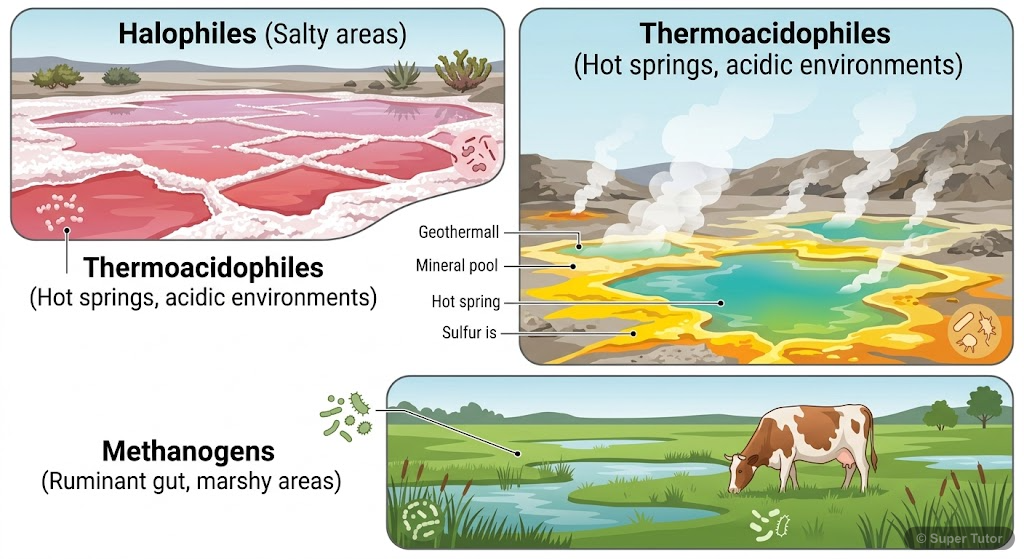
One of 19 illustrations for Morphology of Flowering Plants in Super Tutor — alongside flashcards, concept maps and practice questions.
Overview
Morphology studies the form, structure, colour, size, and relative position of plant parts. Flowering plants show a clear division of labour between the underground root system and the aboveground shoot system. Roots anchor the plant and absorb water and minerals, stems support leaves, branches, flo
Key Concepts
The root is a non
The root is a non-green, cylindrical, descending axis that grows downward from the radicle. Tap root develops from the radicle and persists as the mai
A typical root has a root
A typical root has a root cap, meristematic zone, zone of elongation, zone of maturation, and mature region. Root hairs arise in the maturation zone a
Tap roots may become fusiform
Tap roots may become fusiform in radish, napiform in turnip, conical in carrot, and tuberous in four o'clock plant. Adventitious roots may become tube
The stem is the ascending axis
The stem is the ascending axis and direct prolongation of the plumule. It has nodes and internodes, bears buds, leaves, flowers, and fruits, and branc
Rhizome is a thickened horizontal underground
Rhizome is a thickened horizontal underground stem with nodes, internodes, and terminal bud, as in ginger and turmeric. Corm is a condensed, stout, ve
Learning Objectives
- Identify the main external parts of a flowering plant and their functions.
- Distinguish between tap root, fibrous root, and adventitious root systems.
- Recognize major root modifications for storage, support, and respiration.
- Describe stem features and classify underground, sub-aerial, and aerial stem modifications.
- Explain the structure of a leaf, venation, phyllotaxy, and leaf modifications.
Frequently Asked Questions
What are the important topics in Morphology of Flowering Plants for ICSE Class 11 Biology?
How should I revise Morphology of Flowering Plants for Class 11 exams?
Sources & Official References
Content is aligned to the official syllabus. Refer to the board website for the latest curriculum.
More resources for Morphology of Flowering Plants
For serious students
Get the full Morphology of Flowering Plants chapter — start free.
Quizzes, flashcards, an AI doubt solver and a study plan for ICSE Class 11 Biology. Free to start, no card needed.