Flow of Liquids — Flashcards
ICSE · Class 11 · Physics
40 flashcards for Flow of Liquids (ICSE Class 11 Physics) to test yourself on key terms and facts. Sample: "State the two properties of an ideal liquid."
Interactive on Super Tutor
Studying Flow of Liquids? Get the full interactive chapter.
Quizzes, flashcards, AI doubt-solver and a step-by-step study plan — built for flashcards and more.
Free trial, no card needed.
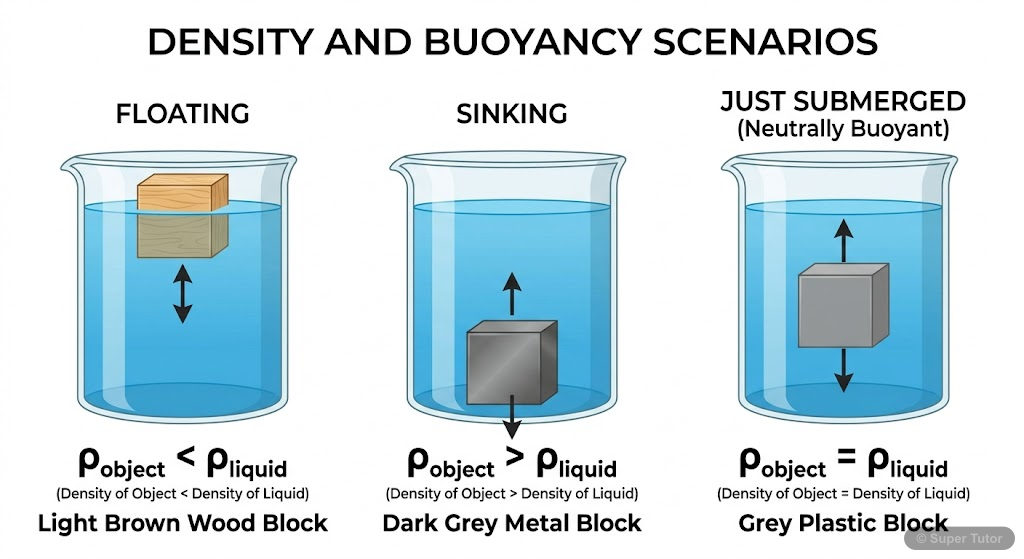
One of 11 illustrations for Flow of Liquids in Super Tutor — alongside flashcards, concept maps and practice questions.
State the two properties of an ideal liquid.
Answer
An ideal liquid has two properties: 1) Zero compressibility, so it is incompressible. 2) Zero viscosity, so it is non-viscous. Real liquids only approximately satisfy these properties.
Why is water often treated as nearly incompressible?
Answer
Pressing water by one atmospheric pressure changes its volume only by a fraction of 0.000048. This change is very small, so water is treated as nearly incompressible in many problems.
State the definition of stream-lined flow.
Answer
When a liquid flows such that each particle passing a certain point follows the same path as the preceding particles which passed the same point, the flow is called stream-lined flow or laminar flow.
Why can two streamlines not intersect each other?
Answer
Two streamlines cannot intersect because the tangent at a point gives the direction of velocity at that point. If two streamlines crossed, there would be two velocity directions at the same point, whi…
State the definition of turbulent flow.
Answer
In turbulent flow, the particles of the liquid follow independent paths and intermingling of two or more layers takes place. The velocity at a point is time-dependent and the velocity gradient is not …
State the formula for critical velocity and define its symbols.
Answer
Formula: v_c = kη/ρD. Here, v_c = critical velocity, k = Reynold's number, η = coefficient of viscosity, ρ = density of liquid, and D = diameter of the tube. Critical velocity is the maximum velocity …
A liquid flows in a tube with k = 1800. What type of flow is it?
Answer
Given: k = 1800. Rule: When k ≤ 2000, the flow is streamlined or laminar or steady. Answer: The flow is streamlined (laminar/steady).
A liquid flows in a tube with k = 2500. What type of flow is it?
Answer
Given: k = 2500. Rule: When 2000 < k < 3000, the flow is unstable. Answer: The flow is unstable.
+32 more flashcards
Practise AllFrequently Asked Questions
What are the important topics in Flow of Liquids for ICSE Class 11 Physics?
How many flashcards are available for Flow of Liquids?
How should I revise Flow of Liquids for Class 11 exams?
Sources & Official References
Content is aligned to the official syllabus. Refer to the board website for the latest curriculum.
More resources for Flow of Liquids
Practice Quiz
Test yourself with a quick quiz
Important Questions
Exam-style questions with answers
Revision Notes
Key points for last-minute revision
Formula Sheet
The chapter's formulas in one place
Chapter Summary
Understand the chapter at a glance
Concept Maps
See how topics connect
Study Plan
Step-by-step plan for this chapter
Syllabus
What topics to cover
For serious students
Get the full Flow of Liquids chapter — start free.
Quizzes, flashcards, an AI doubt solver and a study plan for ICSE Class 11 Physics. Free to start, no card needed.