Heat Transfer — Flashcards
ICSE · Class 11 · Physics
32 flashcards for Heat Transfer (ICSE Class 11 Physics) to test yourself on key terms and facts. Sample: "State the three methods of heat transfer."
Interactive on Super Tutor
Studying Heat Transfer? Get the full interactive chapter.
Quizzes, flashcards, AI doubt-solver and a step-by-step study plan — built for flashcards and more.
Free trial, no card needed.
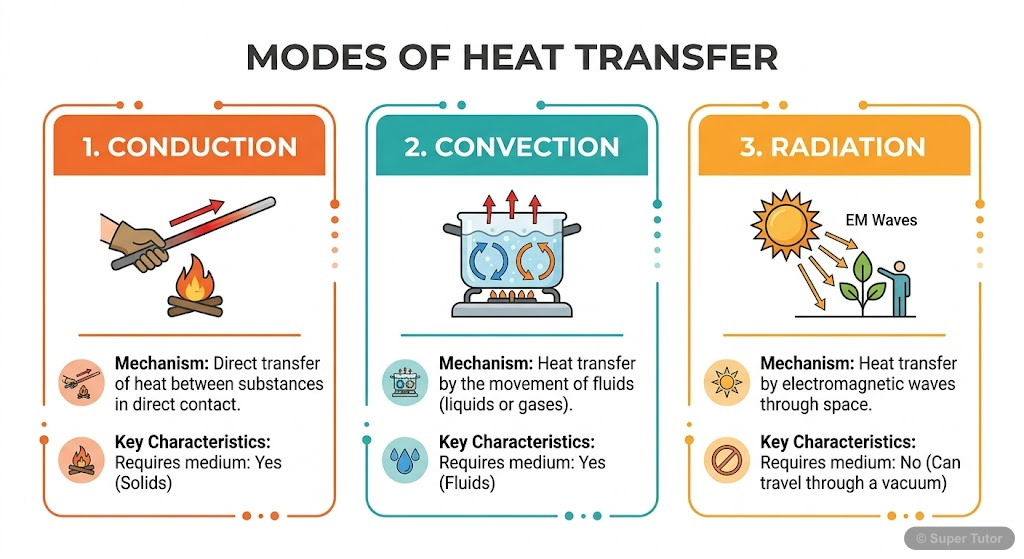
One of 2 illustrations for Heat Transfer in Super Tutor — alongside flashcards, concept maps and practice questions.
State the three methods of heat transfer.
Answer
The three methods of heat transfer are: conduction, convection, and radiation. Conduction happens through particle contact without particles leaving their positions. Convection happens when fluid part…
Why does a metallic bar become hot at the other end when one end is heated?
Answer
Heat travels through the metal by conduction. In metals, free electrons carry thermal energy rapidly from the hot end to the cold end. This is why metals are good conductors of heat.
Why does water in a vessel become hot mainly by convection?
Answer
In a fluid, the warmer, less dense part rises and the cooler, denser part moves down to replace it. This circulation transfers heat through the fluid. That is convection.
Why does heat from the Sun reach Earth even though space has no air?
Answer
Heat from the Sun reaches Earth by radiation. Radiation does not require any material medium and travels as electromagnetic waves with the speed of light.
State the definition of an isothermal surface.
Answer
An isothermal surface is a surface at every point of which the temperature is the same. Heat flow is perpendicular to it, and two isothermal surfaces never intersect.
A hot and a cold isothermal surface are 0.20 m apart, and their temperatures are 80 °C and 20 °C. Find the temperature gradient.
Answer
Given: temperature difference = 80 °C - 20 °C = 60 °C, distance = 0.20 m. Formula: temperature gradient = (θ1 - θ2) / l Calculation: gradient = 60 °C / 0.20 m = 300 °C m^-1 Answer: 300 °C m^-1 The uni…
A slab has area 2 m², thickness 0.50 m, thermal conductivity 4 W m^-1 K^-1, and temperature difference 10 K. Find the rate of heat flow.
Answer
Given: A = 2 m², l = 0.50 m, K = 4 W m^-1 K^-1, temperature difference = 10 K. Formula: dQ/dt = K A (θ1 - θ2) / l Calculation: dQ/dt = 4 × 2 × 10 / 0.50 W Step 1: 4 × 2 = 8 Step 2: 8 × 10 = 80 Step 3:…
State the formula for heat conducted through a slab and explain the symbols.
Answer
Formula: Q = K A (θ1 - θ2) t / l Here, Q is heat conducted, K is thermal conductivity, A is area, θ1 and θ2 are face temperatures, t is time, and l is the length of the slab.
+24 more flashcards
Practise AllFrequently Asked Questions
What are the important topics in Heat Transfer for ICSE Class 11 Physics?
How many flashcards are available for Heat Transfer?
How should I revise Heat Transfer for Class 11 exams?
Sources & Official References
Content is aligned to the official syllabus. Refer to the board website for the latest curriculum.
More resources for Heat Transfer
Practice Quiz
Test yourself with a quick quiz
Important Questions
Exam-style questions with answers
Revision Notes
Key points for last-minute revision
Formula Sheet
The chapter's formulas in one place
Chapter Summary
Understand the chapter at a glance
Concept Maps
See how topics connect
Study Plan
Step-by-step plan for this chapter
Syllabus
What topics to cover
For serious students
Get the full Heat Transfer chapter — start free.
Quizzes, flashcards, an AI doubt solver and a study plan for ICSE Class 11 Physics. Free to start, no card needed.