Waves — Flashcards
ICSE · Class 11 · Physics
34 flashcards for Waves (ICSE Class 11 Physics) to test yourself on key terms and facts. Sample: "State the definition of wave motion."
Interactive on Super Tutor
Studying Waves? Get the full interactive chapter.
Quizzes, flashcards, AI doubt-solver and a step-by-step study plan — built for flashcards and more.
Free trial, no card needed.
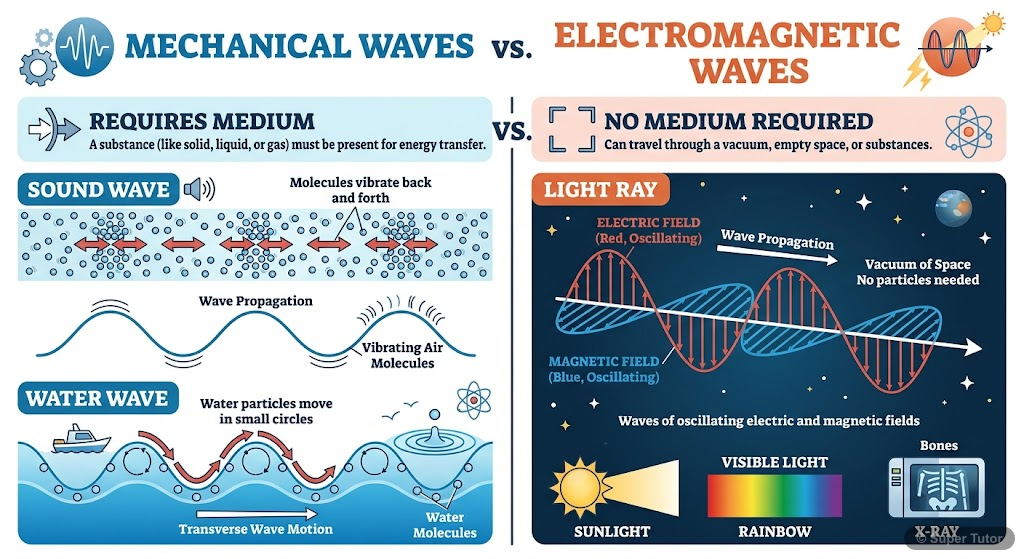
Learn better with visuals Super Tutor pairs illustrations like this with notes and quizzes for Waves.
State the definition of wave motion.
Answer
Wave motion is a disturbance produced in a physical medium which advances in the medium with a definite speed without changing its form.
Why is a material medium necessary for mechanical wave propagation?
Answer
Mechanical waves need a medium with elasticity and inertia. Elasticity provides the restoring force, and inertia helps the disturbance move from one particle to the next.
A wave travels at 340 m/s with frequency 170 Hz. Find the wavelength.
Answer
Given: v = 340 m/s, n = 170 Hz Formula: v = nλ Step 1: λ = v / n Step 2: λ = 340 / 170 m Step 3: λ = 2 m Answer: 2 m…
State the relation between wave speed, frequency, and wavelength.
Answer
Wave speed-frequency-wavelength relation: v = nλ Here, v is wave speed in m/s, n is frequency in Hz, and λ is wavelength in m.
A wave has wavelength 4 m and frequency 5 Hz. Find its speed.
Answer
Given: λ = 4 m, n = 5 Hz Formula: v = nλ Step 1: v = 5 × 4 m/s Step 2: v = 20 m/s Answer: 20 m/s…
Why do particles in wave motion not move from one place to another with the wave?
Answer
In wave motion, the particles of the medium do not move from one place to another. They only oscillate about their equilibrium positions, while energy moves forward through the medium.
A particle in a wave has amplitude 0.08 m. What is the maximum displacement from equilibrium?
Answer
Given: a = 0.08 m Formula: Maximum displacement = amplitude Step 1: Maximum displacement = 0.08 m Answer: 0.08 m…
State the definition of amplitude.
Answer
The maximum displacement through which an oscillating particle of the medium undergoes on either side of its equilibrium position is called amplitude.
+26 more flashcards
Practise AllFrequently Asked Questions
What are the important topics in Waves for ICSE Class 11 Physics?
How many flashcards are available for Waves?
How should I revise Waves for Class 11 exams?
Sources & Official References
Content is aligned to the official syllabus. Refer to the board website for the latest curriculum.
More resources for Waves
Practice Quiz
Test yourself with a quick quiz
Important Questions
Exam-style questions with answers
Revision Notes
Key points for last-minute revision
Formula Sheet
The chapter's formulas in one place
Chapter Summary
Understand the chapter at a glance
Concept Maps
See how topics connect
Study Plan
Step-by-step plan for this chapter
Syllabus
What topics to cover
For serious students
Get the full Waves chapter — start free.
Quizzes, flashcards, an AI doubt solver and a study plan for ICSE Class 11 Physics. Free to start, no card needed.