Waves — Chapter Summary
ICSE · Class 11 · Physics
Summary of Waves for ICSE Class 11 Physics. Key concepts: Wave motion is a disturbance, In a transverse wave and In a longitudinal wave.
Interactive on Super Tutor
Studying Waves? Get the full interactive chapter.
Quizzes, flashcards, AI doubt-solver and a step-by-step study plan — built for chapter summary and more.
Free trial, no card needed.
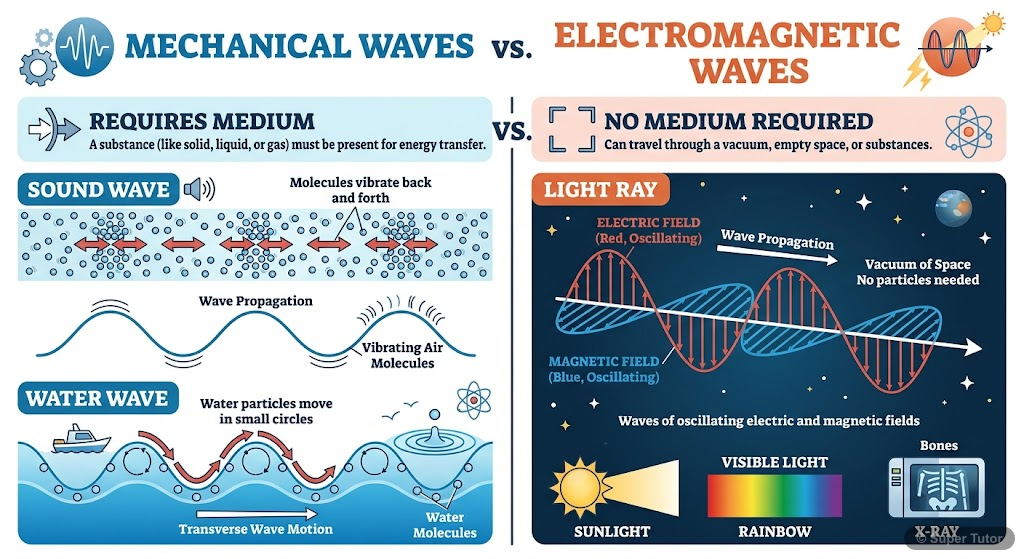
Learn better with visuals Super Tutor pairs illustrations like this with notes and quizzes for Waves.
Overview
Waves are disturbances that travel through a medium with a definite speed without changing shape. Mechanical waves need a material medium with elasticity and inertia. In wave motion, the medium particles do not move forward with the wave; they only oscillate about their equilibrium positions while e
Key Concepts
Wave motion is a disturbance produced
Wave motion is a disturbance produced in a physical medium that advances with definite speed without changing its form. For mechanical waves, elastici
In a transverse wave
In a transverse wave, medium particles oscillate perpendicular to the direction of wave propagation. Light waves are also transverse. Such waves can b
In a longitudinal wave
In a longitudinal wave, medium particles oscillate parallel to the direction of propagation. Sound waves in air are always longitudinal. Such waves ca
Amplitude is the maximum displacement
Amplitude is the maximum displacement of an oscillating particle on either side of its equilibrium position. It is denoted by a.
Time period is the time taken
Time period is the time taken by a particle to complete one oscillation, denoted by T. Frequency is the number of oscillations in one second, denoted
Learning Objectives
- Understand the meaning of wave motion and the need for a material medium in mechanical waves.
- Distinguish between transverse waves and longitudinal waves using particle motion and examples.
- Learn the basic quantities of waves such as amplitude, time period, frequency, wavelength, phase, and wave speed.
- Use the relation v = nλ to connect wave speed, frequency, and wavelength.
- Write the displacement equations of progressive waves in different forms for motion along positive and negative X directions.
Frequently Asked Questions
What are the important topics in Waves for ICSE Class 11 Physics?
How should I revise Waves for Class 11 exams?
Sources & Official References
Content is aligned to the official syllabus. Refer to the board website for the latest curriculum.
More resources for Waves
Practice Quiz
Test yourself with a quick quiz
Important Questions
Exam-style questions with answers
Revision Notes
Key points for last-minute revision
Formula Sheet
The chapter's formulas in one place
Concept Maps
See how topics connect
Study Plan
Step-by-step plan for this chapter
Flashcards
Quick-fire cards for active recall
Syllabus
What topics to cover
For serious students
Get the full Waves chapter — start free.
Quizzes, flashcards, an AI doubt solver and a study plan for ICSE Class 11 Physics. Free to start, no card needed.