Flow of Liquids — Chapter Summary
ICSE · Class 11 · Physics
Summary of Flow of Liquids for ICSE Class 11 Physics. Key concepts: An ideal liquid is, In streamlined or laminar flow and In turbulent flow.
Interactive on Super Tutor
Studying Flow of Liquids? Get the full interactive chapter.
Quizzes, flashcards, AI doubt-solver and a step-by-step study plan — built for chapter summary and more.
Free trial, no card needed.
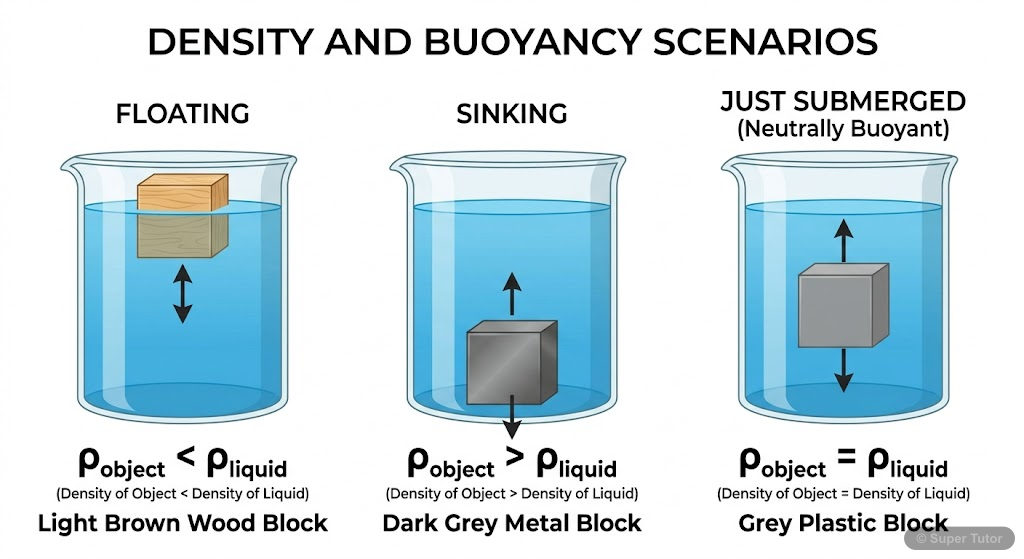
One of 11 illustrations for Flow of Liquids in Super Tutor — alongside flashcards, concept maps and practice questions.
Overview
Flow of liquids is explained through viscosity, streamline motion, critical velocity, Stokes' law, Poiseuille's formula, continuity, Bernoulli's theorem, and Torricelli's theorem. The chapter connects these ideas to how liquids move in tubes, how pressure changes with speed, and how several practica
Key Concepts
An ideal liquid is incompressible
An ideal liquid is incompressible and non-viscous. Its volume does not change on pressing, and it offers no internal friction between layers.
In streamlined or laminar flow
In streamlined or laminar flow, each particle passing a point follows the same path as the previous particle. At a fixed point, velocity remains const
In turbulent flow
In turbulent flow, particles move along independent paths and layers mix. The velocity at a point changes with time, and the velocity gradient is not
Critical velocity is the maximum velocity
Critical velocity is the maximum velocity up to which flow remains streamlined. It is given by v_c = kη/ρD. For k ≤ 2000 flow is streamlined, for 2000
Viscosity is the property by
Viscosity is the property by which a liquid opposes relative motion between adjacent layers. Newton's law of viscosity is F = -ηA(dv/dz), where the fo
Learning Objectives
- Understand the meaning of ideal liquid, viscosity, streamline flow, and turbulent flow.
- Use the concept of critical velocity and Reynold's number to distinguish types of flow.
- Apply Newton's law of viscosity and Stokes' law to motion in viscous media.
- Explain terminal velocity and its dependence on radius, density, and viscosity.
- Use Poiseuille's formula to understand flow rate through a pipe and viscous resistance.
Frequently Asked Questions
What are the important topics in Flow of Liquids for ICSE Class 11 Physics?
How should I revise Flow of Liquids for Class 11 exams?
Sources & Official References
Content is aligned to the official syllabus. Refer to the board website for the latest curriculum.
More resources for Flow of Liquids
Practice Quiz
Test yourself with a quick quiz
Important Questions
Exam-style questions with answers
Revision Notes
Key points for last-minute revision
Formula Sheet
The chapter's formulas in one place
Concept Maps
See how topics connect
Study Plan
Step-by-step plan for this chapter
Flashcards
Quick-fire cards for active recall
Syllabus
What topics to cover
For serious students
Get the full Flow of Liquids chapter — start free.
Quizzes, flashcards, an AI doubt solver and a study plan for ICSE Class 11 Physics. Free to start, no card needed.