Heat Transfer — Chapter Summary
ICSE · Class 11 · Physics
Summary of Heat Transfer for ICSE Class 11 Physics. Part of the ICSE Class 11 Physics syllabus. Heat transfer is the flow of heat from one body to another.
Interactive on Super Tutor
Studying Heat Transfer? Get the full interactive chapter.
Quizzes, flashcards, AI doubt-solver and a step-by-step study plan — built for chapter summary and more.
Free trial, no card needed.
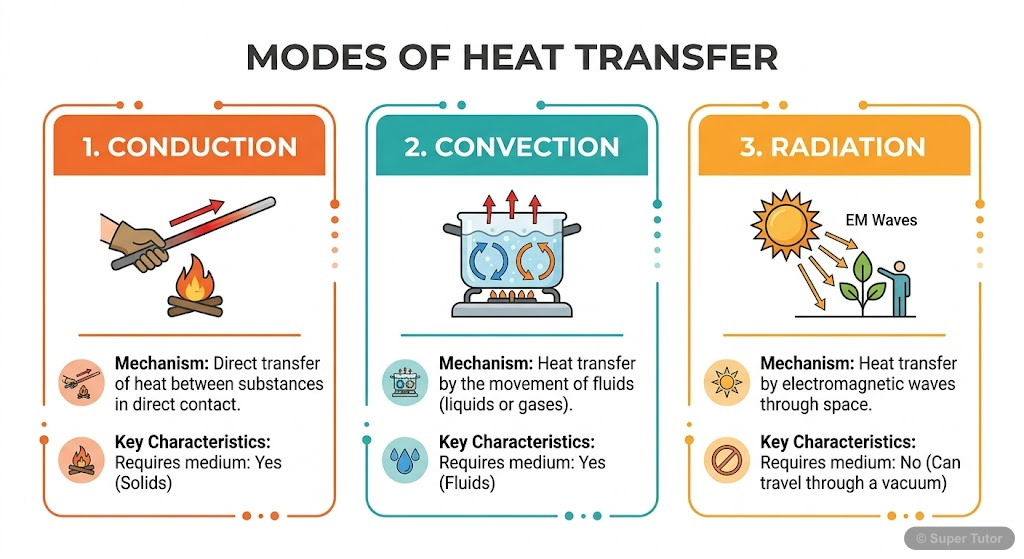
One of 2 illustrations for Heat Transfer in Super Tutor — alongside flashcards, concept maps and practice questions.
Overview
Heat transfer is the flow of heat from one body to another or from one place to another. The three modes of heat transfer are conduction, convection, and radiation. Conduction takes place through direct particle contact without the particles leaving their positions. Convection occurs in fluids when
Key Concepts
Conduction is the mode of heat
Conduction is the mode of heat transfer in which the particles of the body do not leave their positions. In metals, free electrons carry heat quickly.
Convection is the mode of heat
Convection is the mode of heat transfer in which the particles of the fluid move. It occurs only in liquids and gases, not in solids.
Radiation is heat transfer in
Radiation is heat transfer in the form of electromagnetic waves from a hot body. It does not require any medium and travels with the speed of light in
An isothermal surface is a surface
An isothermal surface is a surface at every point of which the temperature is the same. It may be plane, spherical, or cylindrical. Heat flow is perpe
Temperature gradient is the rate
Temperature gradient is the rate of change of temperature with distance between two isothermal surfaces. It is a vector quantity with unit degree Cels
Learning Objectives
- Understand the three modes of heat transfer: conduction, convection, and radiation.
- Identify the conditions under which each mode occurs.
- Define and use isothermal surface and temperature gradient.
- Understand coefficient of thermal conductivity and thermal resistance.
- Apply heat flow formulas for slabs in steady state.
Frequently Asked Questions
What are the important topics in Heat Transfer for ICSE Class 11 Physics?
How should I revise Heat Transfer for Class 11 exams?
Sources & Official References
Content is aligned to the official syllabus. Refer to the board website for the latest curriculum.
More resources for Heat Transfer
Practice Quiz
Test yourself with a quick quiz
Important Questions
Exam-style questions with answers
Revision Notes
Key points for last-minute revision
Formula Sheet
The chapter's formulas in one place
Concept Maps
See how topics connect
Study Plan
Step-by-step plan for this chapter
Flashcards
Quick-fire cards for active recall
Syllabus
What topics to cover
For serious students
Get the full Heat Transfer chapter — start free.
Quizzes, flashcards, an AI doubt solver and a study plan for ICSE Class 11 Physics. Free to start, no card needed.