Biodiversity and Conservation — Flashcards
ICSE · Class 12 · Biology
44 flashcards for Biodiversity and Conservation (ICSE Class 12 Biology) to test yourself on key terms and facts. Sample: "What is biodiversity?"
Interactive on Super Tutor
Studying Biodiversity and Conservation? Get the full interactive chapter.
Quizzes, flashcards, AI doubt-solver and a step-by-step study plan — built for flashcards and more.
Free trial, no card needed.
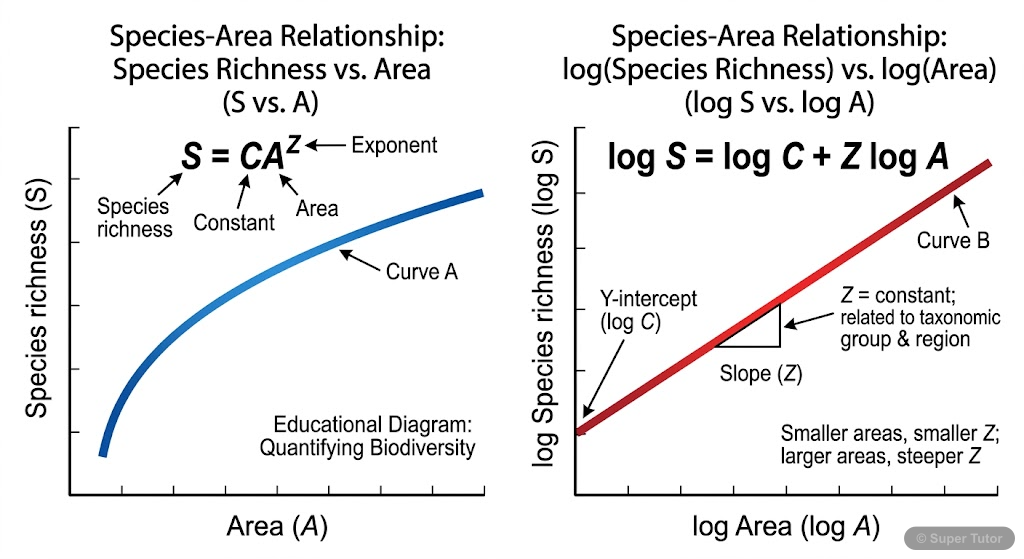
Learn better with visuals Super Tutor pairs illustrations like this with notes and quizzes for Biodiversity and Conservation.
What is biodiversity?
Answer
Biodiversity is the variety of life around us. It includes diversity within species, between species, and among ecosystems. In the simplest sense, it is the sum total of species richness in a given ha…
Who coined the term biodiversity, and who popularised it?
Answer
Walter G. Rosen coined the term biodiversity in 1985, and Edward Wilson popularised it to describe the combined diversity at all levels of biological organisation.
State the UN definition of biodiversity.
Answer
Biodiversity is the variability among living organisms from all sources including terrestrial, marine, and other aquatic ecosystems, and the ecological complexes of which they are a part. It includes …
What are the three main types of biodiversity?
Answer
The three main types are genetic diversity, species diversity, and ecosystem diversity. Genetic diversity is variation within a species, species diversity is the variety of species in a region, and ec…
What is genetic diversity? Give one example.
Answer
Genetic diversity refers to variation in genes within a species. It creates differences among individuals and populations of the same species. A clear example is the large number of genetically differ…
What is species diversity?
Answer
Species diversity refers to the variety of species within a region. It is related to species richness, which means the number of different species present in a habitat. For example, the Western Ghats …
What is ecosystem diversity?
Answer
Ecosystem diversity refers to the variety of ecosystems, landforms, and habitats in a region. India shows high ecosystem diversity because it has deserts, rain forests, mangroves, coral reefs, wetland…
Why is India considered a mega diverse country?
Answer
India is one of the 12 mega diverse countries and together they possess 60 to 70 per cent of the world's biodiversity. India has a wide range of climates, eight floristic regions, rich plant diversity…
+36 more flashcards
Practise AllFrequently Asked Questions
What are the important topics in Biodiversity and Conservation for ICSE Class 12 Biology?
How many flashcards are available for Biodiversity and Conservation?
How should I revise Biodiversity and Conservation for the ICSE Class 12 board exam?
Sources & Official References
Content is aligned to the official syllabus. Refer to the board website for the latest curriculum.
More resources for Biodiversity and Conservation
Practice Quiz
Test yourself with a quick quiz
Important Questions
Exam-style questions with answers
Revision Notes
Key points for last-minute revision
Chapter Summary
Understand the chapter at a glance
Concept Maps
See how topics connect
Study Plan
Step-by-step plan for this chapter
Syllabus
What topics to cover
For serious students
Get the full Biodiversity and Conservation chapter — start free.
Quizzes, flashcards, an AI doubt solver and a study plan for ICSE Class 12 Biology. Free to start, no card needed.