Microbes in Human Welfare — Flashcards
ICSE · Class 12 · Biology
40 flashcards for Microbes in Human Welfare (ICSE Class 12 Biology) to test yourself on key terms and facts. Sample: "What are antibiotics?"
Interactive on Super Tutor
Studying Microbes in Human Welfare? Get the full interactive chapter.
Quizzes, flashcards, AI doubt-solver and a step-by-step study plan — built for flashcards and more.
Free trial, no card needed.
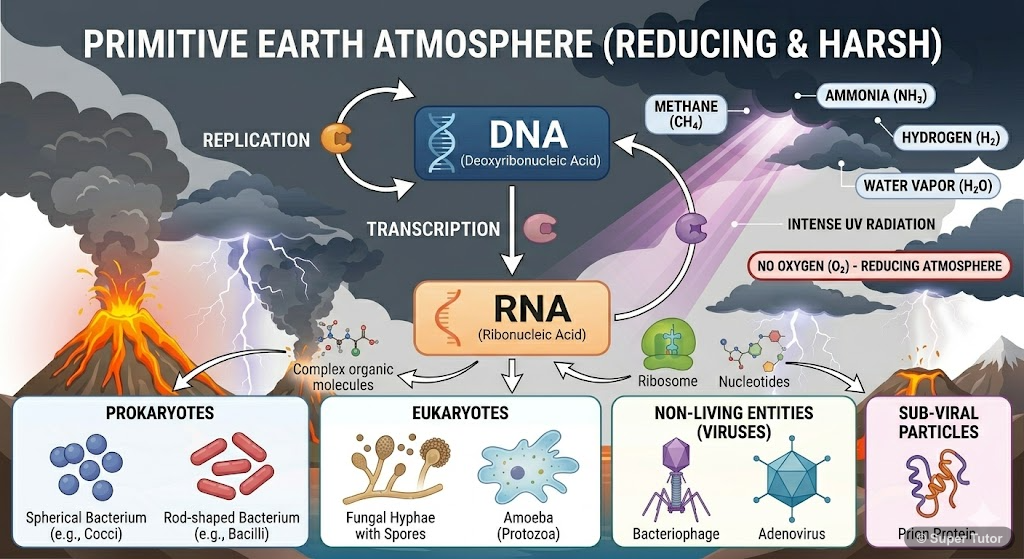
One of 14 illustrations for Microbes in Human Welfare in Super Tutor — alongside flashcards, concept maps and practice questions.
What are antibiotics?
Answer
Antibiotics are chemical substances produced by some microbes that can kill or slow down the growth of other microbes. A major example is penicillin, the first antibiotic discovered.
How was penicillin discovered?
Answer
Alexander Fleming observed a mould growing on a culture plate of Staphylococci, and the bacteria could not grow around it. The mould was Penicillium notatum, which produced penicillin. Later, Ernest C…
Why is penicillin considered a landmark discovery in medicine?
Answer
Penicillin was the first antibiotic discovered and it was a chance discovery. It became one of the most useful medicines for treating bacterial infections and was extensively used during World War II.
What is the role of Lactobacillus in curd formation?
Answer
Lactobacillus belongs to lactic acid bacteria. It grows in milk, produces acids, and converts milk into curd by coagulating and partially digesting milk proteins. Curd formation also improves nutritio…
What microbes are used to make yogurt?
Answer
Yogurt is made by fermenting milk with a mixture of Lactobacillus bulgaricus and Streptococcus thermophilus at 40°C.
How is bread made using yeast?
Answer
Saccharomyces cerevisiae, also called baker's yeast, ferments sugar in bread dough and releases carbon dioxide. The gas makes the dough rise and gives bread its soft, porous texture.
What is the role of Propionibacterium shermanii in cheese making?
Answer
Propionibacterium shermanii produces a large amount of carbon dioxide. This gas forms the characteristic large holes in Swiss cheese. It is also used in direct fermentation production of vitamin B12.
Compare Roquefort cheese and Camembert cheese.
Answer
Roquefort cheese is produced using Penicillium roqueforti, while Camembert cheese is produced using P. camemberti. Both are ripened cheeses, but they use different fungal species.
+32 more flashcards
Practise AllFrequently Asked Questions
What are the important topics in Microbes in Human Welfare for ICSE Class 12 Biology?
How many flashcards are available for Microbes in Human Welfare?
How should I revise Microbes in Human Welfare for the ICSE Class 12 board exam?
Sources & Official References
Content is aligned to the official syllabus. Refer to the board website for the latest curriculum.
More resources for Microbes in Human Welfare
Practice Quiz
Test yourself with a quick quiz
Important Questions
Exam-style questions with answers
Revision Notes
Key points for last-minute revision
Chapter Summary
Understand the chapter at a glance
Concept Maps
See how topics connect
Study Plan
Step-by-step plan for this chapter
Syllabus
What topics to cover
For serious students
Get the full Microbes in Human Welfare chapter — start free.
Quizzes, flashcards, an AI doubt solver and a study plan for ICSE Class 12 Biology. Free to start, no card needed.