Electric Charges and Fields — Flashcards
ICSE · Class 12 · Physics
36 flashcards for Electric Charges and Fields (ICSE Class 12 Physics) to test yourself on key terms and facts. Covers Important Applications and Numerical.
Interactive on Super Tutor
Studying Electric Charges and Fields? Get the full interactive chapter.
Quizzes, flashcards, AI doubt-solver and a step-by-step study plan — built for flashcards and more.
Free trial, no card needed.
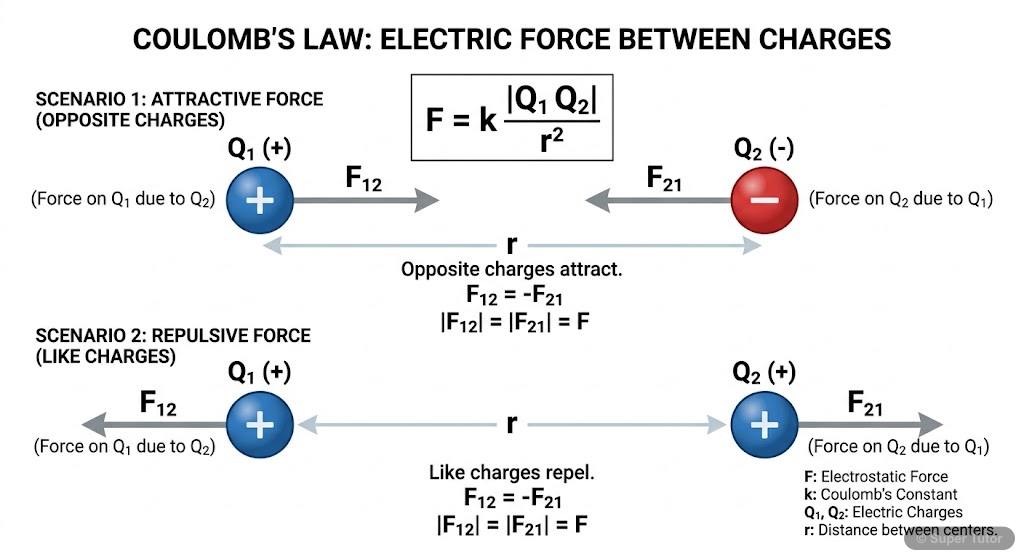
An illustration from Super Tutor's Electric Charges and Fields chapter — alongside flashcards, concept maps and practice questions.
State the law of interaction between electric charges.
Answer
Like charges repel each other while unlike charges attract each other.
Why is repulsion the real test of charge on a body?
Answer
Attraction can occur even between a charged body and an uncharged body due to induction. Repulsion happens only when both bodies are charged with like charge, so it is the definite test.
State the definition of a conductor and give examples.
Answer
Conductors are substances through which electric charge can easily flow. Metals, human body, earth, mercury, and electrolytes are conductors.
State the definition of an insulator and give examples.
Answer
Insulators are substances in which electric charge cannot flow easily. Glass, hard rubber, plastics, and dry wood are insulators.
What is electric charge in terms of electrons in a body?
Answer
If a body has an excess of electrons, it becomes negatively charged. If it has a deficiency of electrons, it becomes positively charged. Only electrons are transferred in ordinary electrification.
How many electrons correspond to a charge of 3.2 × 10^-19 C?
Answer
Given charge, q = 3.2 × 10^-19 C Elementary charge, e = 1.6 × 10^-19 C Formula: n = q / e Step 1: n = (3.2 × 10^-19 C) / (1.6 × 10^-19 C) Step 2: n = 2 Answer: 2 electrons…
State the law of conservation of charge.
Answer
The total amount of charge in an isolated system remains constant.
What is the charge of an electron, proton, and alpha particle?
Answer
Electron: -e Proton: +e Alpha particle: +2e where e = 1.6 × 10^-19 C.
+28 more flashcards
Practise AllFrequently Asked Questions
What are the important topics in Electric Charges and Fields for ICSE Class 12 Physics?
How many flashcards are available for Electric Charges and Fields?
How should I revise Electric Charges and Fields for the ICSE Class 12 board exam?
Sources & Official References
Content is aligned to the official syllabus. Refer to the board website for the latest curriculum.
More resources for Electric Charges and Fields
Practice Quiz
Test yourself with a quick quiz
Important Questions
Exam-style questions with answers
Revision Notes
Key points for last-minute revision
Formula Sheet
The chapter's formulas in one place
Chapter Summary
Understand the chapter at a glance
Concept Maps
See how topics connect
Study Plan
Step-by-step plan for this chapter
Syllabus
What topics to cover
For serious students
Get the full Electric Charges and Fields chapter — start free.
Quizzes, flashcards, an AI doubt solver and a study plan for ICSE Class 12 Physics. Free to start, no card needed.