Atomic Structure
NIOS · Class 10 · Science & Tech
Most important questions from Atomic Structure for NIOS Class 10 Science & Tech board exam 2026. MCQs, short answer, and long answer questions with marks.
Interactive on Super Tutor
Studying Atomic Structure? Get the full interactive chapter.
Quizzes, flashcards, AI doubt-solver and a step-by-step study plan — built for important questions and more.
1,000+ Class 10 students started this chapter today
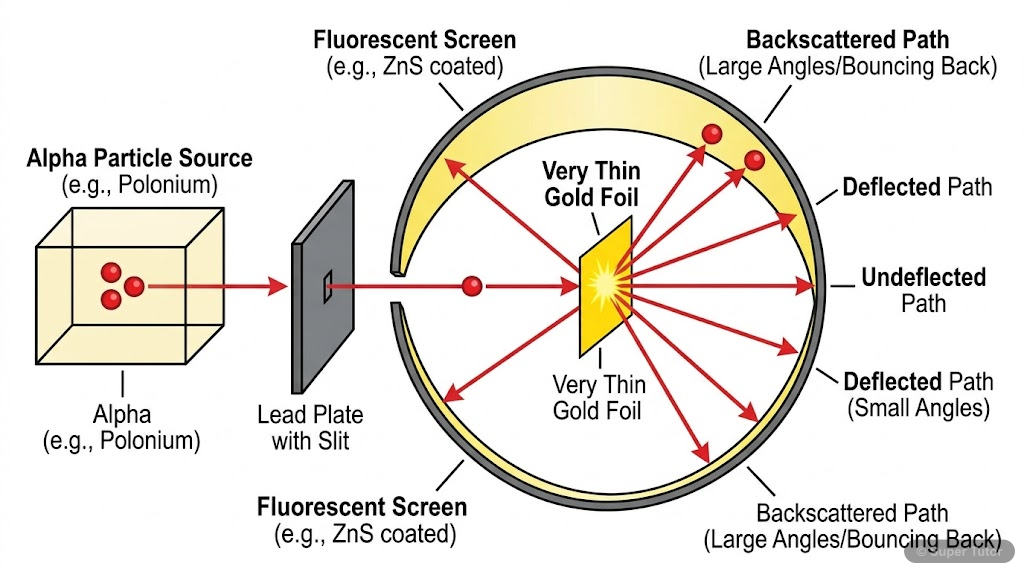
Learn better with visuals Super Tutor has hundreds of illustrations like this across every chapter — all free to try.
Get startedSample Questions
Which model of the atom is compared to a 'plum pudding'?
Show answer
Thomson's model
Thomson's model is called the 'plum pudding' model. Step 1: After discovering electrons, Thomson needed to explain how positive and negative charges were arranged in atoms. Step 2: He proposed atoms were spheres of uniform positive charge with electrons embedded throughout. Step 3: This resembled a plum pudding where the pudding represents positive charge and plums represent electrons. Step 4: The model explained electrical neutrality but was later disproved by Rutherford's experiments. Dalton's model had no internal structure, Rutherford's had a nucleus, and Bohr's had orbital shells.
What is the electronic configuration of sodium (atomic number = 11)?
Show answer
2, 8, 1
Sodium's electronic configuration is 2, 8, 1. Step 1: Sodium has atomic number 11, meaning 11 electrons in a neutral atom. Step 2: Electrons fill shells in order: K shell first (maximum 2), then L shell (maximum 8), then M shell. Step 3: First 2 electrons go to K shell: 2 electrons remaining = 11-2 = 9. Step 4: Next 8 electrons fill L shell: 9-8 = 1 electron remaining for M shell. Therefore: K=2, L=8, M=1 or (2,8,1). This configuration makes sodium highly reactive as it has 1 valence electron.
Which subatomic particle has no electrical charge?
Show answer
Neutron
Neutron has no electrical charge (neutral). Step 1: Atoms contain three fundamental subatomic particles with different charges. Step 2: Electrons carry negative charge (-1), discovered through cathode ray experiments. Step 3: Protons carry positive charge (+1), discovered through canal ray experiments. Step 4: Neutrons carry no charge (0), discovered by Chadwick in 1932, which explained why atomic mass was greater than expected from protons alone. Alpha particles are helium nuclei with +2 charge. Neutrons are essential for nuclear stability.
What is the valency of an element with electronic configuration 2, 8, 7?
Show answer
1
The valency is 1. Step 1: Electronic configuration 2,8,7 means 7 electrons in the outermost (valence) shell. Step 2: For elements with more than 4 valence electrons, valency = 8 - number of valence electrons. Step 3: Valency = 8 - 7 = 1. Step 4: This element (chlorine) needs 1 electron to complete its octet and achieve stability, so it can form 1 bond. Elements try to achieve stable configuration of 8 electrons in outermost shell (octet rule). Valency indicates combining capacity, not the number of valence electrons.
+37 more questions available
Practice AllFrequently Asked Questions
What are the important topics in Atomic Structure for NIOS Class 10 Science & Tech?
How to score full marks in Atomic Structure — NIOS Class 10 Science & Tech?
How many important questions are there in Atomic Structure?
Sources & Official References
Content is aligned to the official syllabus. Refer to the board website for the latest curriculum.
More resources for Atomic Structure
Practice Quiz
Test yourself with a quick quiz
Revision Notes
Key points for last-minute revision
Formula Sheet
All formulas in one place
Chapter Summary
Understand the chapter at a glance
Concept Maps
See how topics connect visually
Study Plan
Step-by-step plan to ace this chapter
Flashcards
Quick-fire cards for active recall
Syllabus
What topics to cover
NCERT Solutions
Every textbook question solved step by step
For serious students
Get the full Atomic Structure chapter — for free.
Quizzes, flashcards, AI doubt-solver and a step-by-step study plan for NIOS Class 10 Science & Tech.