Atomic Structure — Chapter Summary
NIOS · Class 10 · Science & Tech
Summary of Atomic Structure for NIOS Class 10 Science & Tech. Key concepts: Dalton proposed in 1803 that, J and A cathode ray tube consists.
Interactive on Super Tutor
Studying Atomic Structure? Get the full interactive chapter.
Quizzes, flashcards, AI doubt-solver and a step-by-step study plan — built for chapter summary and more.
Free trial, no card needed.
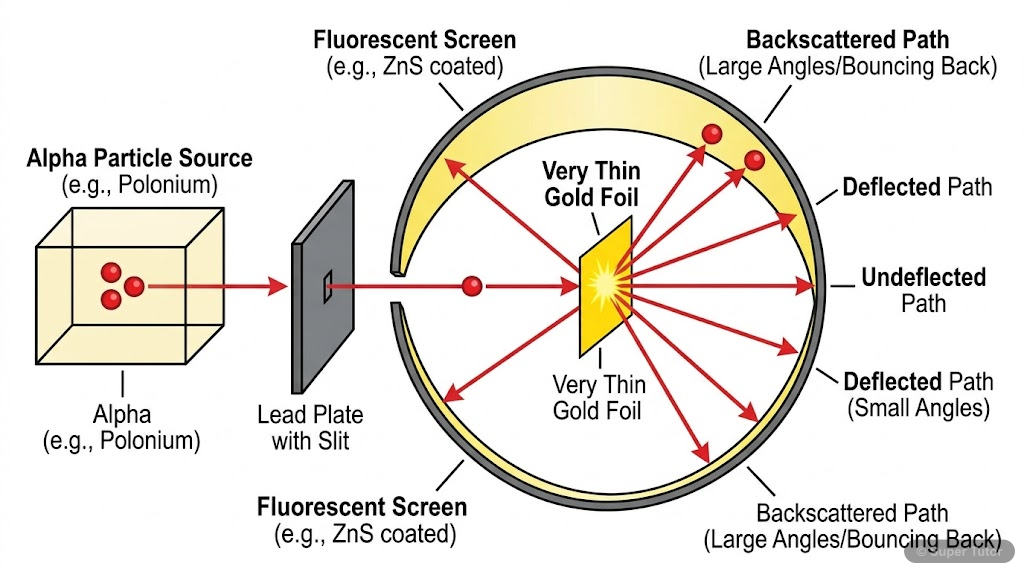
One of 14 illustrations for Atomic Structure in Super Tutor — alongside flashcards, concept maps and practice questions.
Overview
Atomic structure explains how matter is built from smaller particles. Dalton’s idea of an indivisible atom was revised when experiments showed that atoms contain electrons, protons, and neutrons. The chapter traces the discovery of these particles, the development of atomic models, and the rules use
Key Concepts
Dalton proposed in 1803 that
Dalton proposed in 1803 that the atom was the smallest indivisible constituent of matter. The theory explained the law of conservation of mass, the la
J
J.J. Thomson showed in 1897 that cathode rays are streams of negatively charged particles called electrons. An electron has a mass of 9.109389×10^-31
A cathode ray tube consists
A cathode ray tube consists of two metal electrodes in a partially evacuated glass tube connected to a high-voltage source. Cathode rays travel from c
Eugen Goldstein discovered anode rays
Eugen Goldstein discovered anode rays in 1886 using a perforated cathode. The particles were positively charged, and the hydrogen canal-ray particles
Thomson described the atom as
Thomson described the atom as a large sphere of uniform positive charge with small negatively charged electrons scattered throughout it. It is also ca
Learning Objectives
- Recall the evidence showing the presence of charged particles in matter
- Describe the discovery of electron and proton
- Explain Dalton's atomic theory and its failure
- Discuss Thomson's and Rutherford's models of atom and explain their limitations
- Explain Bohr's model of atom in brief
Frequently Asked Questions
What are the important topics in Atomic Structure for NIOS Class 10 Science & Tech?
How should I revise Atomic Structure for the NIOS Class 10 board exam?
Sources & Official References
Content is aligned to the official syllabus. Refer to the board website for the latest curriculum.
More resources for Atomic Structure
Practice Quiz
Test yourself with a quick quiz
Important Questions
Exam-style questions with answers
Revision Notes
Key points for last-minute revision
Formula Sheet
The chapter's formulas in one place
Concept Maps
See how topics connect
Study Plan
Step-by-step plan for this chapter
Flashcards
Quick-fire cards for active recall
Syllabus
What topics to cover
For serious students
Get the full Atomic Structure chapter — start free.
Quizzes, flashcards, an AI doubt solver and a study plan for NIOS Class 10 Science & Tech. Free to start, no card needed.