Political Parties And Pressure Groups — Chapter Summary
NIOS · Class 10 · Social Studies
Summary of Political Parties And Pressure Groups for NIOS Class 10 Social Studies. Part of the NIOS Class 10 Social Studies syllabus.
Interactive on Super Tutor
Studying Political Parties And Pressure Groups? Get the full interactive chapter.
Quizzes, flashcards, AI doubt-solver and a step-by-step study plan — built for chapter summary and more.
Free trial, no card needed.
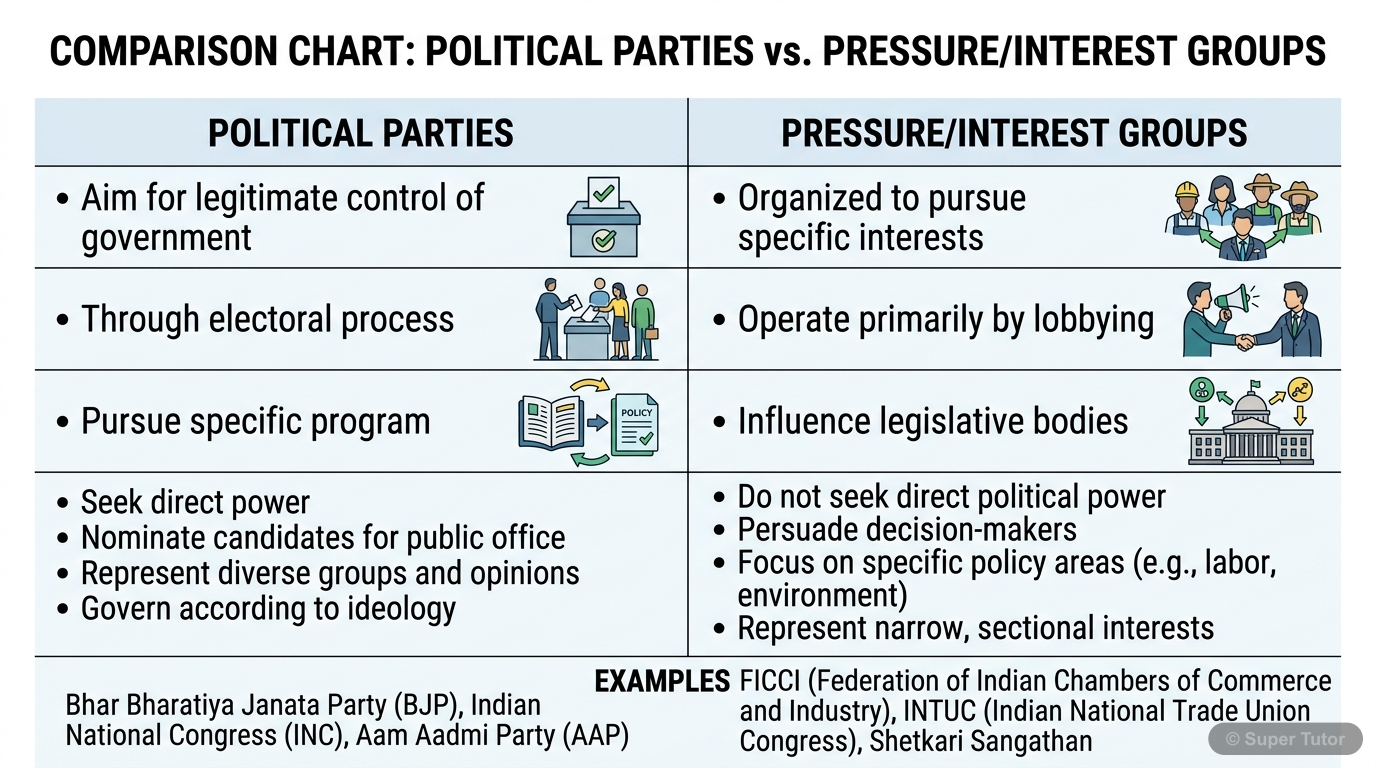
Learn better with visuals Super Tutor pairs illustrations like this with notes and quizzes for Political Parties And Pressure Groups.
Overview
Political parties and pressure groups are essential parts of a democratic system. Political parties help people choose representatives, form governments, and shape public policy through elections. Pressure groups and interest groups support different causes and try to influence government decisions
Key Concepts
A political party is an organized
A political party is an organized group of people with common political views and goals. It seeks political power through constitutional and peaceful
Gilchrist defines a political party as
Gilchrist defines a political party as an organized group of citizens sharing the same political views and trying to control the government as a polit
Political parties nominate candidates
Political parties nominate candidates, campaign in elections, present manifestos, form governments when they win, act as opposition when they lose, sh
India first saw the rise
India first saw the rise of parties with the Indian National Congress in 1885. Congress dominated national politics till 1967. After that, coalition p
The Election Commission grants national party
The Election Commission grants national party status on specific grounds, including recognition in four or more states, minimum seat share, and minimu
Learning Objectives
- Understand the meaning and characteristics of a political party
- Identify the main functions of political parties in democracy
- Explain the growth of political parties in India
- Classify political parties in India into national, state, and registered parties
- Describe the major policies of important national parties
Frequently Asked Questions
What are the important topics in Political Parties And Pressure Groups for NIOS Class 10 Social Studies?
How should I revise Political Parties And Pressure Groups for the NIOS Class 10 board exam?
Sources & Official References
Content is aligned to the official syllabus. Refer to the board website for the latest curriculum.
More resources for Political Parties And Pressure Groups
For serious students
Get the full Political Parties And Pressure Groups chapter — start free.
Quizzes, flashcards, an AI doubt solver and a study plan for NIOS Class 10 Social Studies. Free to start, no card needed.