Modern World-I — Chapter Summary
NIOS · Class 10 · Social Studies
Summary of Modern World-I for NIOS Class 10 Social Studies. Part of the NIOS Class 10 Social Studies syllabus.
Interactive on Super Tutor
Studying Modern World-I? Get the full interactive chapter.
Quizzes, flashcards, AI doubt-solver and a step-by-step study plan — built for chapter summary and more.
Free trial, no card needed.
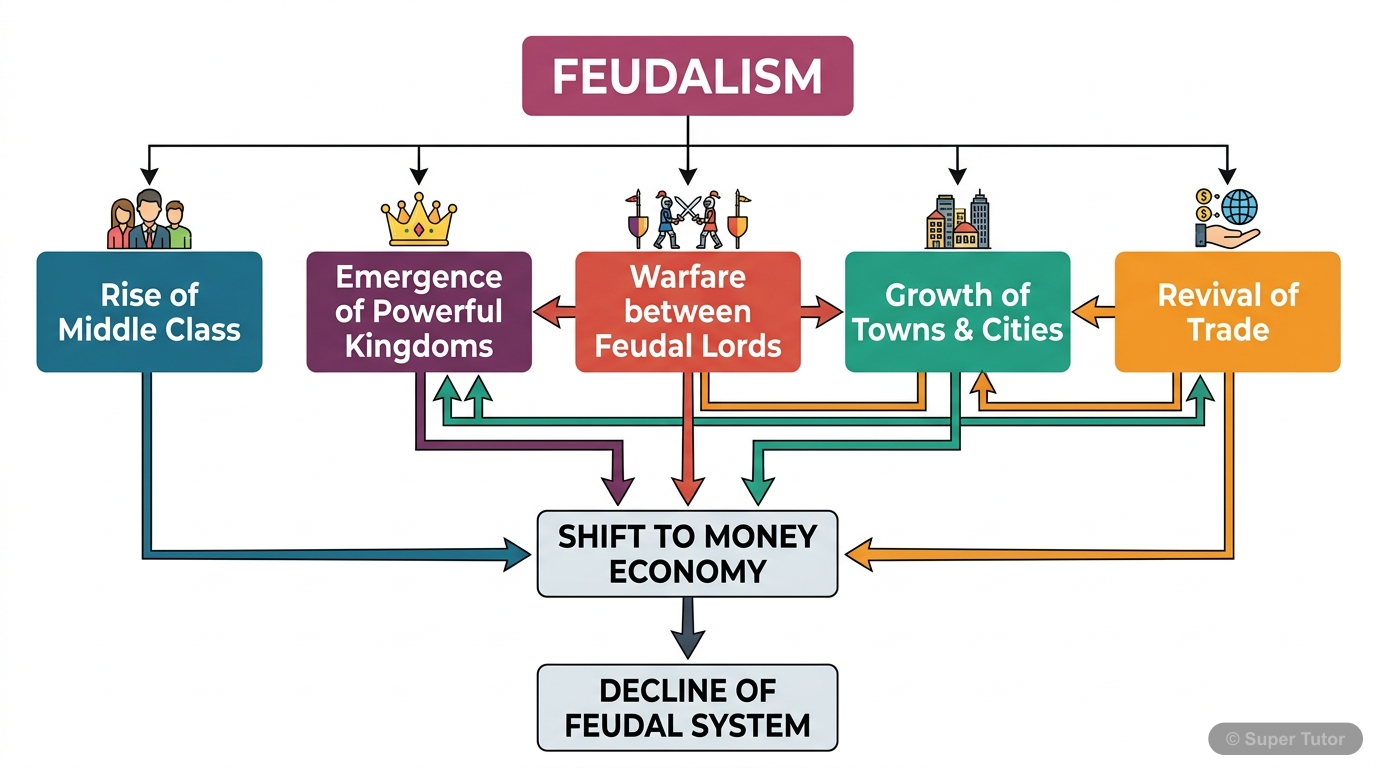
One of 8 illustrations for Modern World-I in Super Tutor — alongside flashcards, concept maps and practice questions.
Overview
Modern World-I traces the major changes that moved Europe from medieval society into the modern age. The chapter connects the decline of feudalism, the Renaissance, the Reformation, the growth of science, voyages of discovery, the Industrial Revolution, and the rise of revolutions in America, France
Key Concepts
Feudalism weakened because of the rise
Feudalism weakened because of the rise of the middle class, growth of powerful kingdoms, warfare among feudal lords, expansion of towns and cities, an
Renaissance means rebirth
Renaissance means rebirth. It started in Italy around the 14th century AD and was marked by reason, humanism, rational thinking, observation, experime
Humanism placed human beings at
Humanism placed human beings at the centre of study and valued their creative potential. Writers used local languages instead of Latin, and the printi
The Reformation began in Germany
The Reformation began in Germany with Martin Luther in 1517 AD. He challenged Church authority, rejected the sale of church positions and indulgences,
The Counter Reformation was a reform
The Counter Reformation was a reform movement within the Catholic Church. Ignatius Loyola founded the Society of Jesus in Spain, and it stressed servi
Learning Objectives
- Explain the decline of feudalism and the rise of towns, trade, and the merchant class.
- Describe the meaning, features, and importance of the Renaissance.
- Explain the causes and impact of the Reformation and Counter Reformation.
- Describe the growth of science during the Renaissance and the work of major scientists.
- Identify the motives and effects of voyages of discovery.
Frequently Asked Questions
What are the important topics in Modern World-I for NIOS Class 10 Social Studies?
How should I revise Modern World-I for the NIOS Class 10 board exam?
Sources & Official References
Content is aligned to the official syllabus. Refer to the board website for the latest curriculum.
More resources for Modern World-I
For serious students
Get the full Modern World-I chapter — start free.
Quizzes, flashcards, an AI doubt solver and a study plan for NIOS Class 10 Social Studies. Free to start, no card needed.