Modern World-I — Syllabus
NIOS · Class 10 · Social Studies
What Modern World-I covers in NIOS Class 10 Social Studies: 4 topics, for the 2026-27 session. Part of the NIOS Class 10 Social Studies syllabus.
Interactive on Super Tutor
Studying Modern World-I? Get the full interactive chapter.
Quizzes, flashcards, AI doubt-solver and a step-by-step study plan — built for syllabus and more.
Free trial, no card needed.
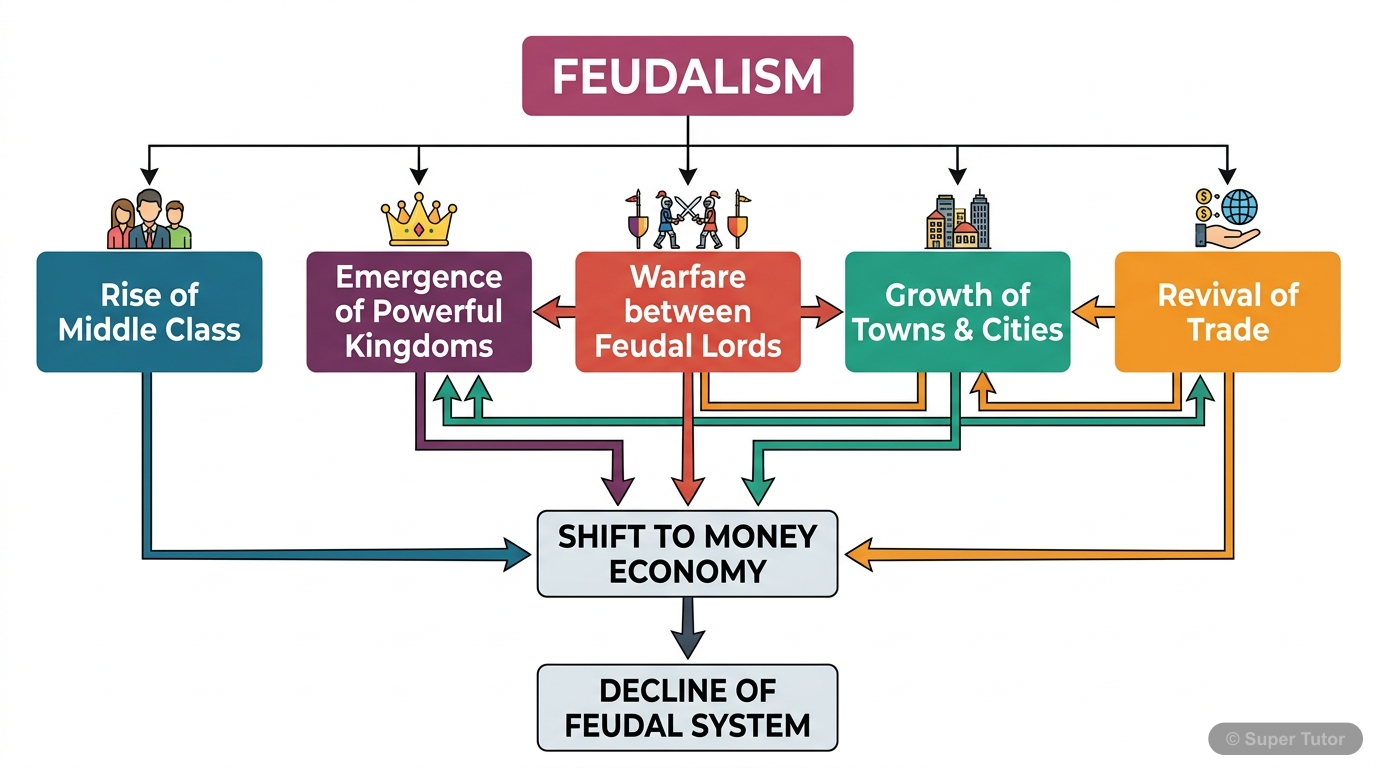
One of 8 illustrations for Modern World-I in Super Tutor — alongside flashcards, concept maps and practice questions.
Topics in Modern World-I
1. Decline of Feudalism and the Rise of New Towns
- Feudalism declined because of the rise of the middle class, powerful kingdoms, warfare between feudal lords, new towns, and the revival of trade.
- Towns became centres of production and were governed by elected representatives.
- People in towns were free from feudal restrictions and could choose their work and movement.
2. Renaissance
- Renaissance means rebirth.
- It started in Italy around the 14th century AD.
- Italian cities were important trading and intellectual centres.
3. Reformation and Counter Reformation
- The Catholic Church was seen as corrupt, superstitious, and greedy for money.
- Martin Luther first challenged the authority of the Roman Catholic Church in 1517 AD.
- Luther believed that the Bible was the only source of religious authority.
4. Development of Science
- Renaissance thinkers stressed reason, observation, and experimentation.
- Scientific inquiry grew strongly during this period.
- Michael Servetus discovered the circulation of blood.
Key Concepts
Central concept: Transformation from medieval Europe to the modern world through Renaissance, Reformation, science, exploration, revolutions, unification, and socialism
Work through every topic in Modern World-I with notes and quizzes
Start This ChapterFrequently Asked Questions
What are the important topics in Modern World-I for NIOS Class 10 Social Studies?
How should I revise Modern World-I for the NIOS Class 10 board exam?
Sources & Official References
Content is aligned to the official syllabus. Refer to the board website for the latest curriculum.
More resources for Modern World-I
Practice Quiz
Test yourself with a quick quiz
Important Questions
Exam-style questions with answers
Revision Notes
Key points for last-minute revision
Chapter Summary
Understand the chapter at a glance
Concept Maps
See how topics connect
Study Plan
Step-by-step plan for this chapter
Flashcards
Quick-fire cards for active recall
For serious students
Get the full Modern World-I chapter — start free.
Quizzes, flashcards, an AI doubt solver and a study plan for NIOS Class 10 Social Studies. Free to start, no card needed.