Political Parties And Pressure Groups — Syllabus
NIOS · Class 10 · Social Studies
What Political Parties And Pressure Groups covers in NIOS Class 10 Social Studies: 4 topics, for the 2026-27 session.
Interactive on Super Tutor
Studying Political Parties And Pressure Groups? Get the full interactive chapter.
Quizzes, flashcards, AI doubt-solver and a step-by-step study plan — built for syllabus and more.
Free trial, no card needed.
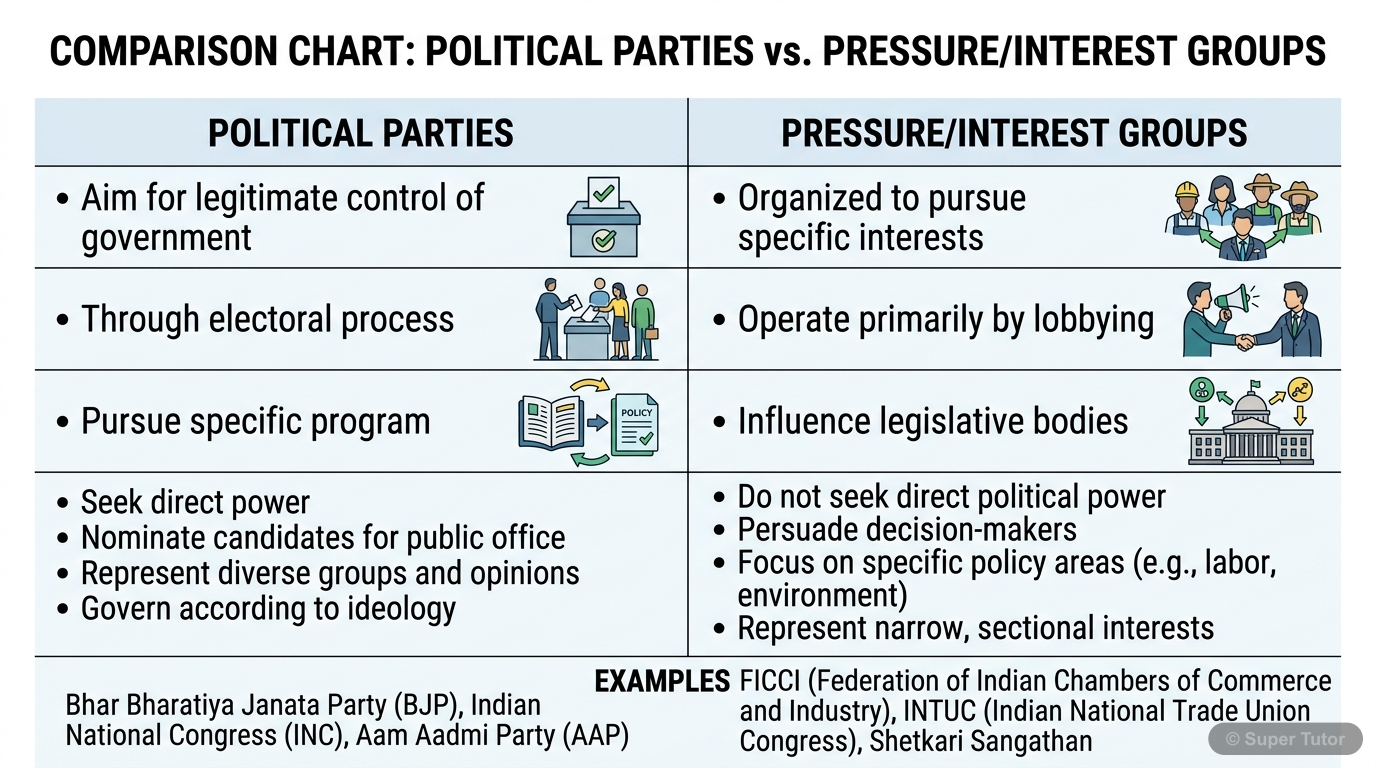
Learn better with visuals Super Tutor pairs illustrations like this with notes and quizzes for Political Parties And Pressure Groups.
Topics in Political Parties And Pressure Groups
1. Meaning and Need for Political Parties
- A political party is an organized group of people with common political views and goals.
- Political parties seek political power through constitutional and peaceful means.
- They help people choose representatives in elections.
2. Definitions Given by Political Scientists
- Gilchrist defined a political party as an organized group of citizens who share the same political views and try to control the government as a political unit.
- Gettell defined a political party as a more or less organized group of citizens who use voting power to control the government and carry out general policies.
- Both definitions show that parties are organized and power-oriented.
3. Evolution of Political Parties in India
- The establishment of the Indian National Congress in 1885 is considered the beginning of the formation of parties in India.
- Congress led the freedom struggle and later became the dominant national party.
- Congress remained dominant in 1952, 1957, 1962, and 1967 at the Centre and in almost all States.
4. Features of the Indian Party System
- India has a multi-party system.
- The contemporary system shows bi-nodal tendencies, with Congress and BJP as two poles.
- Regional parties play a major role in forming governments at the Centre.
Key Concepts
Central concept: Political Parties and Pressure Groups in Democracy
Work through every topic in Political Parties And Pressure Groups with notes and quizzes
Start This ChapterFrequently Asked Questions
What are the important topics in Political Parties And Pressure Groups for NIOS Class 10 Social Studies?
How should I revise Political Parties And Pressure Groups for the NIOS Class 10 board exam?
Sources & Official References
Content is aligned to the official syllabus. Refer to the board website for the latest curriculum.
More resources for Political Parties And Pressure Groups
Practice Quiz
Test yourself with a quick quiz
Important Questions
Exam-style questions with answers
Revision Notes
Key points for last-minute revision
Chapter Summary
Understand the chapter at a glance
Concept Maps
See how topics connect
Study Plan
Step-by-step plan for this chapter
Flashcards
Quick-fire cards for active recall
For serious students
Get the full Political Parties And Pressure Groups chapter — start free.
Quizzes, flashcards, an AI doubt solver and a study plan for NIOS Class 10 Social Studies. Free to start, no card needed.