Elastic Properties of solids — Chapter Summary
NIOS · Class 12 · Physics
Summary of Elastic Properties of solids for NIOS Class 12 Physics. Part of the NIOS Class 12 Physics syllabus.
Interactive on Super Tutor
Studying Elastic Properties of solids? Get the full interactive chapter.
Quizzes, flashcards, AI doubt-solver and a step-by-step study plan — built for chapter summary and more.
Free trial, no card needed.
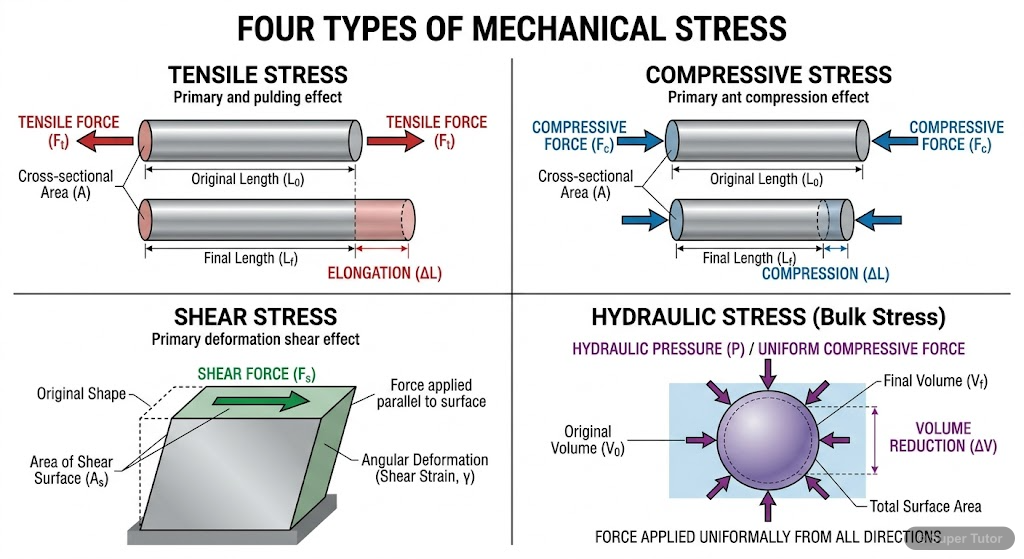
Learn better with visuals Super Tutor pairs illustrations like this with notes and quizzes for Elastic Properties of solids.
Overview
When a force is applied on a solid body, it may change its shape or size. Some materials, like a spring or a steel wire, return to their original form once the force is removed. Others, like wet clay, do not. This behaviour is governed by a fundamental property of matter called elasticity. In this c
Key Concepts
All matter is made up
All matter is made up of atoms and molecules. The forces between them — called intermolecular forces — determine the state of matter. At equilibrium s
Elasticity is the property of
Elasticity is the property of a material to regain its original shape and size after the deforming force is removed. A perfectly elastic body regains
When a deforming force is applied
When a deforming force is applied on a body, an internal restoring force develops inside the body that opposes the deformation. Stress is defined as t
Strain is defined as the ratio
Strain is defined as the ratio of the change in dimension to the original dimension of the body. Since it is a ratio of two similar quantities, strain
When a metallic wire is loaded
When a metallic wire is loaded progressively, the graph of stress vs strain shows several important regions: (1) OA — Region of Proportionality: Strai
Learning Objectives
- Distinguish between the three states of matter based on intermolecular forces and separation
- Understand the difference between elastic and plastic bodies with examples
- Define stress and strain, and distinguish between their different types
- Analyse and interpret the stress-strain curve for a metallic wire and rubber
- State and apply Hooke's Law to solve numerical problems
Frequently Asked Questions
What are the important topics in Elastic Properties of solids for NIOS Class 12 Physics?
How should I revise Elastic Properties of solids for the NIOS Class 12 board exam?
Sources & Official References
Content is aligned to the official syllabus. Refer to the board website for the latest curriculum.
More resources for Elastic Properties of solids
Practice Quiz
Test yourself with a quick quiz
Important Questions
Exam-style questions with answers
Revision Notes
Key points for last-minute revision
Formula Sheet
The chapter's formulas in one place
Concept Maps
See how topics connect
Study Plan
Step-by-step plan for this chapter
Flashcards
Quick-fire cards for active recall
Syllabus
What topics to cover
For serious students
Get the full Elastic Properties of solids chapter — start free.
Quizzes, flashcards, an AI doubt solver and a study plan for NIOS Class 12 Physics. Free to start, no card needed.