Elastic Properties of solids — Revision Notes
NIOS · Class 12 · Physics
Elastic Properties of solids revision notes for NIOS Class 12 Physics: 4 topics in quick points. Part of the NIOS Class 12 Physics syllabus.
Interactive on Super Tutor
Studying Elastic Properties of solids? Get the full interactive chapter.
Quizzes, flashcards, AI doubt-solver and a step-by-step study plan — built for revision notes and more.
Free trial, no card needed.
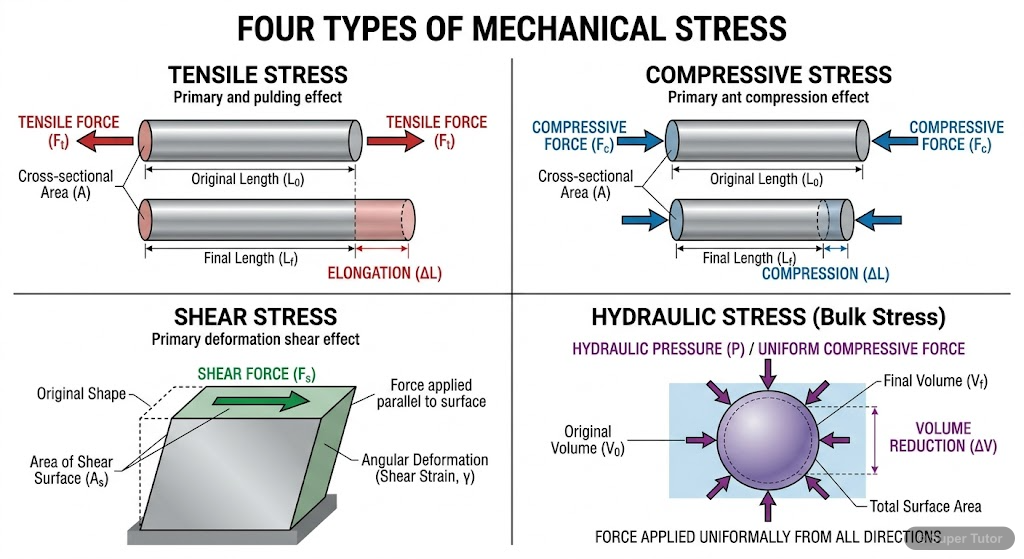
Learn better with visuals Super Tutor pairs illustrations like this with notes and quizzes for Elastic Properties of solids.
Key Topics to Revise
Molecular Theory of Matter and Intermolecular Forces
- All matter is made of atoms and molecules held together by intermolecular forces.
- At equilibrium separation R₀ (≈ 10⁻¹⁰ m for solids), the net intermolecular force is zero.
- When R > R₀: attractive force acts between molecules.
Elasticity, Elastic and Plastic Bodies
- Elasticity is the property of matter to regain its original shape and size after removal of the deforming force.
- Perfectly Elastic Body: regains original state completely on removal of deforming force. Example: Quartz fiber (nearest to perfectly elastic).
- Perfectly Plastic Body: does not regain original shape at all. Example: Ordinary putty (nearest to perfectly plastic).
Stress — Definition, Types and Formula
- When a deforming force is applied, internal restoring forces develop inside the body that oppose the deformation.
- Stress = Internal Restoring Force per unit area of cross-section.
- At equilibrium, restoring force = deforming force in magnitude (but opposite in direction).
Strain — Definition, Types and Formula
- Strain is the change in dimension per unit original dimension of a body due to deforming force.
- Strain is a DIMENSIONLESS and UNITLESS quantity (ratio of two similar quantities).
- Three types of strain correspond to three types of stress: Linear Strain, Volume (Bulk) Strain, and Shearing Strain.
Get complete notes with diagrams and examples
Full NotesKey Concepts
Frequently Asked Questions
What are the important topics in Elastic Properties of solids for NIOS Class 12 Physics?
How should I revise Elastic Properties of solids for the NIOS Class 12 board exam?
Sources & Official References
Content is aligned to the official syllabus. Refer to the board website for the latest curriculum.
More resources for Elastic Properties of solids
Practice Quiz
Test yourself with a quick quiz
Important Questions
Exam-style questions with answers
Formula Sheet
The chapter's formulas in one place
Chapter Summary
Understand the chapter at a glance
Concept Maps
See how topics connect
Study Plan
Step-by-step plan for this chapter
Flashcards
Quick-fire cards for active recall
Syllabus
What topics to cover
For serious students
Get the full Elastic Properties of solids chapter — start free.
Quizzes, flashcards, an AI doubt solver and a study plan for NIOS Class 12 Physics. Free to start, no card needed.