Wave Phenomena and Light — Flashcards
NIOS · Class 12 · Physics
30 flashcards for Wave Phenomena and Light (NIOS Class 12 Physics) to test yourself on key terms and facts. Part of the NIOS Class 12 Physics syllabus.
Interactive on Super Tutor
Studying Wave Phenomena and Light? Get the full interactive chapter.
Quizzes, flashcards, AI doubt-solver and a step-by-step study plan — built for flashcards and more.
Free trial, no card needed.
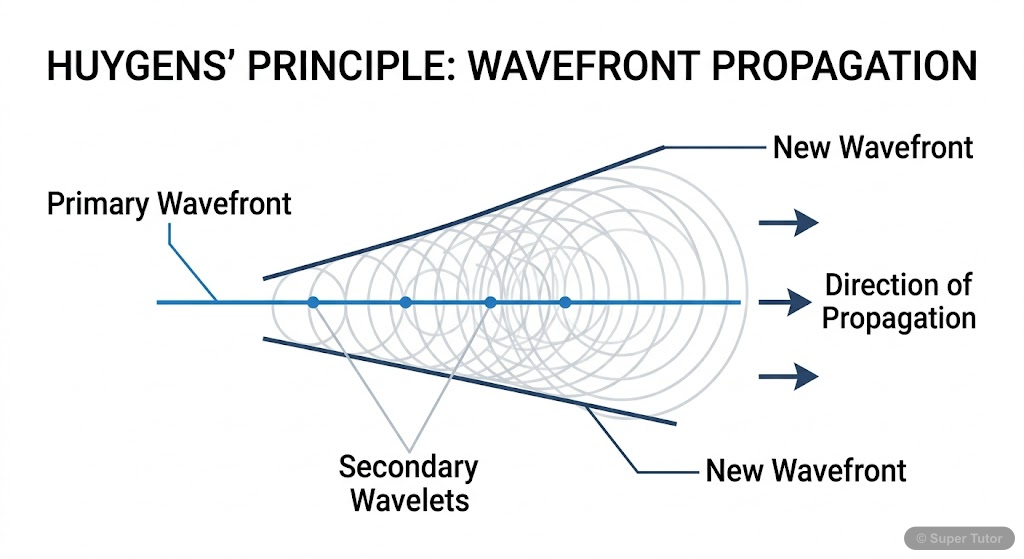
One of 7 illustrations for Wave Phenomena and Light in Super Tutor — alongside flashcards, concept maps and practice questions.
State Huygens' Principle. What are its two key postulates?
Answer
Huygens' Principle states: 1. Every point on a given wavefront acts as a source of new secondary disturbances called secondary wavelets, which spread out in all directions with the speed of light in …
What is a Wavefront? Name the types of wavefronts and the sources that produce them.
Answer
Wavefront: The locus of all points in a medium that are vibrating in the same phase at a given instant of time. Types of Wavefronts: 1. Spherical Wavefront → produced by a point source of light (wave…
At t = 0 s, a secondary wavelet is emitted from a point on a wavefront. If the speed of light in the medium is 3 × 10⁸ m/s, find the radii of the wavelet at t = 2 s and t = 5 s. What is their ratio?
Answer
Given: Speed of light, v = 3 × 10⁸ m/s t₁ = 2 s, t₂ = 5 s Formula: Radius = v × t Step 1: Radius at t₁ = 2 s r₁ = 3 × 10⁸ × 2 = 6 × 10⁸ m Step 2: Radius at t₂ = 5 s r₂ = 3 × 10⁸ × 5 = 15 × 10⁸ m S…
What are Coherent Sources of light? Why are coherent sources necessary for observing interference?
Answer
Coherent Sources: Two light sources are said to be coherent if they emit light waves of: • Same frequency • Same amplitude (ideally) • Constant (fixed) phase difference between them at all times Why …
State the conditions for Constructive and Destructive Interference in terms of (a) Phase Difference and (b) Path Difference.
Answer
CONSTRUCTIVE INTERFERENCE (Bright Fringes): (a) Phase difference: δ = 0, 2π, 4π, ... = 2nπ (where n = 0, 1, 2, ...) (b) Path difference: Δ = 0, λ, 2λ, ... = nλ → Waves arrive IN PHASE → amplitudes add…
Derive the expression for Fringe Width (β) in Young's Double Slit Experiment.
Answer
Setup: Two slits S₁ and S₂, separated by distance d. Screen at distance D. Wavelength = λ. Position of nth Bright Fringe: xₙ (bright) = nλD/d Position of (n+1)th Bright Fringe: x_(n+1) (bright) = (n…
In Young's double slit experiment, the slits are 0.5 mm apart and the screen is placed 1.0 m away. Find the fringe width when light of wavelength 600 nm is used.
Answer
Given: d = 0.5 mm = 0.5 × 10⁻³ m = 5 × 10⁻⁴ m D = 1.0 m λ = 600 nm = 600 × 10⁻⁹ m = 6 × 10⁻⁷ m Formula: β = λD/d Step 1: Substitute values β = (6 × 10⁻⁷ × 1.0) / (5 × 10⁻⁴) Step 2: Calculate β = (6…
In Young's double slit experiment, 10 fringes are observed in a length of 2 cm on the screen. The screen is at 1 m from the slits and wavelength used is 500 nm. Find the slit separation.
Answer
Given: Number of fringes = 10 Total length = 2 cm = 2 × 10⁻² m D = 1 m λ = 500 nm = 5 × 10⁻⁷ m Step 1: Find fringe width β = Total length / Number of fringes β = (2 × 10⁻²) / 10 = 2 × 10⁻³ m Step 2:…
+22 more flashcards
Practise AllFrequently Asked Questions
What are the important topics in Wave Phenomena and Light for NIOS Class 12 Physics?
How many flashcards are available for Wave Phenomena and Light?
How should I revise Wave Phenomena and Light for the NIOS Class 12 board exam?
Sources & Official References
Content is aligned to the official syllabus. Refer to the board website for the latest curriculum.
More resources for Wave Phenomena and Light
Practice Quiz
Test yourself with a quick quiz
Important Questions
Exam-style questions with answers
Revision Notes
Key points for last-minute revision
Formula Sheet
The chapter's formulas in one place
Chapter Summary
Understand the chapter at a glance
Concept Maps
See how topics connect
Study Plan
Step-by-step plan for this chapter
Syllabus
What topics to cover
For serious students
Get the full Wave Phenomena and Light chapter — start free.
Quizzes, flashcards, an AI doubt solver and a study plan for NIOS Class 12 Physics. Free to start, no card needed.