Wave Phenomena and Light — Revision Notes
NIOS · Class 12 · Physics
Wave Phenomena and Light revision notes for NIOS Class 12 Physics: 4 topics in quick points. Part of the NIOS Class 12 Physics syllabus.
Interactive on Super Tutor
Studying Wave Phenomena and Light? Get the full interactive chapter.
Quizzes, flashcards, AI doubt-solver and a step-by-step study plan — built for revision notes and more.
Free trial, no card needed.
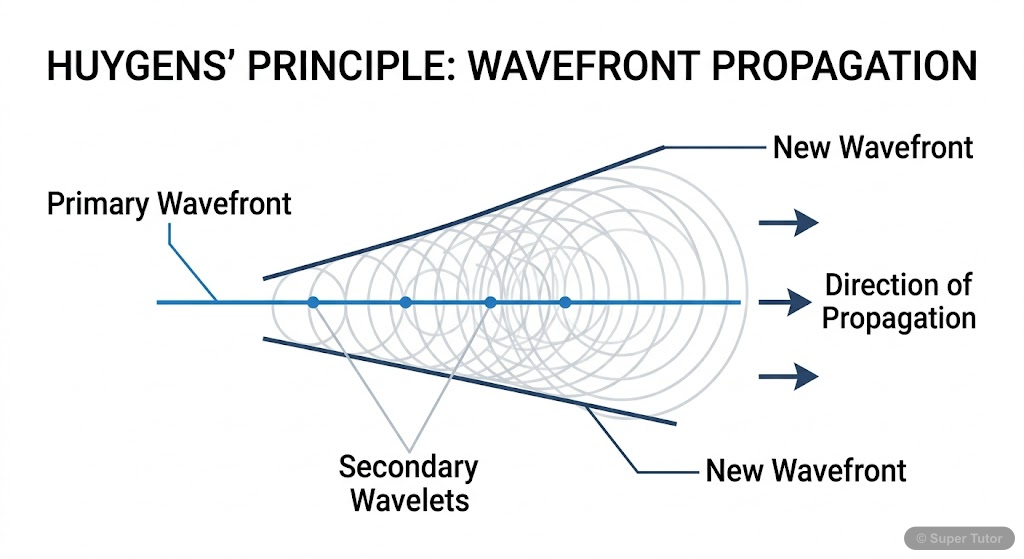
One of 7 illustrations for Wave Phenomena and Light in Super Tutor — alongside flashcards, concept maps and practice questions.
Key Topics to Revise
Huygens' Principle and Wave Propagation
- Christian Huygens postulated that light is a wave that travels through a hypothetical medium called 'ether' (now considered obsolete, but the wave theory remains valid).
- A WAVEFRONT is defined as the locus of all points of a medium that vibrate in the same phase at any given instant of time.
- A point source produces SPHERICAL wavefronts. A line source produces CYLINDRICAL wavefronts. A distant source produces PLANE wavefronts.
Interference of Light — Young's Double Slit Experiment
- Interference is the redistribution of energy (not creation or destruction of energy) when two or more coherent light waves superpose.
- Thomas Young first demonstrated interference of light experimentally in 1802 using his famous Double Slit Experiment (YDSE).
- COHERENT SOURCES are sources that emit light waves of the same frequency, same amplitude, and maintain a constant phase difference between them.
Diffraction of Light
- Diffraction is the bending of light around the corners of an obstacle or through an aperture, into the region of geometric shadow.
- Diffraction is a wave phenomenon — it proves that light behaves as a wave.
- Condition for observing diffraction: size of obstacle/aperture should be of the ORDER OF the wavelength of light (≈ 10⁻⁶ m for visible light).
Polarisation of Light
- Polarisation conclusively proves that light is a TRANSVERSE wave (vibrations perpendicular to the direction of propagation).
- Longitudinal waves (like sound) CANNOT be polarised — if sound could be polarised, it would prove sound is transverse, which it is not.
- UNPOLARISED LIGHT: The electric field vibrates in ALL possible directions (in a plane perpendicular to direction of propagation) randomly and rapidly.
Get complete notes with diagrams and examples
Full NotesKey Concepts
Frequently Asked Questions
What are the important topics in Wave Phenomena and Light for NIOS Class 12 Physics?
How should I revise Wave Phenomena and Light for the NIOS Class 12 board exam?
Sources & Official References
Content is aligned to the official syllabus. Refer to the board website for the latest curriculum.
More resources for Wave Phenomena and Light
Practice Quiz
Test yourself with a quick quiz
Important Questions
Exam-style questions with answers
Formula Sheet
The chapter's formulas in one place
Chapter Summary
Understand the chapter at a glance
Concept Maps
See how topics connect
Study Plan
Step-by-step plan for this chapter
Flashcards
Quick-fire cards for active recall
Syllabus
What topics to cover
For serious students
Get the full Wave Phenomena and Light chapter — start free.
Quizzes, flashcards, an AI doubt solver and a study plan for NIOS Class 12 Physics. Free to start, no card needed.