Wave Phenomena and Light — Chapter Summary
NIOS · Class 12 · Physics
Summary of Wave Phenomena and Light for NIOS Class 12 Physics. Key concepts: A wavefront is the locus, The Principle of Superposition and Interference is.
Interactive on Super Tutor
Studying Wave Phenomena and Light? Get the full interactive chapter.
Quizzes, flashcards, AI doubt-solver and a step-by-step study plan — built for chapter summary and more.
Free trial, no card needed.
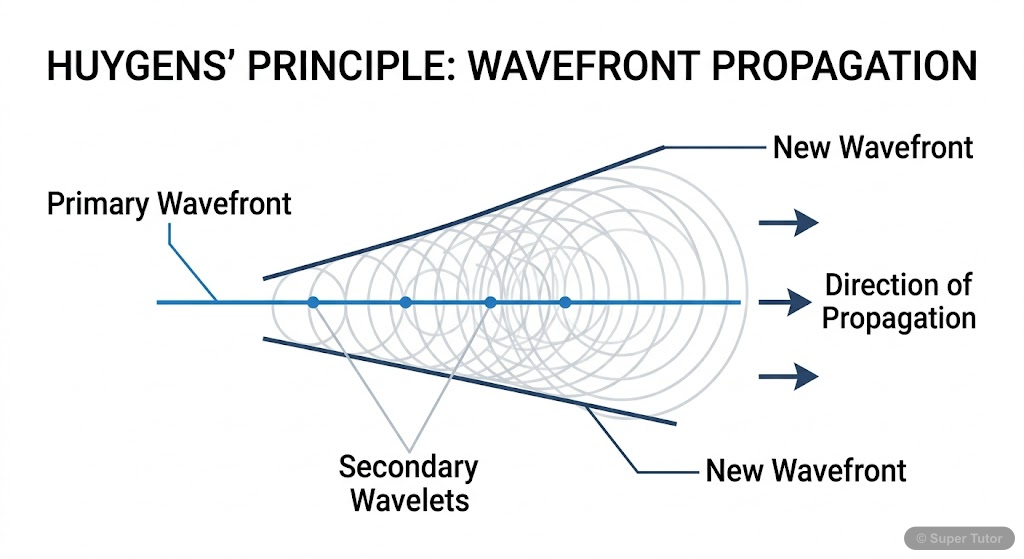
One of 7 illustrations for Wave Phenomena and Light in Super Tutor — alongside flashcards, concept maps and practice questions.
Overview
In our everyday life, we see light travelling in straight lines — forming shadows, reflecting off mirrors, and bending through lenses. But this simple picture of light breaks down when we look more carefully. When light passes through very narrow openings or encounters tiny obstacles, it bends aroun
Key Concepts
A wavefront is the locus
A wavefront is the locus of all points in a medium that are vibrating in the same phase at a given instant. Think of it like circular ripples on a pon
The Principle of Superposition states
The Principle of Superposition states that when two or more waves overlap at a point, the resultant displacement at that point is the algebraic sum of
Interference is the redistribution of energy
Interference is the redistribution of energy when two coherent light waves superpose. In Young's Double Slit Experiment, monochromatic light passes th
Diffraction is the bending of light
Diffraction is the bending of light around the edges of an obstacle or aperture. It is most prominently observed when the size of the aperture or obst
Polarisation is the phenomenon where
Polarisation is the phenomenon where the vibrations of a light wave are confined to a single plane containing the direction of propagation. It is the
Learning Objectives
- State Huygens' Principle and use it to explain how light waves propagate as wavefronts
- Understand the concept of coherent sources and the principle of superposition of waves
- Explain the phenomenon of interference of light and derive conditions for bright and dark fringes
- Describe Young's Double Slit Experiment and derive the expression for fringe width
- Explain the phenomenon of diffraction of light at a single slit and understand the intensity distribution
Frequently Asked Questions
What are the important topics in Wave Phenomena and Light for NIOS Class 12 Physics?
How should I revise Wave Phenomena and Light for the NIOS Class 12 board exam?
Sources & Official References
Content is aligned to the official syllabus. Refer to the board website for the latest curriculum.
More resources for Wave Phenomena and Light
Practice Quiz
Test yourself with a quick quiz
Important Questions
Exam-style questions with answers
Revision Notes
Key points for last-minute revision
Formula Sheet
The chapter's formulas in one place
Concept Maps
See how topics connect
Study Plan
Step-by-step plan for this chapter
Flashcards
Quick-fire cards for active recall
Syllabus
What topics to cover
For serious students
Get the full Wave Phenomena and Light chapter — start free.
Quizzes, flashcards, an AI doubt solver and a study plan for NIOS Class 12 Physics. Free to start, no card needed.