Laws of Motion — Revision Notes
NIOS · Class 12 · Physics
Laws of Motion revision notes for NIOS Class 12 Physics: 4 topics in quick points. Part of the NIOS Class 12 Physics syllabus.
Interactive on Super Tutor
Studying Laws of Motion? Get the full interactive chapter.
Quizzes, flashcards, AI doubt-solver and a step-by-step study plan — built for revision notes and more.
Free trial, no card needed.
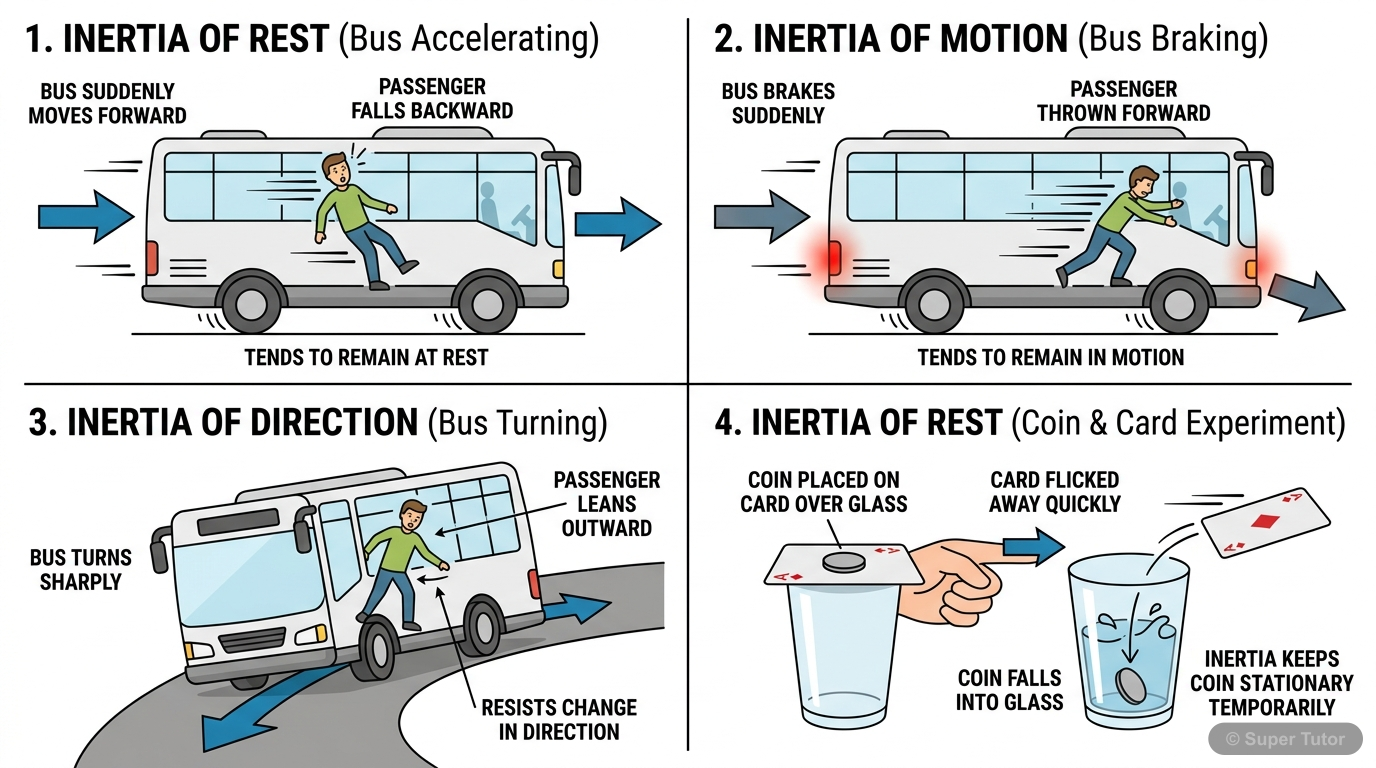
One of 8 illustrations for Laws of Motion in Super Tutor — alongside flashcards, concept maps and practice questions.
Key Topics to Revise
1. Concept of Inertia and Force
- Inertia is the natural tendency of a body to resist any change in its state of rest or uniform motion in a straight line.
- Mass is the measure of inertia – a heavier body has more inertia and is harder to accelerate or decelerate.
- Force is a vector quantity that can change the shape, size, speed, or direction of motion of a body.
2. Newton's First Law of Motion
- Statement: A body continues to remain in its state of rest or of uniform motion in a straight line unless acted upon by a net external (unbalanced) force.
- This law is also called the Law of Inertia.
- It defines force qualitatively – force is that which changes the state of motion.
3. Linear Momentum and Newton's Second Law
- Linear Momentum (p) = mass × velocity. It is a vector quantity with direction same as velocity.
- SI unit of momentum: kg m/s or N·s
- Newton's Second Law: The rate of change of momentum of a body is directly proportional to the net external force acting on it, and the change occurs in the direction of the force.
4. Newton's Third Law and Conservation of Momentum
- Newton's Third Law: When two bodies interact, force exerted by body A on body B is equal in magnitude and opposite in direction to force exerted by B on A. F₁₂ = -F₂₁
- Action and reaction forces are ALWAYS equal in magnitude, opposite in direction, and act on DIFFERENT bodies – they never cancel each other.
- Common examples: (a) Rocket propulsion – gases pushed back, rocket moves forward. (b) Swimming – hand pushes water back, body moves forward. (c) Recoil of gun – bullet moves forward, gun kicks back. (
Get complete notes with diagrams and examples
Full NotesKey Concepts
Frequently Asked Questions
What are the important topics in Laws of Motion for NIOS Class 12 Physics?
How should I revise Laws of Motion for the NIOS Class 12 board exam?
Sources & Official References
Content is aligned to the official syllabus. Refer to the board website for the latest curriculum.
More resources for Laws of Motion
Practice Quiz
Test yourself with a quick quiz
Important Questions
Exam-style questions with answers
Formula Sheet
The chapter's formulas in one place
Chapter Summary
Understand the chapter at a glance
Concept Maps
See how topics connect
Study Plan
Step-by-step plan for this chapter
Flashcards
Quick-fire cards for active recall
Syllabus
What topics to cover
For serious students
Get the full Laws of Motion chapter — start free.
Quizzes, flashcards, an AI doubt solver and a study plan for NIOS Class 12 Physics. Free to start, no card needed.